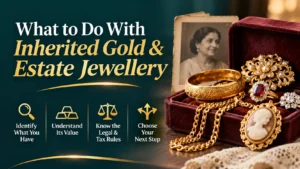
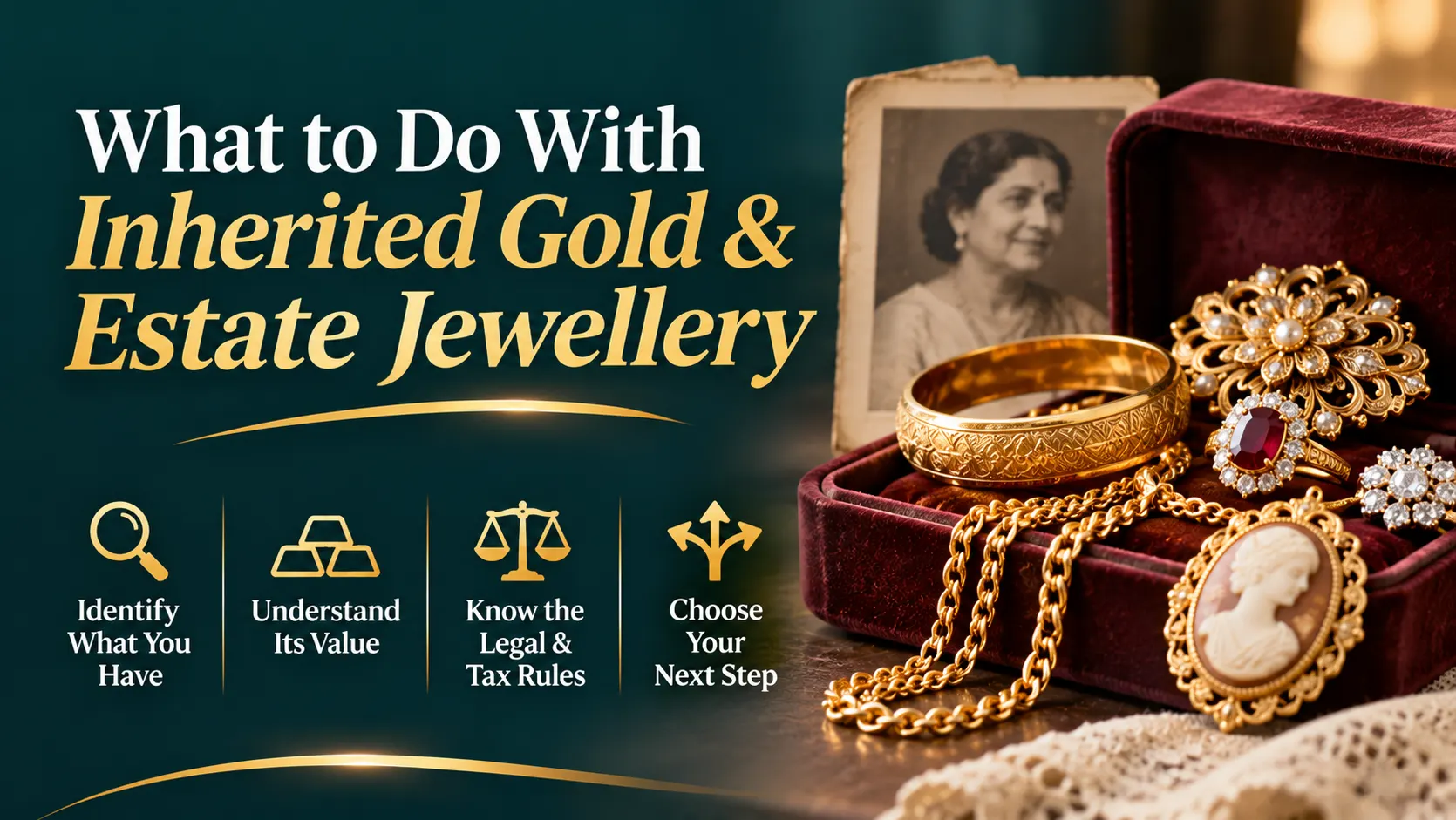
Somewhere in a drawer, a velvet box or a Ziploc bag is a pile of rings, chains, brooches and single earrings, and nobody left who can tell you what any of it is. Inherited jewellery arrives without paperwork, without a story, and often with a lot of grief attached. The pressure to do something with it can feel immediate. It isn’t. The first decisions are the reversible ones, and none of them need to be made this week.
This guide settles four questions in order: what you actually have, what it is worth, who is allowed to sell it, and what the tax position is in Canada. After that, it looks at your options, including the option of keeping everything.
Do not clean, melt or sell anything yet. First, sort the collection into piles. Get an independent valuation of anything signed, antique or stone-set. Confirm the estate is settled and that you hold the right to sell. Only then decide piece by piece, keeping some and selling some if that suits you.
Before anything else: four things not to do
Every mistake below is permanent, and all four tend to happen in the first week, when the box is fresh and everyone wants to help.
Do not clean or polish anything. Polishing can strip the patina from older pieces and cut their collectible value. It never adds any.
Do not melt or scrap anything before it has been looked at. A piece that was worth more than its metal cannot be unmelted.
Do not split the collection between family members before it is valued. Fair division needs numbers first, and an unvalued split is where lasting disagreements begin.
Do not sell in the first weeks of grief. Reputable buyers will tell you the same thing, and a buyer who hurries you is showing you something about themselves.
Sort what you have inherited: scrap gold and estate jewellery
The pile a piece lands in decides where it should eventually be sold, so sorting comes before valuing. Work on a clean table, photograph everything, and look for karat stamps (10K, 14K, 18K) or hallmarks inside bands and on clasps. Treat a stamp as a claim to be verified, not a fact: it is where a buyer’s testing starts, not where it ends.
Scrap gold, broken chains and odd earrings
Broken chains, single earrings, dented bands and anything with no maker’s mark and no notable stones usually belong here. These pieces are worth their metal, and metal is priced by weight and purity. A gold buyer or bullion dealer is the right home for them, and selling gold jewellery of this kind is straightforward once you know what you hold.
Estate jewellery: signed, antique and stone-set pieces
Look for a maker’s name or signature, an old-fashioned setting, an original box or stones that look larger than average. This is estate jewellery in the trade sense: pieces whose design, age or maker can be worth more than the gold in them. They need a specialist’s eye before anything else happens, because the wrong buyer will price them as scrap.
Coins, bullion and silverware
Gold coins, bars and silver pieces go in their own pile. Coins can carry a collector premium above their metal content, so identify them before weighing them. Each of these has its own route to market; for coins and bars, see selling gold coins.
The “not sure” pile
Keep a fourth pile for everything you cannot place. It is fine not to know. A pile of uncertain pieces that stays unsold is far better than a confident guess you cannot undo.
Work out what it is actually worth
Melt value is the baseline for inherited gold, and some pieces are worth more. Knowing the melt figure lets you sanity-check any offer.
Gold melt value and how it is calculated
Melt value is what the pure gold in a piece would be worth as metal, ignoring everything else about it. The formula is weight in grams, multiplied by purity, multiplied by the day’s price per gram. Purity is the karat number divided by 24. The Royal Canadian Mint explains how karats measure gold purity.
Here is the gold melt value calculation, worked through once. Take a 14K chain weighing 10 grams:
- Purity: 14 ÷ 24 = 0.583
- Pure gold content: 10 g × 0.583 = 5.83 g
- Value at an illustrative price of $90 to $110 CAD per gram: 5.83 g × $90 to $110 = about $525 to $640 CAD
The live price must be checked on the day. Weigh the gold only: gemstones, clasps, springs and other non-gold findings do not count, so a weight on the scale is an upper limit, not the answer. Expect any offer to sit below this figure, since melt value is the metal’s full worth before refining costs and the buyer’s margin. To run your own figure, calculate your gold’s melt value on a live price.
When a piece is worth more than its gold
Designer signatures, period pieces, good stones and original boxes can all carry a premium above scrap. That is the whole reason the sorting step matters: a piece sold on weight alone gives up everything the metal calculation leaves out.
Appraisal value is not resale value
There are three kinds of valuation. A replacement value, used for insurance, is what it would cost to buy the piece new, and it runs far above what any buyer will pay. A fair market value is what a willing buyer and seller would agree on, and it is also the figure used for tax purposes. A liquidation value is what a piece fetches in a quick sale. A sale to a buyer is based on the second or third, never the first.
Who has the legal right to sell inherited jewellery
Until the estate is settled, the executor, not the beneficiary, generally controls what can be sold.
A specific bequest, where the will names the piece and the person it goes to, is treated differently from jewellery that forms part of the general estate. The first is yours once the estate allows it; the second is dealt with according to the will or the executor’s plan.
Where several people share a collection, agree in writing before any piece is sold. A short signed note saves the dispute later.
A buyer may reasonably ask for ID, a letter from the executor or an explanation of how the piece came to you. Being asked is the sign of a careful buyer, not an obstacle.
This is general information. Province-level differences are real, and the estate’s lawyer or executor decides the specifics, so if anything is contested, start with them.
Tax on inherited gold and jewellery in Canada
Canada has no inheritance tax, so receiving jewellery does not in itself create a tax bill for you. Estate administration tax or probate fees can still apply to the estate, depending on the province.
For income tax purposes, the general rule is that the deceased person is considered to have disposed of capital property at its fair market value immediately before death. Any gain or loss up to that point is generally dealt with on the deceased person’s final tax return. If the estate sells the jewellery after death, a gain or loss is generally calculated using the fair market value at death and the later sale price.
When you inherit the jewellery, your cost base is generally its fair market value immediately before the person’s death. Special rules can apply, including when property passes to a surviving spouse or common-law partner. That is why a valuation dated close to the death is worth having, even if you do not plan to sell soon: it records your starting point.
Jewellery is also treated differently from ordinary investments. It is classified as listed personal property. A loss on listed personal property can generally be used against gains from other listed personal property, such as jewellery, coins or art. It cannot be used to offset gains on shares or ordinary real estate.
Keep the estate paperwork, the valuation and the sale receipt together in one folder. For your particular situation, ask a Canadian tax accountant to confirm the treatment before you sell or report a gain.
Your options: keep, re-wear, remodel or sell
There is no single right answer. Decide piece by piece, and weigh what each choice costs you in money or in value given up.
Option | Best when | What you give up |
|---|---|---|
Keep as is | The piece matters to you, or you see it as a long-term holding | Storage and insurance cost money, and insurance only works once you know the piece’s value |
Re-wear | The piece suits you and fits or can be resized | Resizing an antique can reduce its value |
Remodel or reset stones | The stones are good, but the design is dated | The original piece is gone, along with any collector value |
Sell | You do not want the piece, or it is broken scrap | The piece itself and the value left behind if it goes to the wrong buyer |
Selling some and keeping some is the usual answer rather than the exception.
Where to sell and where not to
A gold buyer is the right place for scrap and the wrong place for a signed or antique piece. That is not a criticism of gold buyers; they price metal, and metal is all they are set up to value.
Scrap and broken gold: a gold buyer or bullion dealer, priced on the metal.
Signed, antique or significant stone-set pieces: a specialist or auction route, where the premium above metal can actually be realised.
Mixed boxes: get the whole lot looked at before deciding, and expect to split it between routes. If you want to sell jewellery for cash, the sorted scrap pile is the quickest part to turn into it.
Watch for these red flags:
- A quote given only verbally
- No itemisation by karat and weight
- Testing done out of your sight
- Pressure to decide today
- Pop-up and door-to-door buyers
- Fees disclosed only after you accept
Get two or three written quotes. If you are in Toronto or the GTA, our guide to selling gold in Toronto is a good place to start.
Before you decide anything
Two things protect you more than anything else: get the collection valued before you decide, and get more than one written quote before you sell. Everything else can wait, and nothing here has to be rushed. If you would like a second pair of eyes on a box of jewellery, you are welcome to get in touch whenever you are ready.
FAQ
Should I melt inherited gold jewellery down?
No. Melting is permanent, and a signed, antique or stone-set piece can be worth more than its metal. If you are wondering how to melt gold at home, don’t: it needs specialist equipment and is hazardous. A buyer’s written quote already accounts for the metal, so you gain nothing by doing it first.
How do you receive inheritance money or jewellery from an estate?
A jewellery bequest generally reaches you through the executor, who hands over specific items once the estate allows it. You may be asked to sign a receipt. Timing varies, so ask the executor or estate lawyer.
What should I do with an inheritance of gold I do not want to keep?
Sort and value the pieces first, then sell scrap through a gold buyer and signed or antique items through a specialist. For what to do with the proceeds, a financial adviser is the right person to ask.
Do I need an appraisal before selling inherited jewellery?
For signed, antique or stone-set pieces, yes: an independent valuation shows what a buyer should be paying. Plain scrap does not need one, since a written quote itemised by karat and weight is enough. A valuation near the date of death also helps with tax.
How do I split an inherited jewellery collection between siblings?
Value everything first, then agree in writing. Common approaches are taking turns choosing, one person keeping pieces and compensating the others, or selling and sharing the proceeds. Involve the executor or lawyer if anyone disagrees.