You checked the news this morning, saw the gold price per gram quoted at a number that looked genuinely exciting, and figured your old chain or gold ring was about to pay out nicely. Then you took it in for an offer, and the number you got back was a fraction of what you expected. It feels like you’re being lowballed, but you’re not. That gap is completely normal, and once you understand why it exists, you’ll be able to look at any offer and know whether it’s fair.
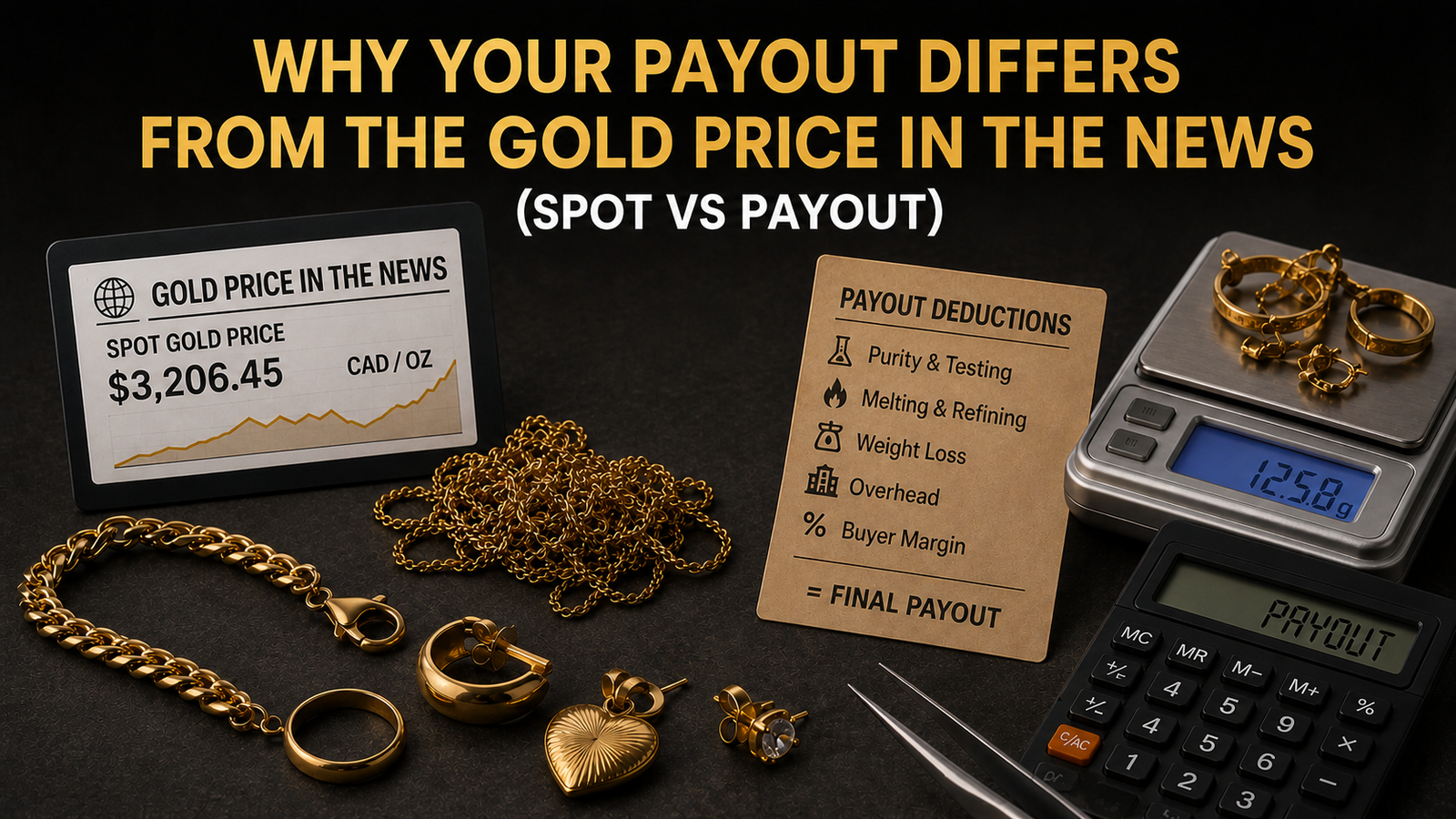
Here’s what’s actually happening: the price you saw in the news is called the spot price, and it’s not what any buyer actually pays you. Your payout is based on something different, and there’s a real, explainable chain of costs between that headline number and the cash in your hand. Below, we’ll break down what spot really means, walk through exactly where the deductions come from, and show the full math from the news price to a real offer.
What "gold price per gram" in the news actually means
The number quoted in financial news is the spot price: the live, constantly moving market price for one troy ounce of pure, 24-karat gold. It’s set by trading activity on global commodity and bullion markets and updates throughout the trading day as buyers and sellers transact.
When headlines report a “gold price per gram,” they’re simply taking that spot price and dividing it by 31.1035, the number of grams in a troy ounce. It’s worth knowing that a troy ounce isn’t the same as the regular ounce you’d use to weigh food or packages; a troy ounce is about 10% heavier. This distinction matters if you ever try to cross-check numbers yourself.
The important thing to understand is what this figure represents: it’s a wholesale price for pure gold traded in bulk, between large institutional players. It’s not a retail number, it’s not adjusted for your item’s actual purity, and it’s not what any buyer, however honest, can pay you for a single ring or chain. Think of it as the ceiling. It’s the theoretical maximum value of the pure gold content, before any real-world costs enter the picture.
Why your payout is lower: what comes out between spot and your offer
Once you understand that spot is a ceiling, the next question is what actually gets subtracted from it, and why. None of these deductions are a scam, they reflect real costs a buyer has to cover to stay in business.
First, purity. Almost nothing you own is 24K gold. Jewelry is typically alloyed with other metals for durability, so a buyer has to calculate the melt value based on your item’s actual karat, using the pure-gold fraction (14K gold, for example, is 58.3% pure).
Second, testing. Before a buyer pays you anything, they need to confirm the karat is what you say it is. That usually means X-ray fluorescence (XRF) testing, an acid test, or a scratch test, all of which take time, equipment, and trained staff.
Third, refining. Turning your item into pure, sellable gold means melting it down and separating the gold from the alloy metals it’s mixed with. That process costs money, and a small amount of metal is inevitably lost along the way.
Finally, overhead and margin. A buyer has rent, staff wages, insurance, and other operating costs to cover, and needs to make a profit to keep the business running. Put simply: your offer equals the melt value of your item, multiplied by a payout percentage that reflects all of the above.
The math, start to finish: from the news price to your cash offer
This is where it all comes together. Let’s say, purely as an illustrative example, that spot gold is quoted at $2,600 per troy ounce. We’ll walk one real piece, a 10-gram 14K gold chain, through every step from that headline number to a final cash offer.
Step 1: Start with the spot price per gram. Divide the troy-ounce spot price by 31.1035 grams. At our example price of $2,600, that works out to roughly $83.60 per gram of pure, 24K gold. This is the ceiling figure the news is quoting, before anything is adjusted for your item.
Step 2: Adjust for karat (pure gold content). Your chain isn’t pure gold, it’s 14K, meaning it’s 58.3% pure. Multiply the per-gram spot price by that purity fraction: $83.60 × 0.583 comes to about $48.74 per gram of actual gold content in a 14K piece. For comparison, a 10K gold price per gram calculation uses a purity of 41.7%, which would bring that same $83.60 down to roughly $34.86 per gram, since 10K gold contains less pure gold.
Step 3: Get the melt value. Multiply that adjusted per-gram figure by the item’s total weight. Our chain weighs 10 grams, so: $48.74 × 10 grams = about $487.40. That’s the melt value, the value of the pure gold your chain actually contains, based on today’s spot price.
Step 4: Apply the payout percentage. A reputable buyer might offer somewhere between 70% and 90% of melt value, to cover testing, refining, and their margin. At 80%, that’s $487.40 × 0.80, which comes to about $389.92. That’s a realistic final cash offer for this chain, starting from a spot price that looked far more impressive at first glance.
How much is scrap gold worth? Realistic payout by buyer type
So how much is scrap gold worth, in practice? The honest answer is that it depends heavily on who you sell to. Payout percentages vary because different buyers carry different overhead, sell in different volumes, and sit at different points in the supply chain.
| Buyer Type | Typical Payout (% of Melt) | Why |
|---|---|---|
| Local Gold/Jewelry Buyer or Refiner | 80–90% | Lower overhead, often sells directly to refiners, and competes on transparency. |
| Independent Jewelry Store | 70–85% | Moderate overhead; may resell or repurpose pieces rather than melt them. |
| Online Gold-Buying Service | 65–80% | Shipping, insurance, and processing costs can reduce the offer. |
| Pawn Shop | 40–60% | Higher risk tolerance, resale uncertainty, and a business model built around margin. |
These are broad ranges, not guaranteed quotes, actual offers depend on your item, local market conditions, and the buyer’s current needs. As a quick sanity check, remember that a 14K gold price per gram sits at 58.3% of the pure spot figure, and a 10K gold price per gram sits at 41.7%, so you can rough out your own melt value before you ever walk in the door. The best way to know you’re getting a fair deal is simple: get two or three offers and compare them.
Does this work the same in Canada?
The same logic applies to gold prices per gram in Canada, with one added variable: currency. Spot gold is quoted globally in U.S. dollars, but Canadian buyers pay in Canadian dollars, so the USD/CAD exchange rate affects the per-gram price. A weaker Canadian dollar can push the CAD gold price higher even when the USD gold price remains unchanged. For Canadian gold buyers, the final payout also depends on purity, testing, refining costs, deductions, overhead, and the buyer’s margin.
If you’re wondering whether it’s a good time to sell gold, here’s the honest answer: spot prices move daily, and often several times within a single day, so trying to time the exact peak isn’t realistic for most sellers. Nobody, including professional traders, reliably catches the top of the market.
A more useful way to think about it is this: if you need the cash now, and the offer you’re getting is a fair percentage of your item’s melt value, then it’s a reasonable time to sell, regardless of where spot happens to sit that week. The lever that actually matters more than market timing is choosing the right buyer and making sure the percentage they’re offering is fair.
How to check your offer is fair (before you sell)
Before you accept any offer, run through this quick checklist:
- Know your karat and weight. Check any stamp on the piece for the karat, and weigh it yourself if you can. If it has stones or other non-gold materials, their weight should be subtracted before any calculation.
- Work out the melt value. Using today’s spot price per gram and your item’s karat fraction, estimate the melt value yourself, the same way we did above.
- Ask the buyer to show their work. A transparent buyer should be willing to tell you exactly what spot price they used, the purity they tested, the pure-gold weight they calculated, and the percentage they’re applying.
- Compare against typical ranges. Check the percentage they offered against the buyer-type table above, and get two or three offers before deciding. A buyer who won’t explain their math is a red flag.
Conclusion
The gap between the gold price in the news and the offer in your hand isn’t a trick, it’s just math. The spot price is a ceiling, a wholesale figure for pure gold that no individual seller actually receives. Your real payout is a percentage of your item’s melt value, shaped by its purity and the buyer’s real costs to test, refine, and process it. Once you know how to work out that melt value yourself, you’re in a strong position to compare offers and recognize a fair one when you see it. If you’d like a transparent, in-person evaluation that walks you through the exact numbers, we’re happy to show you the math on your piece.
FAQ
Why is my gold offer so much lower than the price on the news?
The news reports the spot price, the wholesale market rate for one troy ounce of pure, 24-karat gold. Your item almost certainly isn’t 24K, and your offer also has to account for the buyer’s costs to test, refine, and process it, plus their margin. That combination is why the final number is meaningfully lower than the headline figure.
What percentage of spot should I get for scrap gold?
For a reputable buyer, a fair offer generally falls between 70% and 90% of your item’s melt value, not the raw spot price. Pawn shops and less transparent buyers often pay closer to 40–60%. Always ask what percentage of melt value is being applied so you can compare it against these ranges.
How much is 14K gold worth per gram compared to 24K?
14K gold is 58.3% pure, so its per-gram value is 58.3% of the pure 24K spot price. For example, if 24K spot works out to $83.60 per gram, 14K gold would be worth roughly $48.74 per gram before any buyer deductions are applied.
Is the gold price per gram different in Canada?
The underlying spot price is the same global figure, quoted in U.S. dollars, but Canadian buyers pay out in Canadian dollars. This means the exchange rate between USD and CAD can shift the per-gram number in Canada even when the U.S. dollar gold price stays flat. The deduction process for testing, refining, and margin works the same way in both countries.