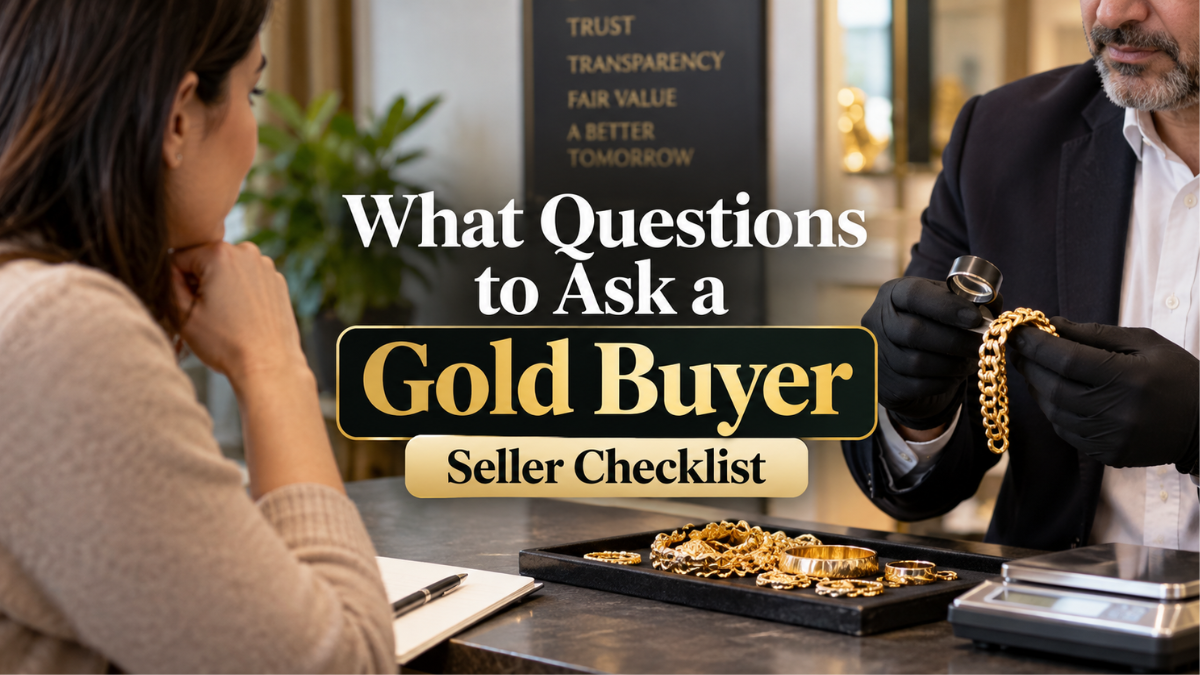
If you are wondering how to sell gold without leaving money on the table, the answer usually comes down to what you ask before you say yes to an offer. The gap between a fair payout and a lowball one can run into the hundreds or thousands of dollars, depending on the size and purity of what you’re selling. It comes down to the questions you ask, and whether the buyer’s answers hold up.
This guide walks through the exact questions to ask, what a fair answer sounds like for each one, and the red flags that mean you should walk away. Whether you’re selling for the first time or not, treat this as your pre-appointment checklist.
Before You Ask Anything, Know What You're Selling
Before you can judge whether a buyer’s answer is fair, you need a basic sense of what you are holding.
Bullion, jewellery, scrap, or estate pieces
Gold coins and bars are priced almost entirely on their metal content, since their value is tied directly to the spot price. Jewellery is different: some of what you paid covered craftsmanship, brand, or design, and a buyer will not pay for that. Scrap gold (broken chains, single earrings, dental gold) and designer or estate pieces sit somewhere in between.
Purity and weight decide most of the value
Karat tells a buyer how much pure gold is actually in the piece (24 karat is pure, 10 karat is roughly 41.7% gold), and weight is measured precisely, usually in grams. To get a rough sense of your item’s underlying value before any margin is applied, multiply the weight in grams by the purity (as a decimal) by the current spot price per gram: not per troy ounce, since that will overstate the value by roughly 31 times. If you only have a per-ounce spot price, divide it by 31.1 to convert to price per gram first.
How to Sell Gold: Questions Every Seller Should Ask
This is the core of the conversation. Ask these six questions, and pay attention to how willingly the buyer answers, not just the answer itself.
1. How do you calculate your offer?
A transparent buyer should walk you through it plainly: they weigh the item, test or confirm the karat, check the live spot price, and then apply their margin. A knowledgeable buyer should also be able to explain which category: bullion, gold jewellery, scrap, or estate; your item falls into and why that affects the price. If the answer is vague, or the buyer skips straight to a number without explaining the steps, press for the breakdown before you go further.
2. What is today’s spot price you’re working from?
Spot price changes throughout the trading day, and a legitimate buyer should be able to quote the figure they are using right now. If their number is more than a few hours old compared to a live reference, that’s a transparency gap. Ask them to requote using a current price.
3. Do you price each item by its own karat?
Mixed jewellery lots are sometimes lumped together and priced at the lowest karat in the pile. Ask directly whether each piece is weighed and valued on its own purity, since this single question can protect a meaningful amount of your payout.
4. What is your margin or spread over spot?
Every buyer needs to make a profit, so a margin is normal and expected. A disclosed spread in the range of roughly 5–15% below melt value for jewellery and scrap is typical; bullion dealers often run tighter, closer to 1–5%. A buyer who won’t name a number, or whose margin runs noticeably wider than that once you calculate it, deserves more scrutiny.
5. Will you put the offer in writing and itemise it?
A fair offer should be easy to write down: item, weight, karat, spot price used, and the final number. A buyer who refuses to put the offer in writing is giving you reason to walk.
6. What identification and paperwork do you need?
In Canada, dealers in precious metals and stones are regulated under the Proceeds of Crime (Money Laundering) and Terrorist Financing Act, which requires them to verify and record client identification for covered transactions as part of FINTRAC’s compliance framework. A buyer who skips this step entirely is not following that framework, walk away.
Where Can You Sell, and Who Tends to Pay Best?
There is no single best place to sell gold that suits everyone, but the options for selling gold in Canada fall into a few clear categories.
Bullion dealers, jewellers, pawnshops, and mail-in or online buyers
Each serves a different kind of seller. Bullion dealers specialise in coins and bars and typically price close to spot with minimal markup. Local jewellers can be convenient and may pay reasonably for recognized, branded jewellery, though pricing varies widely from shop to shop. Pawnshops offer speed but usually at a lower payout, since their margins tend to be wider. Mail-in and online buyers can be competitive, but you lose the ability to negotiate face-to-face, so reputation and their itemised written offer matter even more here.
Why dedicated bullion dealers usually pay closest to spot
It comes down to their business model: their margins are built around recognised bullion products with well-established purity, so there is less guesswork and less need for a wide dealer spread. For jewellery, scrap, or mixed lots, a specialist gold buyer who explains their pricing clearly can be a stronger option than a general pawnshop, since jewellery pricing depends more on the buyer’s own diligence than on a standardised product.
Knowing where to sell gold starts with knowing what category your item falls into bullion, jewellery, or scrap; since that determines which type of buyer is likely to give you the fairest price.
How to Compare Offers the Right Way
A common mistake sellers make is comparing headline numbers instead of comparing offers properly.
Ask every buyer to break their offer down into the same four parts: the spot price they used, the purity they measured, the weight they recorded, and the margin they applied. Once you have that breakdown from two or three buyers, you can compare them like-for-like, rather than comparing one buyer’s polished pitch against another’s unexplained figure. Transparency on the numbers is the floor, not a favour.
Is It a Good Time to Sell Your Gold?
This is less about timing the market and more about working from an accurate baseline. Spot price moves continuously throughout the trading day, so check a trusted live spot-price reference,shortly before any conversation with a buyer, rather than relying on a figure from more than a few hours ago.
Beyond that, whether it is a good time to sell often comes down to your own circumstances rather than a market forecast. If you need the cash, or the pieces have no sentimental value and you have confirmed a fair current baseline, that is generally a reasonable moment to sell. Speculating on price direction is outside the scope of a seller’s checklist.
How Much Gold Can You Sell Without Reporting in Canada?
This is worth answering carefully rather than with a specific number, because there isn’t one fixed dollar threshold that triggers reporting. Licensed dealers in precious metals and stones are required to record identification and transaction details under FINTRAC’s anti-money-laundering framework, and this record-keeping applies regardless of the amount involved it’s a sign you’re dealing with a legitimate business, not a red flag in itself.
Separately, any income from selling gold may have tax implications depending on your personal situation, including whether the gold is treated as personal-use property or as an investment. This is a tax and compliance matter rather than a fixed dollar threshold, and the details can differ from one seller’s situation to the next. For anything specific to your circumstances, check the Canada Revenue Agency’s guidance on capital gains or speak with a tax professional, rather than relying on a general figure. This section is general information only, not tax advice.
Red Flags: When to Walk Away
A few warning signs are worth knowing before you walk in. If you notice any of these, it is reasonable to end the conversation and take your gold elsewhere:
- The buyer does not ask for identification at all
- You feel pressured to decide on the spot, with no time to think or compare
- Your gold is tested or weighed somewhere you cannot see
- The buyer refuses to itemise the offer or explain the numbers
- The offer is far below your own rough estimate (weight × purity × spot price)
Trust your own math over a buyer’s pressure. If the numbers do not add up and they will not explain why, that is answer enough.
Conclusion
Selling gold does not have to feel like a gamble. The seller who asks these questions, and pays attention to how confidently they are answered, is the one who controls the conversation rather than being carried along by it. Before you accept any offer, get more than one itemised quote, compare them side by side, and only sell once the numbers genuinely make sense to you.
FAQ
What questions should I ask before selling my gold?
Ask how the buyer calculates their offer, what spot price they are using today, whether each item is priced by its own karat, what margin they apply over spot, whether they will itemise the offer in writing, and what identification they require. Clear, specific answers to all six are a good sign.
How do I know a gold buyer's offer is fair?
Compare the offer against your own rough estimate: weight (in grams) multiplied by purity multiplied by the current spot price per gram, minus a reasonable margin. Ask for an itemised breakdown so you can see exactly how the buyer reached their number, then compare that breakdown against at least one other quote.
Where is the best place to sell gold in Canada?
It depends on what you are selling. Bullion dealers tend to pay closest to spot for coins and bars, while jewellers, pawnshops, and online buyers vary more widely for jewellery and scrap. Getting a couple of itemised quotes is the most reliable way to find the best price for your specific pieces.
How much gold can I sell without reporting in Canada?
There is no single fixed dollar threshold for this. Licensed dealers generally record identification for compliance reasons regardless of amount, and any tax obligations depend on your personal circumstances. Check the Canada Revenue Agency’s guidance or speak with a tax professional for specifics.
Should I sell my gold now or wait?
That depends more on your own needs than on market timing. Check a live spot-price reference so you are working from an accurate current baseline, then decide based on whether you need the funds and whether the pieces hold sentimental value worth keeping.