Figuring out your gold coin worth is really two separate jobs. The first is working out its real value in Canadian dollars. The second is finding someone trustworthy to pay you that value when you sell. This guide walks through both, in order.
How much is a gold coin worth today?
Most gold coins in circulation today, including modern bullion coins bought as an investment, trade almost entirely on their metal content. A smaller group carry an added rarity premium because of their age, mintage numbers, or condition. So how much is a gold coin worth in practice? For the average owner, it tracks the live gold spot price in Canadian dollars, adjusted for the coin’s exact weight and purity.
The two values every gold coin has
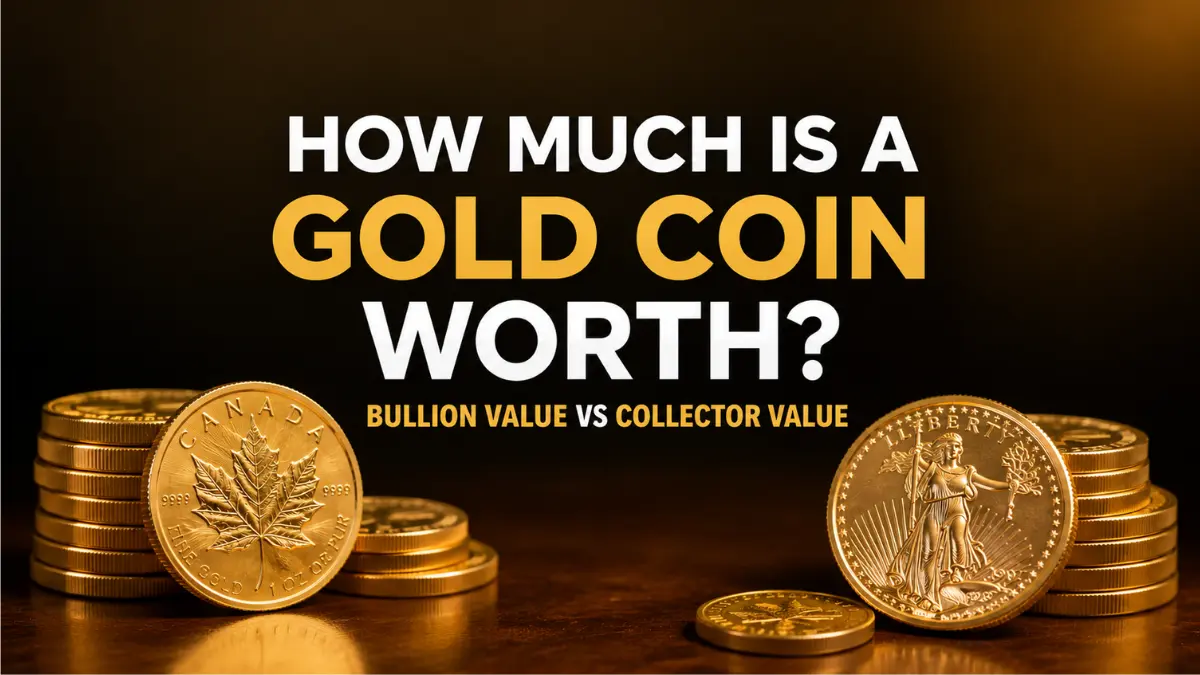
Every gold coin sits between two value systems. There is its bullion value, the raw worth of the gold inside it if priced purely on metal content. And there is its collector, or numismatic, value, which reflects what collectors will pay for a coin’s history, scarcity, or condition, regardless of gold content. A coin’s true worth is whichever figure is higher on a given day.
Why face value and sale price are never the same
Many gold coins, including Canadian and other government-issued bullion coins, carry a nominal face value, sometimes as low as a few dollars. That figure is a legal formality tied to the coin’s status as currency, not a reflection of its market worth. A coin with a $5 face value can easily be worth hundreds once its gold content is factored in, so the stamped denomination should never be used to estimate a coin’s actual worth.
Bullion value vs numismatic value explained
Understanding the difference between bullion value and numismatic value is the single most useful thing a coin owner can learn, because the most common mistake is assuming an ordinary, mass-produced bullion coin must be rare simply because it is old or made of gold. In reality, most gold coins in circulation are common, and their worth begins and ends with metal content.
What is bullion value?
Bullion value comes from three inputs: the coin’s weight in troy ounces (the standard unit for precious metals, where one troy ounce equals roughly 31.1 grams), its purity, and the current gold spot price. Purity is usually expressed as a decimal, such as .9999 for coins that are essentially pure gold, or .900 for older coins alloyed with other metals for durability. Multiply the pure gold content by the spot price, and that figure is the coin’s bullion floor.
What is a numismatic or collectible gold coin value?
Numismatic, or collectible, value sits on top of bullion value and depends on factors unrelated to weight, including rarity, original mintage numbers, condition or grade, and current collector demand. A coin that is genuinely scarce, well preserved, or tied to a notable minting year can carry a premium worth many times its melt value, though most coins never reach this tier.
How to tell which value your coin has
A rough rule of thumb: if a coin was minted recently, in large numbers, and mainly sold as an investment product, its value is almost certainly bullion-driven. If it is older, minted in smaller numbers, or shows features collectors specifically look for, it is worth having assessed for numismatic value before it is priced purely on metal content.
How to work out what your gold coin is worth
Working out your own coin’s value does not require special equipment, just a few known figures and a simple calculation. The example below uses illustrative Canadian dollar figures for demonstration only, not a live quote, since gold prices move throughout every trading day.
Step 1: Confirm weight and purity
Start with the coin’s exact weight in troy ounces and its purity. This is usually stamped on the coin or listed in the original documentation if bought new. A standard one-troy-ounce Canadian Maple Leaf, for example, is minted at .9999 purity, meaning it is almost entirely pure gold.
Step 2: Check the live gold spot price in CAD
Next, look up the current gold spot price quoted in Canadian dollars per troy ounce. This figure updates constantly during trading hours and is widely available through bullion dealers and financial data sites, so check it fresh rather than relying on an older figure.
Step 3: Do the math
The basic calculation is weight in troy ounces multiplied by purity, multiplied by spot price. As a purely illustrative example, if the spot price were roughly C$6,400 per troy ounce, a one-troy-ounce coin at .9999 purity would carry a bullion value of approximately C$6,399. This is not a live quote, but it shows how the calculation works
Step 4: Add or subtract the premium
The final adjustment accounts for premium, the amount a buyer or seller adds above or below pure bullion value. Dealers typically buy below spot to cover costs and margin, and sell above it. A reasonable buyer’s offer falls within a modest, clearly explained percentage of spot, with any collector premium sitting on top.
How to identify a legitimate, reputable gold buyer
Working out a fair value only matters if you can find someone who will actually pay it. This is where most sellers run into trouble, so it is worth spending real time vetting a buyer before handing over a coin.
Credentials and transparency
A trustworthy buyer operates from a verifiable physical address, publishes their current buy prices openly, and is willing to test or weigh your coin in front of you rather than taking it into a back room. If a buyer avoids sharing any of this basic information, treat it as a warning sign rather than a formality to skip.
Reputation checks
Look for independent reviews across multiple platforms, not just testimonials on the buyer’s own website. A long, verifiable track record in business and membership in a recognised numismatic or bullion industry association are both reasonable signs of legitimacy, though neither guarantees a fair price on their own.
Pricing transparency
A fair buyer ties their offer directly to the live spot price and explains how they arrived at their number. They provide a written quote with no pressure to accept immediately, and there is no obligation to sell once you have the figure in hand.
Questions to ask before you hand over a coin
Before agreeing to a sale, ask what spot price they are using, what percentage of spot their offer represents, whether the coin will be tested in front of you, and whether the quote is provided in writing. A buyer confident in their pricing will answer all of this without hesitation.
Red flags and common scams when selling gold coins
Most problems when selling gold coins follow a handful of recognisable patterns. Knowing what a fair transaction looks like makes each one easy to spot without needing to assume bad faith on every offer.
Lowball offers and melt-only pressure
A fair transaction reflects a coin’s actual value, so an offer that ignores obvious collector characteristics and prices a potentially rare coin purely at melt value deserves a second opinion before you accept it.
Refusing to test or weigh the coin in front of you
In a legitimate transaction, testing and weighing happen where you can see them. If a buyer insists on taking your coin out of sight before quoting a price, that is a departure from how a fair sale normally works.
No written quote or rushed decisions
A genuine offer can be written down and does not expire in the next five minutes. Pressure to decide immediately, or a refusal to put a number in writing, both run counter to how a reasonable buyer operates.
Vague or hidden fees and spreads
A fair transaction has a clearly stated spread between buy and sell prices, with no surprise deductions once you have agreed to sell. Ask for the final number in writing before completing any transaction.
How to compare offers and get a fair price
The easiest way to compare offers from different buyers is to convert each one into a percentage of the live spot price. which turns wildly different-looking dollar figures into a single, directly comparable number.
Benchmark every offer against spot
Take whatever dollar amount a buyer offers and divide it by the coin’s bullion value at the current spot price. This tells you what percentage of spot you are actually being offered, which is the only number that lets you compare buyers fairly.
Understand the spread
Buyers quote a lower price when purchasing and a higher price when selling, and that gap, known as the spread, covers their operating costs and profit margin. A reasonable spread is a normal part of the business, but an unusually wide one is worth questioning.
Always get more than one quote
Before accepting any offer, get quotes from at least two or three separate buyers. Differences of even a few percentage points of spot can add up to a meaningful amount on a larger coin or collection.
Conclusion: value first, then a trustworthy buyer
Establishing what a gold coin is worth always comes down to the same sequence: work out whether its bullion or collector value is higher, calculate that figure against the live gold spot price in Canadian dollars, then find a buyer whose transparency and reputation you have actually checked. Compare any offer as a percentage of spot rather than a raw dollar figure, and never let pressure to decide quickly override that process. A gold coin’s worth is straightforward to establish; the only real risk is skipping the verification step before you sell.
FAQ
How much is a 1 oz gold coin worth today?
Its bullion value equals purity multiplied by the current gold spot price in Canadian dollars. Since spot price changes constantly, check a live source before relying on any figure, and add a collector premium only if the coin has genuine rarity.
How do I know if my gold coin is bullion or a collectible?
Modern coins minted in large numbers and sold mainly as investment products are almost always bullion-priced. Older coins, smaller mintages, or unusual condition are worth having assessed for collector value.
What is my gold coin worth if it's damaged or worn?
Damage generally reduces or eliminates any collector premium, since condition is central to numismatic value, but it rarely affects bullion value much, as the gold content is unchanged unless material has actually been lost.
How can I tell if a gold buyer is legitimate and trustworthy?
Look for a verifiable physical address, published buy prices tied to live spot, willingness to test your coin in front of you, independent reviews, and a written, no-obligation quote.