Few things waste a trip like reaching the counter and being turned away because you left the right paperwork at home. If you are planning a sale, the ID to sell gold in Ontario is simple, but it is not optional, and knowing exactly what to bring saves you a wasted trip. This guide covers the document checklist, the Canadian and Ontario rules behind it, and the honest answer to whether you can sell without ID.
What You Need to Bring to Sell Gold in Ontario
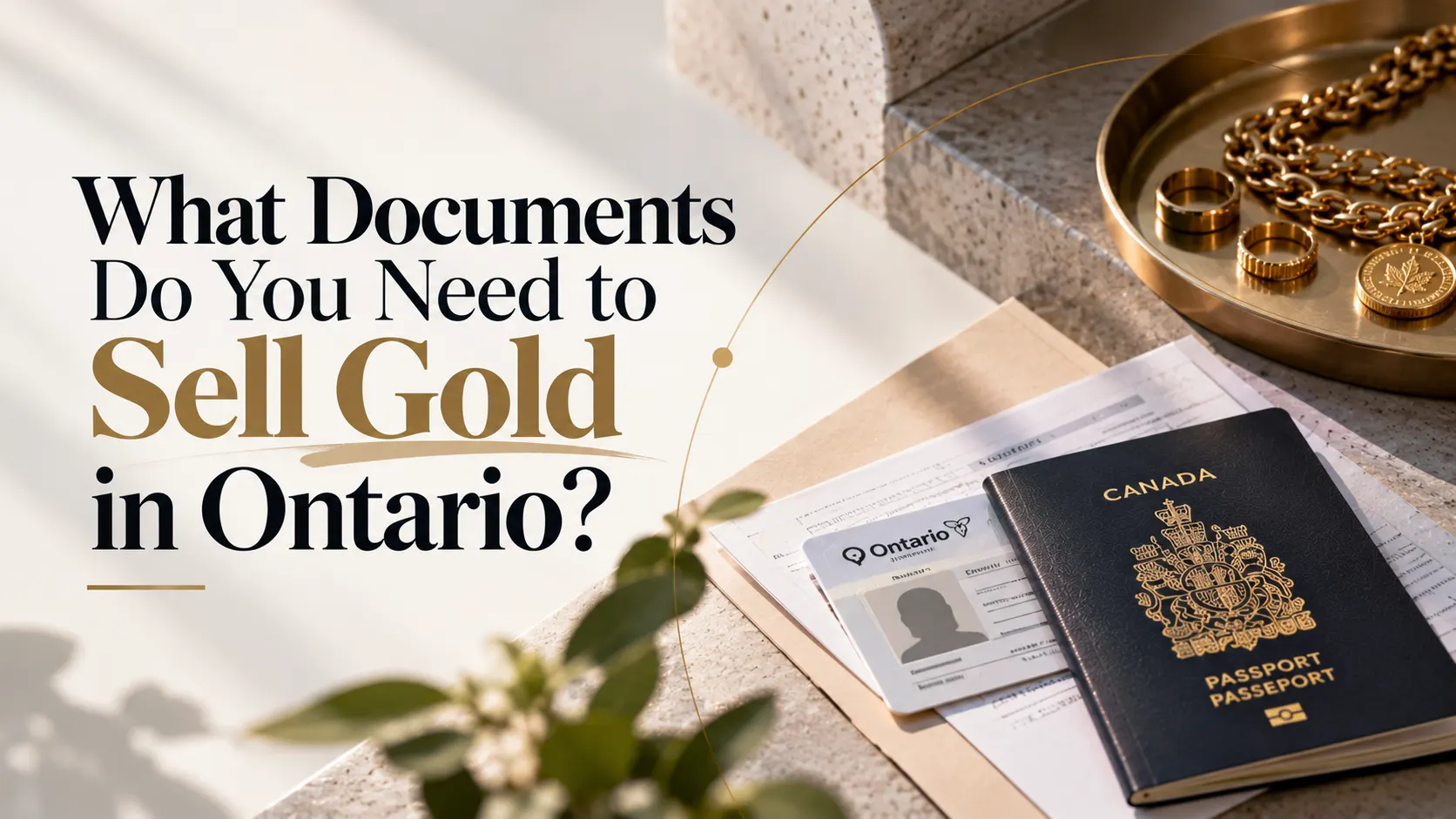
The requirements to sell gold in Ontario come down to one non-negotiable item and a handful of helpful extras. The one thing you must have is a valid, unexpired piece of government-issued photo ID. Accepted examples include an Ontario driver’s licence, a Canadian passport, or an Ontario Photo Card. The buyer will check that the name and photo match you, and will usually record the ID details.
For larger sales, some buyers also ask for a second piece of ID or proof of your current address, such as a recent utility bill. Policies vary by buyer, so it is smart to call ahead if your sale is substantial.
Everything else is about speeding things up. An original purchase receipt, a certificate of authenticity, or an assay card for bars and coins helps the buyer verify what you have faster. If the gold was inherited or gifted, any paperwork showing where it came from can ease authentication. And whether you are selling jewellery, coins, or bullion, the ID stage works the same way.
Document | Required or optional | Why it helps |
Valid government photo ID (Ontario driver’s licence, Canadian passport, Ontario Photo Card) | Required | Lets the buyer verify who you are, which they must do by law |
Second piece of ID | Sometimes requested for larger sales | Adds confidence on higher-value transactions |
Proof of current address | Sometimes requested for larger sales | Confirms your details for the buyer’s records |
Original purchase receipt | Optional | Supports proof of ownership and can speed up valuation |
Certificate of authenticity or assay card | Optional | Helpful for bars and coins; confirms weight and purity |
Provenance paperwork (inherited or gifted gold) | Optional | Helps with authentication and a smoother conversation |
Why Gold Buyers in Ontario Ask for ID: The Rules
If you have ever felt that being asked for ID is the buyer being difficult, the reality is the opposite. The selling gold rules in Canada exist to protect the public, and a reputable buyer is simply following the law.
Across Canada, dealers in precious metals fall under federal anti-money-laundering rules administered by FINTRAC, the Financial Transactions and Reports Analysis Centre of Canada. Those rules require dealers to verify the identity of the people they deal with and to keep records, and FINTRAC’s website explains the obligations for precious metals dealers in detail.
In Ontario, pawn shops have an extra layer. Pawnbrokers record transactions and the identity of the person they deal with under the provincial Pawnbrokers Act, which you can read on the Ontario e-Laws site.
The purpose is twofold: to deter money laundering and to stop stolen goods from being quietly resold for cash. That second point works in your favour. A buyer who keeps proper records is a buyer who can prove your transaction was legitimate, which protects the honest seller too.
Can You Sell Gold Without ID in Ontario?
If you are asking, “can I sell gold without ID,” the honest answer is no, not at a licensed, reputable buyer in Ontario. A legitimate buyer will not complete a purchase without valid ID, and any buyer willing to skip that step is a warning sign. It often means they are cutting corners on the law, and that can put you at risk of being underpaid or dealing with someone you cannot hold accountable.
Most people asking this question are not trying to do anything wrong. The real worry is usually privacy, identity theft, or wanting a quick cash sale. Those are fair concerns, and the answer is to choose a reputable buyer with clear data handling, not to look for a buyer who skips the rules. Ask how your ID information is stored and who can access it.
You may also have come across US content about selling gold anonymously. That framing does not carry over to Canada. The rules, reporting authorities, and tax agencies are different, so do not assume an American guide applies to an Ontario sale.
Pawn Shops vs Bullion Dealers vs Jewellers: ID Requirements Compared
If you are comparing pawn shop ID requirements with those at other buyers, the key takeaway is that every legitimate buyer type asks for ID. It is never a reason to choose one over another. What differs is the governing rule and what each buyer is best suited for.
Buyer type | ID required? | Governing rule | Best for |
Pawn shop | Yes | Ontario’s Pawnbrokers Act; transaction is logged | Quick loans or sales, though payouts are often lowest |
Bullion dealer/specialist gold buyer | Yes | Federal rules administered by FINTRAC | Coins and bars, with transparent live pricing |
Jeweller / cash-for-gold | Yes | Applicable dealer rules | Scrap jewellery, usually paid on melt value |
Pawn shops record your ID and log the transaction, and they typically offer the lowest payout. Specialist bullion buyers verify ID under FINTRAC rules and are usually the smoother choice for coins and bars thanks to transparent pricing. Jewellers and cash-for-gold shops still require ID, with payouts generally based on melt value.
If you would rather keep ownership of your gold while you need cash, a gold loan is an alternative worth considering.
The $10,000 Reporting Threshold, Explained Simply
One of the most common misconceptions is that selling below a certain amount keeps a transaction off the books. It does not work that way.
Canada has a large cash transaction reporting concept: above certain amounts, including the well-known $10,000 figure, dealers have additional reporting duties to FINTRAC. That is the dealer’s obligation. It is not a ban on your sale and it is not a tax on you.
Your own tax obligation is separate. Profit on a gold sale can be a capital gain that you are responsible for reporting to the CRA, regardless of how large or small the sale is. So the myth that selling under a threshold means it is unreported or untaxed is simply false. For more on this, see our guide to gold taxes and capital gains.
How to Prepare for a Smooth, Fast Sale
A little preparation makes the whole visit quicker:
- Bring your photo ID and, if you have them, the original receipt or certificate.
- Know the rough weight and karat of what you are selling.
- Check the live gold price before you go so the offer is easy to judge.
- Choose an established Ontario buyer with real reviews and a physical location.
Ready to go? You can sell gold in Ontario with a team that walks you through every step.
The takeaway is simple: valid government-issued photo ID is the one thing you must bring to sell gold in Ontario, while receipts and proof of ownership make the process faster. A reputable buyer asking for ID is following the law and protecting you.
If you are ready to sell, visit GTA Gold Buyers at our Whitby or Burlington locations for a clear, honest offer from a reputable Ontario buyer.
FAQ
Do you need ID to sell gold jewellery in Ontario, or just bullion?
Yes, you need ID for both. Licensed buyers treat jewellery, coins, and bullion the same way at the ID stage. Whether you are selling a broken chain or a gold bar, expect to show valid government-issued photo ID before the buyer completes the purchase.
What ID is accepted when selling gold in Ontario?
Any valid, unexpired government-issued photo ID is generally accepted, such as an Ontario driver’s licence, a Canadian passport, or an Ontario Photo Card. Buyers may ask for a second piece of ID or proof of address on larger sales, so check with them first.
Can a minor sell gold in Ontario?
Policies vary, but reputable buyers generally deal only with adults who can present valid photo ID. In Ontario the age of majority is 18, so a minor will typically need a parent or guardian to complete the sale. Call the buyer ahead of time to confirm their policy.
Does selling gold get reported to the CRA?
Dealers report large transactions to FINTRAC, not automatically to the CRA. However, any profit you make selling gold may be a capital gain that you must report on your tax return, no matter the sale size. Speak with a tax professional about your situation.