When you buy TD gold bars, you know what you paid. What is less obvious is how much you will get back when you sell. The purchase price includes a premium over the value of the gold itself, and you may not recover that premium even if gold prices rise.
Your resale value depends on the bar’s gold content, the current market price and the buyer’s offer. The refiner, markings and packaging can also affect how easily the bar is verified. This guide explains what you pay when buying, what your bar may be worth later and how to compare selling options in Canada.
What TD Gold Bars Actually Are
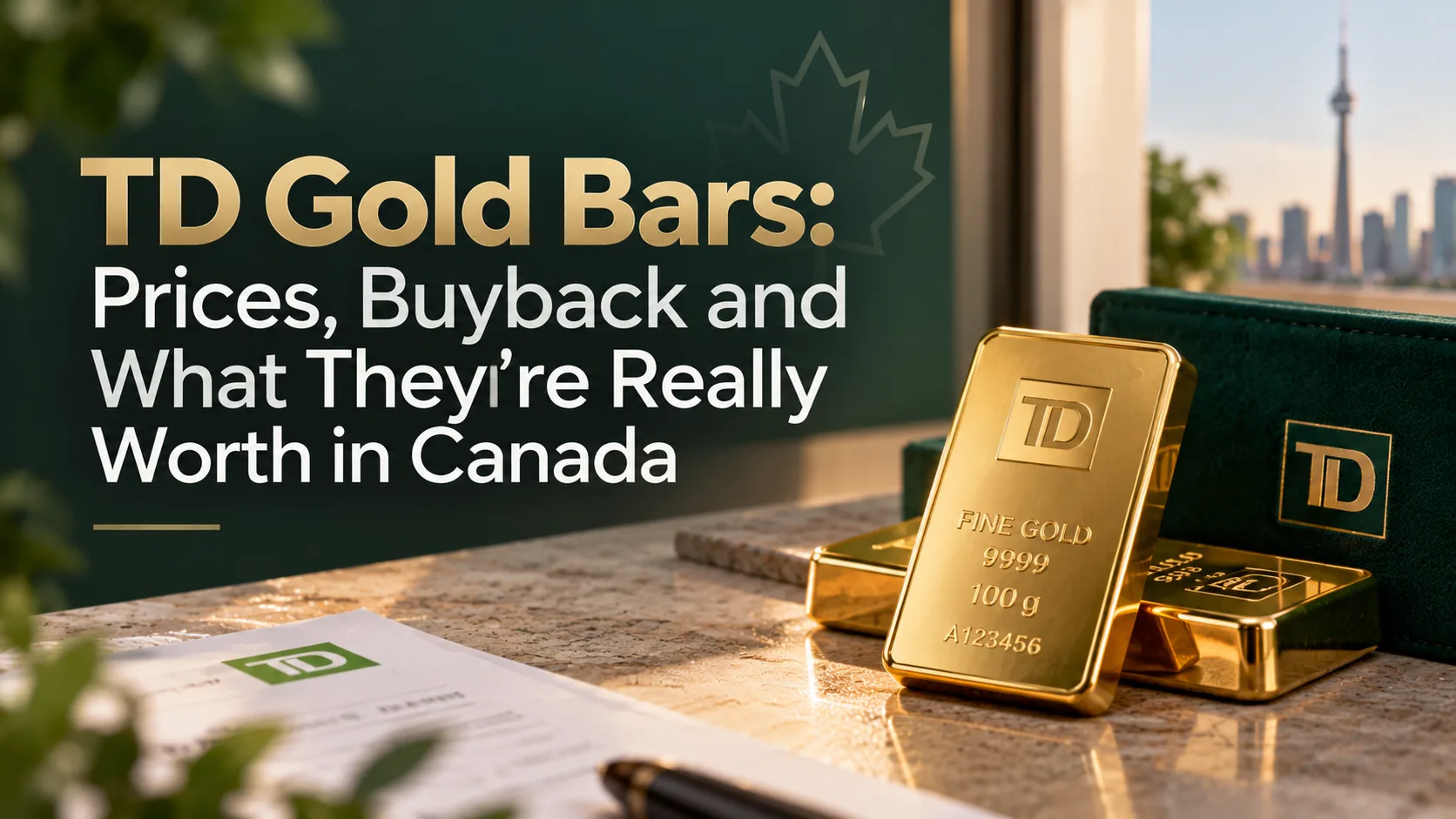
TD does not refine gold itself. It sells bullion produced by specialist refiners, including current TD-branded bars made by Valcambi. TD also sells bars produced by the Royal Canadian Mint, while older TD-branded bars may carry Johnson Matthey markings.
A typical one-ounce Valcambi bar contains .9999 fine gold, meaning it is 99.99% pure. Depending on the product, its markings may include the TD shield, weight, purity, serial number and refiner’s assay mark. Check your own bar because markings and packaging can vary by product and production period.
TD offers bars ranging from one gram to ten troy ounces. Smaller bars usually cost more per gram because their premiums make up a larger share of the price. Larger bars tend to have lower premiums per gram but require more money upfront.
TD’s online purchasing limits and account conditions can also affect how you buy. Check the current product listing and transaction terms before placing an order.
TD Gold Bar Prices Today: What You Pay vs Spot
The gold price TD Bank customers see when buying a bar includes more than the value of its gold. The price reflects the underlying market rate, currency conversion where applicable and the premium charged for the product.
To estimate the metal value, use this formula:
Gold value in CAD = gold price per troy ounce in CAD × bar weight in troy ounces × purity
For a .9999 fine bar, multiply by 0.9999. If the gold price is quoted in US dollars, convert it to Canadian dollars first. The Bank of Canada’s daily exchange rates provide a reference, although a dealer’s exchange rate may differ.
You can compare your estimate with the live CAD gold price used as a reference for gold valuations. Your calculated metal value is not a guaranteed purchase or resale price.
TD bar prices by size
The table below records TD’s displayed prices on September 26, 2026, at 6:46 a.m. EST, using a reference gold price of C$6,109.04 per troy ounce. These figures are historical, not current quotes.
Bar size | Approx. premium over spot | Cost per gram (relative) | Notes |
1 g | 22.2% | 19.7% higher | Historical price: C$239.92 |
10 g | 3.5% | 1.4% higher | Historical price: C$2,032.76 |
1/2 oz | 4.7% | 2.6% higher | Historical price: C$3,196.98 |
1 oz | 2.0% | Baseline | Historical price: C$6,233.69 |
10 oz | 1.9% | 0.1% lower | Historical price: C$62,265.66 |
Premiums compare the listed price with the estimated gold value at the time. Cost per gram compares each size with the one-ounce bar. Figures are rounded, and TD’s prices change with the market.
Smaller bars can cost more per gram, while larger bars usually offer better pricing per gram. However, a larger bar requires more money upfront, and you cannot sell only part of it if you later need cash.
TD’s published online transaction limits have included CAD 24,999.99 per 24 hours for TD customers and CAD 2,999.99 per 24 hours for non-TD customers. Limits and account conditions can change, so confirm the current terms before buying.
What TD Gold Bars Are Really Worth When You Sell
You may not get back what you paid for a TD gold bar. Your offer depends on the gold content, the current market price and the buyer’s pricing terms.
Melt value vs resale value
Melt value is the estimated value of the gold itself before a buyer’s costs and margin. For a .9999 fine bar, multiply its weight in troy ounces by the current gold price per troy ounce in Canadian dollars and then by 0.9999.
The amount you receive may be lower. Buyers account for verification, handling, resale costs and profit margin. The difference between a dealer’s selling price and buying price is called the buy-sell spread. It varies with the buyer and market conditions, so there is no single payout percentage that applies to every TD gold bar.
Does the TD name affect resale value?
A TD-branded bar may be familiar to Canadian buyers, but the logo does not guarantee a higher offer. Buyers may consider the refiner, weight, purity markings and how easily they can verify the bar. Recognition also varies between buyers and markets, so compare offers rather than assuming one brand will always sell for more.
Keep the original assay card and packaging if you have them. Clear markings, a matching serial number and intact packaging can make verification easier. Missing packaging does not automatically make a genuine bar unsellable, although the buyer may need additional checks.
Why you may not recover the premium you paid
Suppose you bought a gold bar for 3,100 Canadian dollars, and its gold content is now worth 3,000 Canadian dollars. One buyer offers 2,910 Canadian dollars, while another offers 2,960 Canadian dollars. These are illustrative figures, not current quotes or typical payout rates.
The second buyer offers C$50 more, but both offers are below the bar’s estimated gold value. Neither recovers your original purchase price. Compare actual offers with the current market value rather than relying on what you paid.
What You Need to Sell Gold in Canada
If you’re checking the ID to sell gold in Canada, confirm the buyer’s requirements before visiting. GTA Gold Buyers asks sellers to bring valid, government-issued photo ID. Requirements may differ between businesses, so check with your chosen buyer.
Bring the bar and its original assay card or packaging, if available. Proof of purchase may help establish the bar’s history, but ask whether the buyer requires it.
Here’s what usually happens when you sell:
- Inspection: The buyer checks the bar’s markings and condition.
- Testing and weighing: The buyer verifies its weight and purity as needed.
- Quote: The buyer calculates an offer using the current gold price and its buying terms.
- Payment: You review the offer and payment method before deciding whether to sell.
Qualifying investment-grade gold bullion is generally exempt from GST/HST under Canada’s applicable rules. The bullion must meet the requirements for purity and form, including relevant recognition criteria. A .9999 fine bar meets the usual purity threshold, but purity alone does not establish eligibility in every case. Keep your transaction records and confirm the treatment if your circumstances are unusual.
Where to Sell TD Gold Bars for the Best Price
The best place to sell a TD gold bar is the buyer offering the strongest final price for your specific bar. Compare quotes close together in time because gold prices change throughout the day. Ask how each offer is calculated, whether fees apply and how payment is made.
Where to sell | Typical offer vs spot | Speed | Best for |
TD branch | Request a quote for the specific bar; terms may vary | Depends on branch arrangements | TD clients who prefer their bank |
Independent gold buyer | Varies; compare quotes against estimated metal value | Often an in-person assessment | Sellers comparing offers |
Pawn shop or jeweller | Varies by business and whether it buys bullion | Depends on the shop | Getting another local quote |
TD has offered branch selling arrangements for physical precious metals, but confirm current eligibility and pricing directly. Being able to sell through your bank does not guarantee the highest offer.
An independent bullion buyer gives you another quote to compare against TD’s offer. Focus on the final amount you will receive, not just a headline gold price.
GTA Gold Buyers purchases gold bullion and evaluates items for sellers. Read about its gold bullion buying service, or find local options for selling gold in Whitby and selling gold in Burlington. Compare the quote with any offer from TD before deciding.
If you need cash but want to keep your gold, you could also ask about a gold loan. This lets you borrow against your gold rather than sell it outright. Check the interest, fees, repayment period and consequences of missed payments before agreeing.
TD Gold Bars vs Other Ways to Own Gold
If you’re comparing ways to own gold through TD, decide whether you want to hold the metal yourself or use a financial product. Different TD precious metals options come with different costs, terms and selling arrangements.
TD bars vs Gold Maple Leaf coins: Both provide physical gold. Coins let you sell individual units rather than an entire bar, which may help if you want to sell smaller amounts. The Royal Canadian Mint’s bullion information explains its gold products and specifications.
TD bars vs Royal Canadian Mint bars: Both may contain .9999 fine gold. Check the weight, purity, refiner markings and packaging of the specific bar. The brand alone does not guarantee a higher resale offer.
Physical bars vs financial products: When comparing TD precious metals gold options, distinguish physical bullion from certificates or account-based products. TD Wealth has offered precious-metals certificates, but check the current terms for availability, fees, ownership arrangements and physical delivery. A certificate is not the same as keeping a bar yourself.
FAQ
How much is a 1 oz TD gold bar worth right now?
A one-ounce TD gold bar’s metal value follows the current gold price for one troy ounce, converted to Canadian dollars where necessary and adjusted for purity. The amount you receive when selling may be lower because buyers apply their own pricing spreads. Check the current market price and request a quote for your specific bar.
Will TD buy back gold bars, and is it the best price?
TD has offered branch selling arrangements for physical precious metals, but confirm current eligibility and terms with the bank. Selling through TD does not guarantee the highest offer. Request a quote for your specific bar and compare it with an independent bullion buyer before deciding.
Do I need ID to sell a TD gold bar in Canada?
Requirements depend on the buyer and applicable rules. GTA Gold Buyers asks sellers to bring valid, government-issued photo ID. Contact your chosen business before visiting to confirm what it accepts. Bring your bar and any assay card or proof of purchase you have, and ask whether additional documents are needed.
Do you pay GST or HST when you sell TD gold bars?
Qualifying investment-grade gold bullion is generally exempt from GST/HST when it meets the applicable requirements for purity and form. A .9999 fine bar meets the usual purity threshold, but eligibility can depend on other conditions and the transaction. Keep your documentation and confirm the treatment if your circumstances are unusual.
Can TD gold bars go in an RRSP or TFSA?
Some gold bullion may qualify for an RRSP or TFSA if it meets the applicable requirements for purity, refiner accreditation and form, and is held through the plan’s trustee or custodian. You generally cannot simply place a bar you keep at home into a registered account. Confirm the specific bar’s eligibility and custody arrangements with your plan provider before buying.