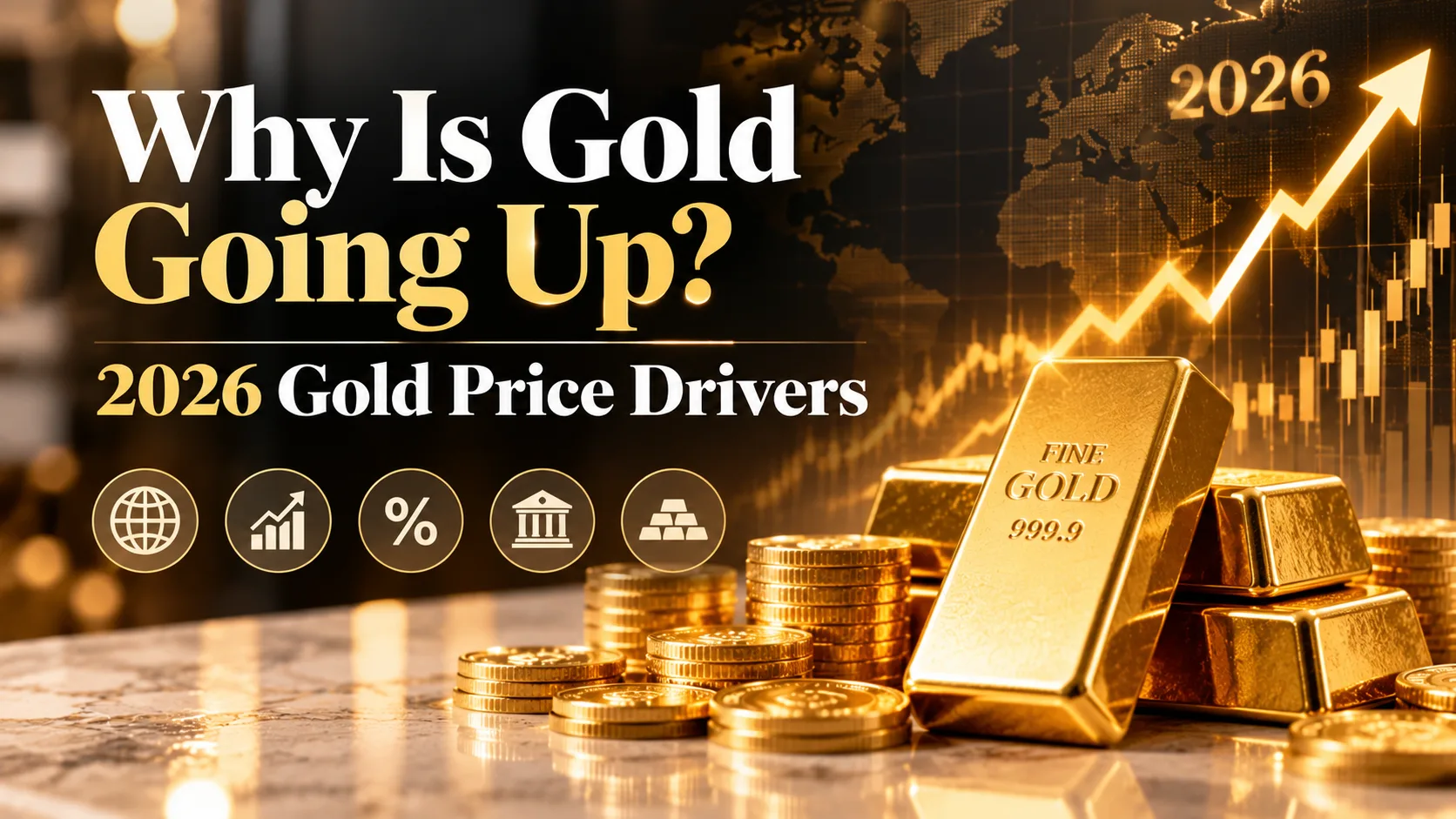
Gold has experienced a historic rally in 2025 and 2026, with the London Bullion Market Association (LBMA) benchmark reaching a record US$5,405 per ounce in late January 2026 before pulling back. As prices move sharply, many investors are asking: why is gold going up, and what is driving the market?
The answer lies in several factors moving at the same time. Central banks have continued adding gold to their reserves, while changes in real interest rates and the US dollar affect the relative appeal and cost of holding the metal. Inflation concerns, geopolitical tensions, and investment demand can add further buying pressure.
For Canadian investors and consumers, the exchange rate matters too. Because gold is priced globally in US dollars, movements in the Canadian dollar can amplify changes in the local gold price. Understanding these gold price drivers can help explain why gold has risen so sharply and what could influence its next move.
What Drives The Price Of Gold? (The Short Answer)
Because gold pays no yield or dividends, its opportunity cost rises and falls relative to yield-bearing assets like government bonds and cash deposits. Gold prices are driven by an interplay of real interest rates, US dollar strength, central bank reserves, inflation expectations, and geopolitical risk.
Ultimately, the market value of gold functions as a barometer of overall monetary health and economic trust. Key gold price drivers include interest rate policies, currency valuations, central bank reserve policies, geopolitical risks, and physical and investment demand.
The Main Reasons Gold Is Going Up In 2026
Central Banks Are Buying Gold at Record Pace
Central banks around the world have been purchasing physical bullion at near-record levels to diversify their foreign exchange reserves away from single-currency dependence. Emerging market nations, in particular, are accumulating gold reserves to protect national balance sheets against sovereign sanctions and international trade frictions. According to data published by the World Gold Council, sovereign net gold purchases have maintained an unprecedented multi-year streak, effectively setting a strong price floor under the physical market.
Central banks are actively diversifying their reserves away from single-currency concentration, particularly US dollar-denominated Treasuries, to insulate their balance sheets against inflation, sanctions, and geopolitical shifts. Physical gold serves as an unencumbered reserve asset with no counterparty risk, according to the World Gold Council’s 2026 Central Bank Gold Reserves Survey.
The World Gold Council’s 2026 survey found that 89% of reserve managers expect global central bank gold holdings to increase over the following 12 months, while 45% expect their own institutions’ gold holdings to increase.
Falling Real Interest Rates
Real interest rates, which account for inflation, are an important factor in gold’s opportunity cost. When central banks cut benchmark interest rates or when inflation outpaces yield gains, real yields decline. As real returns on cash and government debt shrink toward zero or drop into negative territory, the opportunity cost of holding non-yielding physical gold vanishes, sparking capital shifts into bullion. The Federal Reserve’s interest-rate decisions are therefore closely watched by gold investors because changes in US rates can affect Treasury yields, the dollar and the relative appeal of gold.
A Weaker US Dollar and De-Dollarization
Gold is universally priced in US dollars on global exchanges. Consequently, there is an inverse relationship between the strength of the greenback and precious metal pricing. When the US dollar weakens against a basket of major foreign currencies, gold becomes less expensive for international buyers holding other currencies, expanding global demand. Furthermore, a broader global trend toward de-dollarization, where nations settle bilateral trade in local currencies, has led sovereign entities to hold larger physical gold balances instead of US Treasury debt.
Inflation And Currency-Debasement Fears
Persistent structural inflation and expanding government sovereign debt levels continue to erode the purchasing power of fiat currencies. Investors frequently turn to hard assets as a long-term hedge against systemic currency debasement. Because gold maintains intrinsic value and cannot be printed by monetary authorities, it serves as an enduring store of value during prolonged inflationary cycles.
Geopolitical Tension and Safe-Haven Demand
During periods of international conflict, trade disputes, and geopolitical instability, investors prioritize capital preservation over speculative growth. Gold is historically recognized as the premier safe-haven asset because it carries no counterparty risk and operates outside the control of individual banking systems. Heightened global tensions naturally accelerate capital allocation into precious metals to guard against tail-risk events.
Steady Investor, ETF, and Physical Demand
Beyond institutional central bank accumulation, private retail demand and institutional investment flows have surged. Inflows into gold-backed Exchange-Traded Funds (ETFs) have rebounded sharply as wealth managers rebalance portfolios toward defensive allocations. Combined with robust retail demand for physical bars, coins, and consumer jewellery in major eastern markets, physical demand channels remain tight.
Why Gold Is Rising Faster In Canada (CAD Lens)
Because gold is quoted internationally in United States dollars (USD), domestic precious metal prices in other countries are directly tied to local exchange rates. Because global gold is denominated in US dollars, a weakening Canadian dollar automatically inflates the local price of gold in Canada, even if international USD spot prices remain completely unchanged.
Canadian investors and consumers holding local currency often observe significantly larger price jumps in domestic retail markets. To track real-time domestic movements, local market participants frequently monitor the live gold price in Canada today to gauge local valuation shifts.
Will Gold Keep Rising, Or Is This A Bubble?
Determining whether current price momentum will persist requires weighing ongoing structural supports against potential macroeconomic headwinds.
The bullish case rests partly on continued central bank buying, investor demand, and geopolitical uncertainty. The World Gold Council expects central banks to remain significant buyers through the rest of 2026, while investment demand is expected to be an important source of demand growth.
The risk is that the same forces can reverse. Higher real yields can make interest-bearing assets more attractive. A stronger US dollar can put pressure on gold. Investors who bought after a sharp rally may also take profits, creating a faster correction. While sustained central bank demand and geopolitical friction provide a structural floor for prices; a sharp rise in real bond yields or a prolonged US dollar rally could quickly trigger profit-taking and pullbacks. Gold already showed this level of volatility in 2026. The World Gold Council reported a record price of US$5,405 per ounce in January, followed by a decline to around US$4,002 per ounce in June.
That is why forecasts such as a possible US$6,000 gold price should be treated as scenarios, not promises. The actual path will depend on interest rates, currencies, economic growth, investor positioning, and demand.
What This Means If You’re Thinking About Gold
Whether held in a portfolio or stored physically, gold primarily serves as long-term capital preservation and portfolio diversification rather than a speculative growth asset. Neither approach removes the risk of price movements. Gold can rise quickly, but it can also correct sharply. The 2026 market has already shown both sides.
If you already own jewellery, coins, or bullion, a higher market price also means it may be useful to check what your holdings are currently worth. If you are considering whether to sell gold in Canada, it helps to understand current gold market trends and plan your selling strategy by comparing the value offered by a buyer with the relevant gold purity, weight, and current market conditions.
A gold loan is another option some owners consider when they want access to funds without immediately selling their gold. The terms, interest costs, and eligibility requirements can vary, so they should be checked before making a decision.
If you are considering buying gold, focus on why you want to own it, how long you expect to hold it, and how much price volatility you can accept. A rising price alone does not make an asset suitable for every buyer.
FAQ
Why is gold going up so fast right now?
Gold’s 2026 moves have been driven by several factors working together, including central bank demand, investor flows, geopolitical uncertainty, currency movements, and changing expectations for interest rates. The market has also been highly volatile. Gold reached a record US$5,405 per ounce in January before falling sharply and later recovering.
Does gold go up when interest rates fall?
Gold often benefits when real interest rates fall because lower real yields reduce the return investors can earn from competing assets such as bonds and cash. But the relationship is not automatic. Expectations for inflation, economic growth, the US dollar, and investor demand can also move the gold price at the same time.
Will gold hit $6,000 in 2026?
A US$6,000 gold price is a forecast scenario, not a guaranteed outcome. Whether gold reaches that level would depend on factors such as central bank buying, interest rates, the US dollar, geopolitical risk, and investment demand. Gold’s 2026 price swings show why forecasts should be treated as estimates rather than certainty.
Is gold a good hedge against inflation?
Gold can help protect purchasing power over longer periods, which is why investors often consider it an inflation hedge. It does not provide a guaranteed protection against short-term inflation, though. Gold can fall even while inflation remains high if real yields rise, the US dollar strengthens, or investors reduce their exposure to the metal.