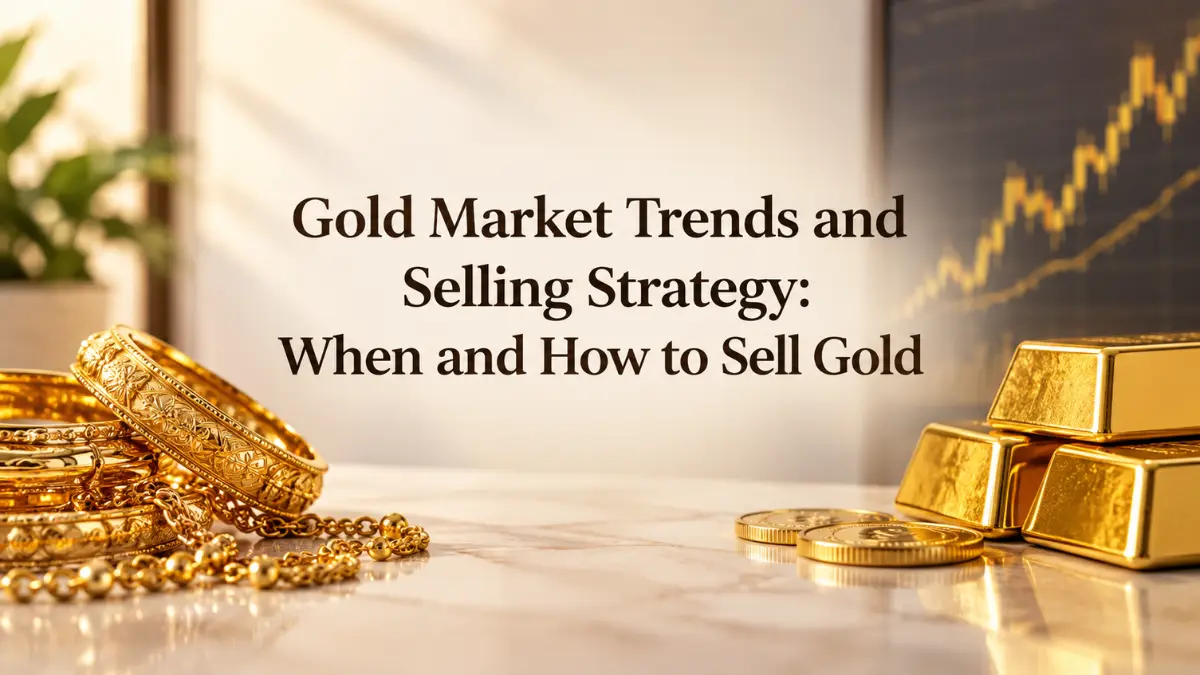
Gold has served as a store of value for centuries, but the moment you decide to sell turns it from a holding into a timing decision. Reading gold market trends before you act is what separates a considered sale from a rushed one, and a simple gold-selling strategy is what keeps that decision grounded in reason rather than emotion.
This guide walks through how gold prices behave, what actually moves them, the signals that suggest selling or holding, a repeatable framework for planning a sale, and practical tips for getting full value from whatever form of gold you own.
Understanding Gold Market Trends
Over long stretches, gold has tended to rise in value, but it does not climb in a straight line. It moves in extended cycles: multi-year advances driven by uncertainty or falling real interest rates, followed by long, flat stretches where prices drift sideways. Within any of those cycles, week-to-week volatility can be sharp. Understanding gold market trends means separating the direction of travel from the noise along the way-a single dramatic session rarely tells you anything about where the metal is headed.
Short-term price trends vs. the long-term trend
Short-term gold price trends respond to headlines: a central bank statement, an inflation reading, a currency swing. They can reverse within days. The long-term trend reflects slower forces-monetary policy cycles, official-sector buying, structural demand. Sellers who react to short-term moves often sell into a dip; sellers who track the longer trend have a far better sense of whether current pricing is genuinely favorable.
How to read a gold price trend before you sell
Look at gold price trends over at least one to five years rather than one week. Note where current pricing sits within that range-near the top, mid-range, or near the lows. Check whether the move has been steady or a sudden spike, since spikes often retrace. Then ask a simple question: if this level held for six months, would you still be happy selling?
What Drives Gold Prices: A Simple Market Analysis
A useful gold market analysis comes down to a handful of recurring drivers. Each one has a direct implication for anyone holding metal they may sell.
Inflation and interest rates
Gold pays no interest, so its appeal rises when real interest rates-nominal rates minus inflation-are low or negative and fades when they climb. Rising inflation alongside slow-moving rates has historically been supportive; aggressive rate hikes have been a headwind. What it means for a seller: an environment of falling real rates often supports higher offers, so there is usually less pressure to sell quickly.
US dollar strength and currency movements
Gold is priced internationally in US dollars, so a stronger dollar tends to weigh on the price and a weaker one tends to lift it. If you hold gold outside the United States, your local currency matters just as much: a weaker home currency can raise the value of your gold even when the US-dollar price is flat. What it means for a seller: always check the price in the currency you will actually be paid in.
Central bank demand and geopolitical uncertainty
Central banks have been steady buyers of gold as a reserve asset, and research from the World Gold Council consistently identifies official-sector demand as a meaningful support for the market. Periods of geopolitical stress or financial instability typically add safe-haven buying. What it means for a seller: stress-driven rallies can be strong but are often temporary.
Supply, mining output, and seasonal demand
Mine supply changes slowly, so it rarely causes sharp moves, though recycled gold does rise when prices are high. Demand has a seasonal rhythm, with jewellery buying clustering around festival and wedding seasons in major markets. What it means for a seller: supply and seasonality set the backdrop rather than the trigger -useful context, not a timing signal on their own.
Best Time to Sell Gold
Turning those drivers into a decision is the practical question. The best time to sell gold is rarely a specific date; it is the point where market conditions and your own circumstances line up.
Sell signals vs. hold signals
| Signals it may be a good time to sell | Signals it may be better to hold |
|---|---|
| Prices are strong relative to their multi-year range | Prices sit near the lower end of their recent range |
| Real interest rates are rising, reducing gold's appeal | Real interest rates are falling or negative |
| Your home currency is weak, boosting local value | Your currency is unusually strong against the US dollar |
| You have a defined need for the cash | Selling would be purely reactive to a headline |
| Gold has grown beyond its intended share of your assets | Your holding still matches your long-term plan |
| A rally looks driven by a short-lived event | Structural demand drivers remain firmly in place |
Signals rarely align perfectly. Treat them as weight of evidence rather than a checklist requiring unanimity.
Seasonal and market-cycle timing
There is no single month that reliably delivers the highest price. That said, demand in major consuming markets tends to concentrate around autumn festival and wedding seasons, and trading volumes often thin out in midsummer and late December, which can make pricing choppier. A thin market is not a good place to negotiate. If you have flexibility, selling during an active trading period generally means tighter pricing and more competitive offers.
Should you sell at record-high prices?
Record highs are appealing but they are not automatically the peak -strong trends frequently set several highs in succession. The risk runs both ways: sell too early and you leave gains behind; wait for a top and you may sell into the decline that follows. A sensible compromise is to sell a portion at strong pricing and keep the rest, which removes the pressure to call the exact top.
Building Your Gold Selling Strategy
Most sellers decide in the moment. A structured gold selling strategy replaces that with four decisions made in advance.
Define your goal
Start with why you are selling. Liquidity means you need the cash by a set date and timing is secondary. Profit-taking means you are converting an unrealized gain and can afford to be patient. Rebalancing means gold has outgrown its intended share of your assets and you are trimming back to target. Each goal points to a different level of urgency and a different acceptable price.
Selling all at once vs selling in stages
Selling everything in one transaction is simple, gives certainty, and often earns better pricing on larger volumes. Selling in stages -a set portion at intervals or at rising price levels -averages out your exit and lowers the cost of getting the timing wrong. Staged selling suits profit-taking and rebalancing; a single sale usually suits a genuine liquidity need.
Match the strategy to your goal and timeline
Short timelines call for a single, prompt sale and a focus on finding the best buyer rather than the best moment. Longer timelines let you wait for favourable conditions and sell in stages. Write your timeline down before you approach a buyer, because a deadline you have not acknowledged tends to become a negotiating weakness.
Set a target price and a walk-away point
Decide in advance the price at which you are happy to sell and the offer below which you will decline. Express both as a percentage of the current spot value rather than a fixed figure, so the plan stays valid as the market moves. Having a walk-away number written down is the single most effective defence against a persuasive lowball offer.
Selling Strategy by Type of Gold
What you own changes how you should sell it.
Gold jewellery. Most jewellery sells for its metal content, not its retail price, so expect offers based on karat and weight. Designer pieces, antiques, and items with gemstones may be worth more intact -have those appraised separately before anyone melts them.
Gold coins. Bullion coins trade close to spot with a modest premium. Rare or collectible coins can carry numismatic value well above their metal content, so identify the mint, year, and condition first and approach a gold coin specialist rather than a general buyer.
Gold bars and bullion. Bars from recognized refiners with intact assay certificates and packaging achieve the tightest spreads to spot. Keep documentation together; unverifiable bars may need assaying, which costs time and money.
Scrap and broken gold. Sort by karat before you go, since mixed lots are usually priced at the lowest karat present. Refiner-linked buyers typically pay more for scrap than retail shops do.
Practical Gold Selling Tips to Get the Best Value
These gold selling tips apply regardless of market conditions.
Know your purity and weight. Check for karat marks (10K, 14K, 18K, 22K) or fineness stamps (585, 750, 999). Weigh your items on an accurate gram scale at home. Knowing roughly what you hold before you walk in makes any offer immediately easier to assess.
Understand spot price vs the offer you’ll receive. Spot is the wholesale price for pure gold. Your offer will be a percentage of that, after adjusting for purity and the buyer’s refining costs and margin. A fair offer sits somewhat below spot; the point is to know how far below, and why.
Get multiple quotes. Obtain at least three written offers, quoted on the same day and on the same items, so they are genuinely comparable. Ask each buyer how they calculate the figure. Competing quotes are the most reliable way to establish what your gold is actually worth.
Avoid common scams and lowball offers. Be wary of pressure to decide immediately, items weighed out of your sight, vague verbal quotes, and mail-in services that melt before confirming a price. Checking a buyer’s track record through a body such as the Better Business Bureau takes minutes and filters out most bad actors.
Conclusion
Selling gold well follows a chain: read the trend rather than the headline, understand the drivers behind it, weigh the sell and hold signals against your own circumstances, then apply a gold selling strategy built around your goal, timeline, target price, and walk-away point. The practical steps -knowing your purity, understanding spot, and comparing written quotes -turn that plan into the best available price.
If you are close to a decision, a valuation from a reputable, established buyer is a sensible next step. It costs nothing to find out what your gold is worth.
FAQ
Is now a good time to sell gold?
That depends less on the calendar than on where prices sit within their multi-year range and what you need the money for. If gold is strong relative to recent years and you have a defined goal -profit-taking, liquidity, or rebalancing -conditions are likely reasonable. If you would only be reacting to a headline, waiting is usually wiser.
What is the best time of year to sell gold?
No month reliably produces the highest price. Demand in major consuming markets tends to rise around autumn festival and wedding seasons, and trading is often thinner in midsummer and late December, which can widen spreads. If you have flexibility, selling during an active trading period generally brings more competitive offers.
Should I sell my gold now or wait?
Ask what changes if you wait. If you have no deadline and the long-term drivers still look supportive, waiting costs you little. If you need the funds, or gold has grown beyond its intended share of your assets, selling now is defensible. Selling part of your holding is a reasonable middle path
What is the most profitable way to sell gold?
Usually selling to a buyer closest to the refining chain, with several written quotes for comparison and full knowledge of your karat and weight. Collectible coins and designer jewellery are exceptions -they can be worth considerably more sold intact to a specialist than melted for metal content.