
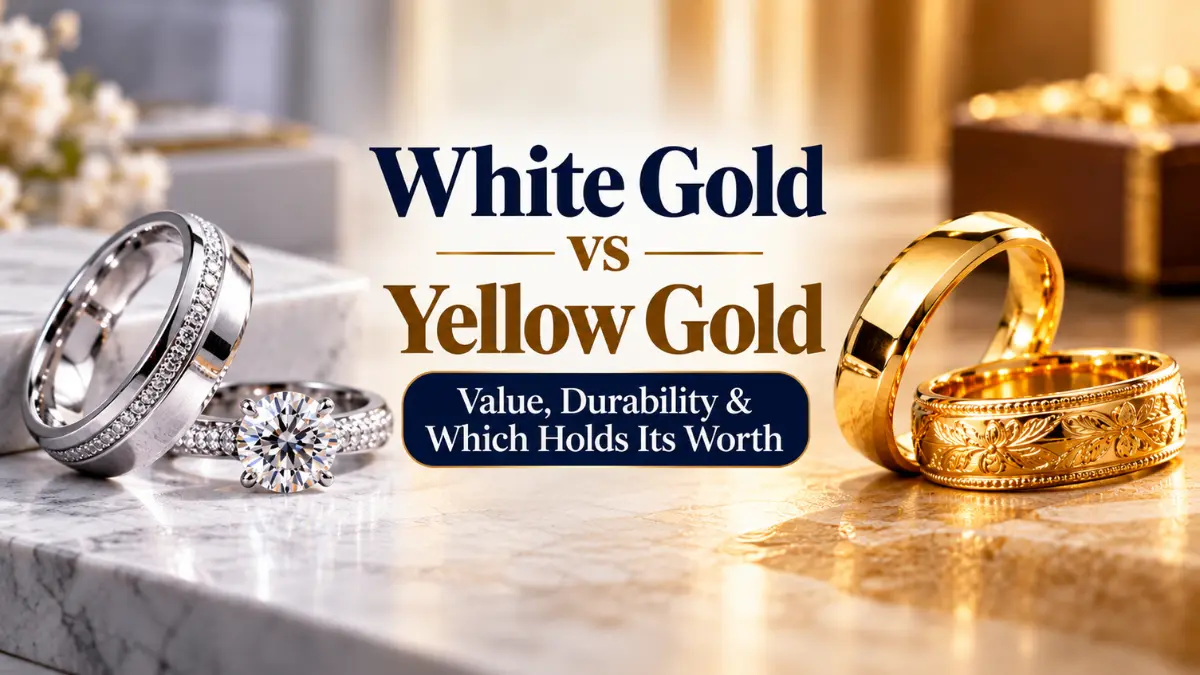
White gold vs. yellow gold is one of the first decisions a ring or fine-jewellery buyer has to make, and it comes down to more than looks.
Both are real gold of the same karat purity – 14k white gold and 14k yellow gold contain exactly the same amount of pure gold.
What actually separates them is colour, how much upkeep each needs, how well each holds up to daily wear, and – the question buyers ask most – which one is worth more when it’s time to sell. Same-karat pieces are valued on their gold content at resale, so colour alone rarely decides which sells for more; karat, weight and condition do. Below is a straight comparison of both metals so you can choose the one that fits your style, budget and how much maintenance you’re willing to do.
White Gold vs Yellow Gold at a Glance
| Factor | White Gold | Yellow Gold |
|---|---|---|
| Colour | Bright, cool white (from rhodium plating) | Warm, classic yellow |
| Composition | Gold alloyed with palladium, nickel or silver | Gold alloyed with copper and silver |
| Durability | Harder alloy, more scratch-resistant | Softer, but easier to polish and restore |
| Upkeep | Needs periodic rhodium re-plating | Minimal - occasional polish |
| Typical price | Often a modest premium over yellow gold | Baseline for the same karat |
| Resale value | Valued on gold content, same as yellow gold | Valued on gold content, same as white gold |
| Best for | Cooler skin tones, modern styles, diamond settings | Warmer skin tones, classic and vintage styles |
What Is White Gold?
How white gold is made
White gold starts as pure (24k) gold, which is naturally yellow and too soft for everyday jewellery. To make it white and wearable, gold jewellers alloy it with white-toned metals – most commonly palladium, nickel or silver – then finish the piece with a thin layer of rhodium plating. Rhodium is a bright, hard, platinum-family metal, and it’s what gives white gold its crisp, silvery shine; the alloy underneath actually has a faint warm cast before plating, as one industry overview of white gold alloys explains.
Is white gold real gold?
Yes. Karat measures how much pure gold a piece contains, not its colour – 14k white gold and 14k yellow gold both contain 58.3% pure gold, and 18k versions of each contain 75%. The remaining percentage is alloy metal, and that alloy is what determines the colour, not the gold itself.
One thing to flag: nickel, a common whitening alloy, can trigger a skin reaction in people with metal sensitivities. If that’s a concern, ask for a palladium-based white gold alloy instead, which is naturally hypoallergenic.
What Is Yellow Gold?
Yellow gold is the metal in its most traditional form: pure gold alloyed mainly with copper and silver, which keeps its warm, classic tone rather than shifting it toward white. There’s no rhodium layer involved, so the colour you see is the colour of the metal itself, all the way through.
Karat still matters for yellow gold the same way it does for white. 14k yellow gold (58.3% pure gold) has a slightly lighter, more muted yellow and is noticeably harder than 18k yellow gold (75% pure gold), which is richer in colour but softer since it contains less alloy metal to reinforce it. Because it needs no plating, yellow gold also keeps its exact colour and finish from the day it’s made – there’s no maintenance step required to keep it looking as intended.
Colour & Appearance: How They Compare
White gold reads cool and bright, close to platinum or silver, which tends to suit cooler or fairer skin tones and pairs especially well with diamonds – the white metal doesn’t compete with a stone’s colour grade the way yellow gold can. Yellow gold reads warm, and it flatters warmer or deeper skin tones while giving coloured gemstones (sapphires, emeralds, rubies) a more traditional, vintage-leaning look.
One appearance difference buyers often miss: white gold’s finish isn’t static. As the rhodium layer wears down through daily contact, the alloy underneath starts to show a faint warm or yellowish cast, and the piece gradually looks less crisp until it’s re-plated. Yellow gold’s colour, by contrast, stays essentially the same throughout its life, since there’s no coating to wear away.
Durability: Which Is Tougher for Daily Wear?
White gold generally has the edge for scratch resistance. Nickel- and palladium-based alloys are harder than the copper-silver alloy used in yellow gold, and the rhodium plating adds a further hard, protective layer on top while it lasts. Yellow gold is comparatively softer, which sounds like a downside, but it cuts both ways: softer metal is easier for a jeweller to polish out scratches and restore to a like-new finish, while white gold’s hardness makes it more scratch-resistant but somewhat less forgiving to refinish.
Karat affects both metals the same way: the higher the karat, the more pure gold and the less hardening alloy, so 18k white or yellow gold is softer and more prone to denting than 14k of the same colour. For a gold ring or piece worn every day – the highest-wear scenario in jewellery – 14k in either colour holds up better than 18k, and white gold’s added hardness is a genuine (if modest) practical advantage over yellow gold.
Maintenance & Lifetime Cost
This is where the two metals genuinely diverge, and it’s easy to miss when you’re only comparing sticker prices. White gold’s rhodium layer wears thin with everyday contact, and once it does, the piece needs re-plating to keep its bright white look. Most jewellers recommend re-plating roughly every 1–3 years for a piece worn daily, more often for rings that see heavy wear, and the cost is typically a modest service fee rather than a major expense – but it recurs for as long as you own the piece.
Yellow gold, by comparison, needs next to nothing: an occasional professional polish to keep the surface bright, and that’s it. There’s no coating to maintain and no recurring service to budget for.
The net takeaway for total cost of ownership: white gold typically carries a small, ongoing maintenance cost that yellow gold simply doesn’t have. It’s rarely a dealbreaker, but it’s worth factoring in if you’re choosing a piece you’ll wear daily for years.
Price: Is White Gold More Expensive Than Yellow Gold?
At the same karat, white gold and yellow gold start from a similar base price, because that price is driven mainly by gold content – and the same karat means the same amount of pure gold. What actually moves the price from there is everything alloyed and finished around that gold: white gold’s alloy metals (palladium in particular is expensive), the labour and materials for rhodium plating, and general brand or retailer markup that applies to either colour.
In practice, white gold often carries a modest retail premium over yellow gold of the same karat – commonly cited in the range of 10–15% – mainly because of the palladium content and the plating step, not because the gold itself is worth more. If budget is the deciding factor, yellow gold (or a nickel-based rather than palladium-based white gold alloy) is typically the lower-cost route at the same karat.
Resale Value: Which Sells for More?
What your gold is actually worth at resale
When you sell gold jewellery – whether to a buyer, pawnbroker or refiner – it’s usually valued on its melt or scrap value first: purity (karat) times weight times the current gold price. Colour isn’t part of that formula. A 14k white gold ring and a 14k yellow gold ring of the same weight contain the same amount of pure gold, so at melt value they’re worth essentially the same.
Where white and yellow gold resale differ
In practice, a few things can nudge one ahead of the other, but none of them are about colour itself. Condition matters: a white gold piece that needs re-plating can look duller to a buyer evaluating it by eye, even though the gold content hasn’t changed. Buyer demand shifts with trends and region – yellow gold has seen renewed demand in recent years, which can help at resale to a private buyer (as opposed to melt value) if the piece is being sold as jewellery rather than scrap. And brand or designer pieces sell on their own reputation, in either colour, well above scrap value.
The straight verdict: neither white gold nor yellow gold reliably sells for more purely because of its colour. Karat, weight and condition drive resale value – not white vs yellow.
How to Choose: White Gold or Yellow Gold?
| If you prioritise… | Better pick | Why |
|---|---|---|
| Cooler skin tone or modern style | White gold | Cool tone flatters fair/cool complexions and modern settings |
| Warm skin tone or classic/vintage style | Yellow gold | Warm tone complements deeper complexions and traditional design |
| Daily durability, fewer scratches | White gold | Harder alloy resists scratching better |
| Lowest possible upkeep | Yellow gold | No plating to wear down or renew |
| Tightest budget at the same karat | Yellow gold | No palladium or plating premium |
| Resale priority | Either | Resale tracks karat, weight and condition, not colour |
| Nickel allergy | Yellow gold or palladium white gold | Standard nickel-alloy white gold can irritate sensitive skin |
Conclusion
When it comes to white gold vs yellow gold, both are equally real gold – the karat stamp guarantees the same purity regardless of colour. What actually separates them is colour, upkeep (white gold needs occasional rhodium re-plating; yellow gold doesn’t) and durability (white gold’s alloy is generally harder). Resale value tracks karat, weight and condition, not colour, so neither metal has a built-in resale edge over the other.
The right pick comes down to your style and skin tone, how much maintenance you want to deal with, your budget, and – for sensitive skin – whether nickel is a concern. Either way, you’re buying real gold that holds real value.
FAQ
Is white gold worth more than yellow gold?
Not inherently. At the same karat, both contain the same amount of pure gold, so their base value is essentially equal. White gold sometimes carries a modest retail premium (roughly 10–15%) because of its alloy metals and rhodium plating, but that’s a manufacturing cost, not a sign the gold itself is worth more.
Is white gold real gold?
Yes. White gold is pure gold alloyed with white metals such as palladium, nickel or silver, then finished with rhodium plating for colour. Karat measures the actual gold content and is identical for white and yellow gold at the same karat level – colour has no bearing on purity.
Does white gold or yellow gold hold its value better?
Neither has a built-in advantage. Resale value is driven by karat, weight and condition, since most buyers value gold on its melt content. A well-kept piece in either colour holds its value about equally; a white gold piece overdue for re-plating may simply look less appealing to a buyer, even though its gold content is unchanged.
Is white gold more expensive than yellow gold?
Often slightly, yes. Same-karat pieces start from a similar base price, but white gold’s alloy (palladium in particular) and its rhodium plating step typically add a modest premium – commonly cited around 10–15% – on top of the base gold price.