
Why Purity Is the Number That Decides Your Payout
Every offer for precious metals is based on three things: purity, total weight, and the live market price. Weight and market prices are easy to check, but the seller usually cannot confirm purity without proper equipment. That makes gold purity testing an important part of the evaluation.
Gold purity can be shown as karats or fineness. 24K is pure gold at about 99.9%, 18K is 75.0% and is commonly marked 750, 14K is 58.5% and marked 585, and 10K is 41.7% and marked 417. For example, if a 30-gram lot is treated as 14K when it is actually 18K, the difference is nearly 5 grams of pure gold. That can mean a several-hundred-dollar difference in the offer.
How Gold Buyers Test Gold: Visual Checks, Loupes, and Magnets
Before running electronic scans, we perform preliminary visual and physical checks to identify obvious metallic traits. Note that these initial steps filter out common base metals but do not establish definitive purity.
Reading the Hallmark Under a Jeweller's Loupe
Using a 20x magnification jeweller’s loupe, we inspect discreet areas such as inner ring bands, earring posts, and chain clasps for official manufacturer hallmarks and fineness stamps.
This initial gold karat testing gives us a useful starting point. However, a hallmark is a claim about the item, not definite proof of its composition. Gold-plated brass or silver can sometimes carry markings that suggest solid gold.
The Magnet Check and What It Does Not Prove
Next, we use a strong neodymium magnet. Solid gold, silver, and platinum are non-magnetic, so strong attraction can point to iron, steel, or nickel in the item. This can quickly identify some counterfeit pieces and items with ferromagnetic cores.
However, passing a magnet test does not prove that an item is solid gold. Copper and brass are also non-magnetic. The magnet only helps identify obvious ferromagnetic metals.
XRF Analysis: How the Machine Reads Your Gold
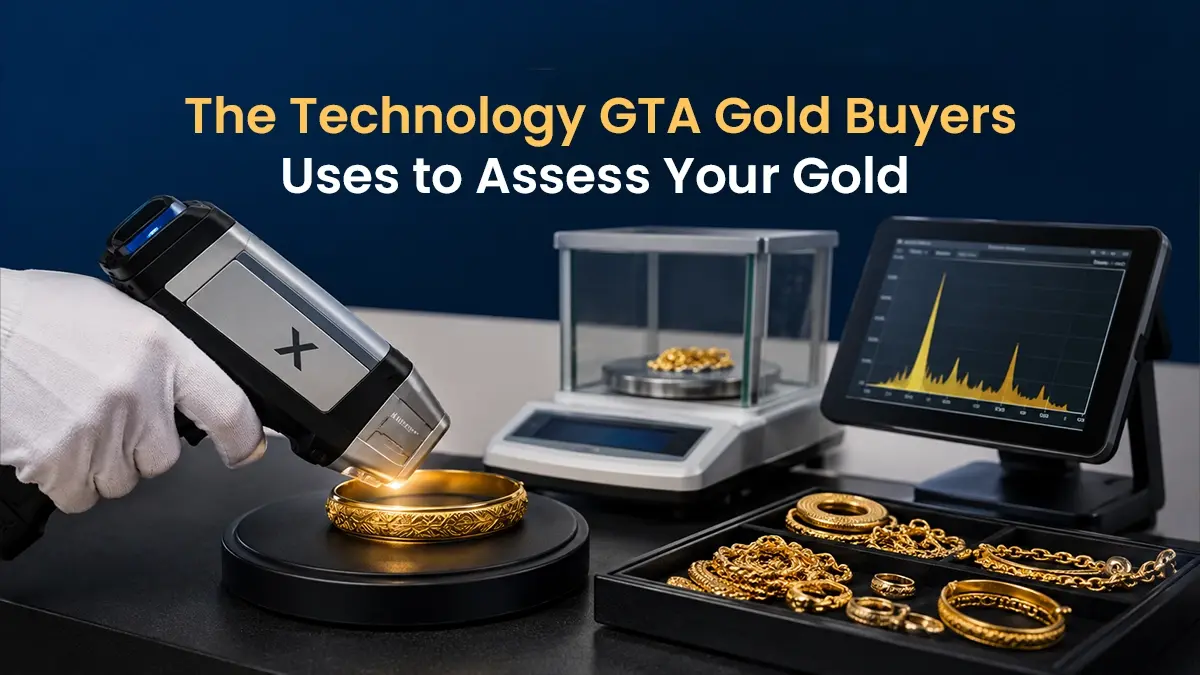
The main part of our evaluation uses XRF gold testing, or X-ray fluorescence. It is a non-destructive method that provides a fast analysis of the elements in the metal.
How X-Ray Fluorescence Works, in Plain Language
An XRF analyzer directs a low-energy X-ray beam at the surface of the metal. The energy excites the atoms in the alloy. These atoms then give off secondary X-rays.
Each metal produces a different energy signature. The analyzer measures those signals and uses them to determine the composition of the sample.
The process takes seconds and does not require us to scratch, cut, or melt the jewellery.
What the Reading Actually Shows You
The XRF screen gives more than a general karat range. It provides an elemental breakdown with exact percentages. You can see the gold percentage along with other elements found in the alloy, such as silver, copper, zinc, nickel, palladium, or metals that may indicate surface plating.
For example, a sample reading may look like this:
Sample XRF Screen Readout:
Au (Gold): 58.54% (14K)
Cu (Copper): 29.10%
Ag (Silver): 8.20%
Zn (Zinc): 4.16%
Status: Solid 14K Gold Alloy
Why Non-Destructive Testing Matters
Older testing methods could require filing jewellery or melting material into bars. XRF analysis can scan an item in seconds without scratching or changing its physical condition. This matters if you decide not to sell an heirloom or another valuable item because it can be returned to you in its original condition.
There is one important limitation. XRF mainly reads the surface, at a depth of approximately 10 to 50 microns. Heavy gold plating over a dense base-metal core can therefore affect a single reading. When an item looks suspicious or the result does not match other evidence, a secondary test can provide confirmation.
When We Still Reach for Acid and Density Tests
Secondary methods are useful when an item is unstamped, unusual, or produces a reading that needs further checking. Each method answers a different question.
The Acid Scratch Test on a Touchstone
The acid test for gold is mainly used for custom-made jewellery, unmarked pieces, or items with unclear readings. The item is lightly rubbed against a slate touchstone, leaving a small metallic streak. A testing solution for a specific karat is then applied to the streak.
If the streak reacts or disappears under a particular concentration, the metal does not meet that karat level. If it remains stable, the stated karat is supported. The acid is applied to the streak on the touchstone, not directly to the jewellery.
Specific Gravity for Coins, Bars and Heavy Chains
Specific gravity testing can help with dense items such as bullion coins, cast bars, and heavy chains when surface testing is not enough. Weigh the item dry, then weigh it while fully submerged in water. The relationship between its mass and water displacement gives its density.
Pure gold has a specific gravity of 19.32 g/cm³. Copper is much lower at 8.96 g/cm³, while tungsten is close to gold at 19.25 g/cm³. This method can help identify unusual cores, fillers, or plating.
It is not reliable for jewellery with gemstones or hollow sections because trapped air can affect the water displacement measurement.
Which Test Answers Which Question
Each testing method looks at the gold in a different way. When a result is unclear, using more than one test helps us confirm the purity instead of relying on a single reading.
| Method | What It Answers | Speed | Damage to Your Item | When We Use It |
|---|---|---|---|---|
| Magnet Screen | Identifies ferromagnetic base metals such as steel and nickel | Immediate, seconds | None | Initial screening for all items |
| Hallmark & Loupe | Reveals manufacturer stamps and claimed karat | Under 1 minute | None | First visual inspection |
| XRF Analysis | Provides an exact alloy composition breakdown | 5 to 10 seconds | None, non-destructive | Primary testing for standard jewellery |
| Acid Scratch | Confirms a threshold karat rating on a streak | 1 to 2 minutes | Microscopic wear on the touchstone only | Unstamped or custom items |
| Specific Gravity | Verifies core density against possible surface plating | 2 to 3 minutes | None | Solid bullion, coins, and thick chains |
From Reading to Offer: How Your Gold Is Actually Valued
Once we know the purity and weight, the next step is to turn those readings into a value. Understanding how gold is valued when selling comes down to a simple calculation:
Purity percentage × weight in grams × live price per gram = gold value
Worked Valuation Example
Suppose you bring in a 22.00-gram scrap gold chain that tests at 14K, which is 58.5% pure.
- Calculate the fine gold content:
22.00 grams × 58.5% = 12.87 grams of fine gold
- Apply the market rate:
If the illustrative live spot price of pure gold is $100.00 CAD per gram, then:
12.87 grams × $100.00 = $1,287.00 CAD
This is an illustrative calculation, not a guaranteed payout. Since gold prices can change throughout the day, use the GTA Gold Buyers Gold Calculator to check the current market rate and estimate your potential payout.
This is an illustrative calculation, not a guaranteed payout. The actual market price changes, so check the current figure with GTA Gold Buyers
Handling Stones and Mixed Lots
Stones, glass, and decorative enamel are not part of the precious-metal weight, so their weight needs to be estimated and deducted. A 1-carat gemstone or cubic zirconia weighs about 0.20 grams. In a professional evaluation, the stones are visually assessed, and their estimated weight is deducted from the metal weight.
Mixed-karat items are also separated by purity. For example, 10K, 14K, and 18K pieces are sorted into separate groups and weighed individually instead of averaging their purity together.
How to Tell Whether a Buyer's Testing Is Honest
You should feel comfortable asking questions while your items are being tested. A reputable buyer should be willing to explain the process and show you how the offer was calculated.
- Watch the Process Live: Reputable buyers position both the digital scale and the XRF readout screen in full view so you can verify each weight and elemental percentage yourself.
- Check Scale Calibration: Ensure the scale is tared to absolute zero before any jewellery is placed on the platform.
- Ask for Testing Rationale: Request a clear explanation of why a specific test (XRF vs. acid vs. specific gravity) was selected for your item.
- Verify the spot price: Ask which live market price is being used and compare it with an independent source such as Kitco Gold.
- Compare quotes without pressure: Take your itemized quote and compare it with other buyers. A legitimate business should not pressure you into accepting a same-day offer.
- Recognize red flags: Be cautious if testing happens in a private back room, you receive one lump-sum figure without a karat and weight breakdown, or the buyer refuses to explain deductions for stones.
What You Can Check at Home Before You Come In
You can do a few basic checks at home, but they cannot replace professional testing.
- Find and photograph the hallmark: Use a magnifying glass or your phone camera to look for stamps inside ring bands, on chain end caps, or near clasps.
- Run a household magnet over the items: A strong refrigerator or hardware magnet can help separate obvious iron or nickel-based pieces.
- Look for surface wear: Check edges, clasp hinges, and ring undersides. If another colour appears where the surface has worn away, the item may be plated.
- Weigh the lot: Use a digital kitchen scale to get a rough weight in grams.
These checks only give you a starting point. They cannot establish true purity. Avoid DIY acid testing kits because strong nitric acid can cause chemical burns and may permanently damage jewellery you later decide to keep. Gold-plated and gold-filled items have only a microscopic layer of gold, so they generally have little to no melt resale value.
FAQ
Does testing my gold damage it?
No. Modern screening with a jeweller’s loupe, magnet checks, and XRF gold testing is non-destructive. The X-ray analyzer reads the surface composition without scratching or changing the item. If a secondary acid test is needed, the small streak is made on an external touchstone, so the jewellery itself remains unharmed.
How accurate is XRF gold testing compared to a lab assay?
Professional XRF analyzers can typically measure elemental composition within about 0.1% to 0.2% of the exact composition. Destructive fire assay remains the laboratory standard for bulk mining and refining, but XRF provides fast, non-destructive results that are suitable for commercial gold buying.
Can a gold buyer tell if my jewellery is gold plated?
Yes. A plated item may pass a basic visual or magnet check, but XRF analysis can identify base metals such as copper, zinc, or silver beneath the surface. When plating is heavy, density testing or a touchstone scratch check can provide additional evidence of a non-gold core.
Is testing free, and am I obligated to sell after it?
At GTA Gold Buyers, testing and valuations for gold selling are completely free, transparent, and non-obligatory. Our specialists test your items, explain the purity and weight breakdown, and provide a written offer. You keep full ownership and can accept the offer or choose to keep your items.