How do pawn shops work when a bill lands before payday, or when a watch or gold chain sits unworn in a drawer? Pawn shops pay cash for items like these, and because the collateral is the item itself, nobody asks about your income. The terms of a short-term loan are strict, though, and most people never read them. This article covers what a pawnbroker does, a pawn loan step by step, what it costs in Canada, Ontario’s rules, what happens if you don’t repay, what pawn shops take, and when selling makes more sense.
Pawn Shop Meaning: What a Pawnbroker Actually Does
The pawn shop meaning is straightforward: if you’re asking what a pawn shop is, it’s a licensed business, run by a pawnbroker, that lends money against items you leave as security and also buys and resells secondhand goods. The pawnbroker does two separate things, and it helps to keep them apart.
The first is the pawn loan. You pledge an item as collateral; you keep ownership, and you can get it back by repaying the loan with interest. The second is a straight purchase, where the shop pays you for the item and it is theirs for good. A pawn loan is a secured loan with one unusual feature: it is non-recourse, which means the item is the only thing the shop can take if you don’t repay. What that means in practice is covered below.
You can spot most pawn shops by the sign of three golden balls, the oldest symbol of the trade.
How Does Pawning Work? The Pawn Loan Step by Step
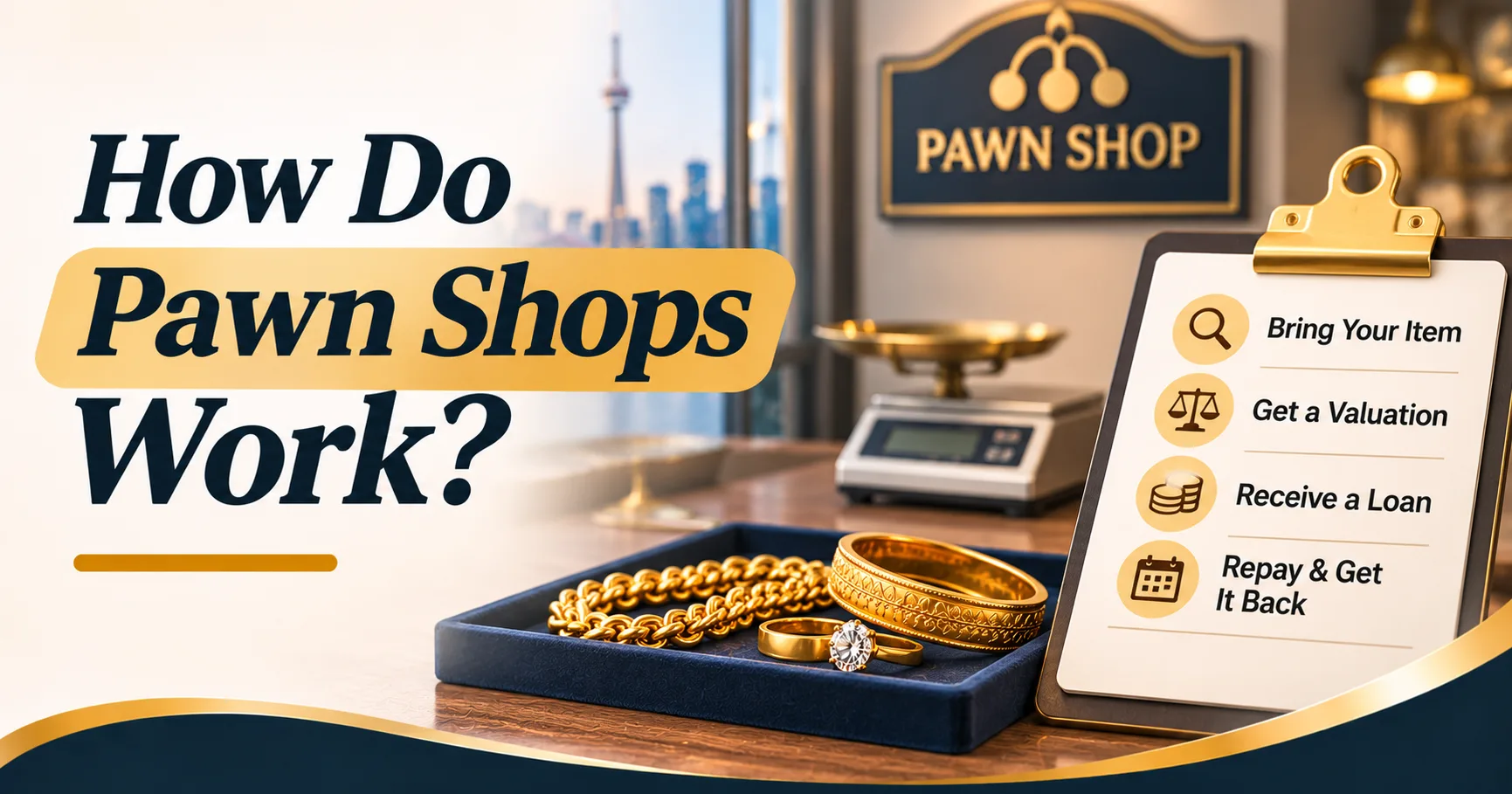
How does pawning work, and how does a pawn shop work once you’re at the counter? Every pawn loan follows the same path:
- Bring the item and a government-issued photo ID. You must be 18 or older.
- The pawnbroker checks the item: they test gold, check serial numbers, and make sure electronics work and aren’t locked.
- They offer a loan based on what they can resell the item for.
- You accept and get a pawn ticket.
- You leave with cash while the shop stores the item.
- Repay the loan plus interest and fees before the term ends, show the ticket, and take the item home.
- If you need longer, ask to pay the interest so far and extend the term. The shop isn’t obliged to agree.
In Ontario, the ticket must show the shop’s name and address, your name, the date, a description of the item, the amount lent, the interest rate, and any ticket or storage charge. Read the interest rate and the last day to redeem before you sign, and keep the ticket somewhere safe. Who can use it is covered in the FAQs below.
Because the offer is sized to what the shop can resell the item for, not to what you paid or what it means to you, it will come in well under the item’s value.
How Do Pawn Shops Work in Canada? Interest Caps and Ontario Rules
How do pawn shops work in Canada? Pawn loan interest is capped by the Criminal Code, and in Ontario, the Pawnbrokers Act sets the redemption period and record-keeping rules.
Pawn Loan Interest Rates Under Canada’s Criminal Code
The Criminal Interest Rate Regulations set two ceilings on the annual percentage rate (APR), in force since January 1, 2025.
Pawn loan amount | Maximum pawn loan interest (APR) |
Under $1,000 | 48% |
$1,000 or more | 35% |
Here is what the cap means in dollars. A $500 pawn loan at 48% a year costs about $60 in interest over three months, before any ticket or storage fee. Ask the shop to write the total you’ll owe on the last day of the term, in dollars, and compare it with the amount you’re borrowing.
Fees count too. The Criminal Code treats every fee and charge on the loan as interest, so ticket, storage, and appraisal fees all count toward the 48% or 35% cap. Ontario’s Pawnbrokers Act separately caps the ticket charge at 20 cents and storage at 10 cents per cubic foot a month. Don’t pay any fee that isn’t printed on the pawn ticket.
You can also check the cap yourself. 48% a year is about 4% a month, so if a shop quotes a monthly rate higher than that on a small loan, ask them to show the APR in writing.
Ontario’s Pawnbrokers Act: Redemption Period, ID and Police Reports
You have one year to redeem your item. For loans over $15, the shop must also mail you a notice and give you at least 15 more days before the item becomes theirs. Pawnbrokers are licensed by the municipality, record every pawner’s ID details, and send police a daily report of what they take in, which is how stolen goods get traced. Ontario pawnbrokers also can’t take a cross, medal, or decoration in pawn.
What Happens If You Don't Repay a Pawn Loan?
If you don’t repay by the end of the term and any notice period, the item becomes the pawn shop’s, and they sell it. You owe nothing more. There are no collection calls and no lawsuit, because the loan is non-recourse.
What you lose is the item and everything it was worth above the loan. That is the real cost of a forfeited pawn: not the interest, but the gap between what the shop lent and what the item would have sold for.
If you can’t repay in full, go in before the last day and ask to pay the interest owed to extend the term. Once the item is forfeited, you can only buy it back at the shop’s selling price.
What Do Pawn Shops Buy and Take?
What do pawn shops buy, and what do pawn shops take as security for a loan? Mostly small, valuable things they can resell quickly, with gold and jewellery at the top of the list.
What pawn shops take | What the pawn shop checks before an offer |
Gold and silver jewellery | Karat, weight and whether it’s plated |
Watches | Brand, working order, box and papers |
Phones, laptops and game consoles | Model, working order, charger, not locked to an account |
Power tools | Brand, working order, batteries |
Musical instruments | Brand, condition, case |
Designer handbags | Authenticity, condition, receipt or dust bag |
Firearms | Only at shops licensed for them, with your firearms licence |
Pawn shops refuse anything they suspect is stolen, or that has a removed serial number, phones still locked to an account, and items from anyone under 18. In Ontario, they also refuse crosses, medals and decorations, as covered above.
Bring the charger, box, papers, or receipt. Anything that proves the item works and is yours raises the offer.
Pawn Shops vs Gold Buyers: When Selling Your Gold Pays More
Pawn only what you want back. If you’re parting with gold or silver for good, a gold buyer prices it on its gold content rather than discounting it for the risk that you won’t come back.
The difference comes from how each is priced. A pawn loan is sized to what the shop can safely resell the item for, because the loan has to cover the chance you never return. A gold buyer prices gold by its weight, karat, and the day’s spot price. For a local side-by-side, see our guide to pawn shops and gold buyers in Oshawa.
If you decide to sell, GTA Gold Buyers quotes your gold against the day’s price, so you know what the metal is worth before you decide.
Using Pawn Shops Wisely
So how do pawn shops work in the end? About four in five pawned items in Canada are redeemed by their owners, which means most pawn loans finish with the item going home. Only pawn what you’re sure you can redeem within the term, and sell what you don’t need back; before you sign, get the total owed on the last day in writing.
Selling Your Engagement Ring Without Regret
A ring without a stamp can still be gold or platinum, because quality marks are not compulsory in Canada, so have it tested rather than assuming. When you sell an engagement ring, sell each part to the buyer who pays for that part, then gather your paperwork and get three written offers; GTA Gold Buyers weighs and tests the metal in front of you.
FAQ
How much will a pawn shop give you for a $1,000 item?
Well under $1,000. The loan is sized to what the shop can resell the item for, as explained in the step-by-step section, so the offer always sits below the item’s value. Get offers from two shops and compare them in writing before you accept either.
Is it worth taking things to a pawn shop?
Yes, for a small, short loan that you’re sure you can repay within the term, when the cost you’ve worked out in dollars is worth it to you. No, if you don’t want the item back. In that case, selling is the better route, as the pawn vs. sell section shows.
Does pawning something affect your credit score?
No. Pawn shops don’t check your credit and don’t report to credit bureaus. If you don’t repay, the shop keeps the item, and that’s the end of it.
Can someone else pick up my pawned item?
In Ontario, whoever holds the pawn ticket is presumed entitled to redeem the item unless the ticket is marked non-transferable, so guard the ticket like cash. A lost ticket can be replaced with a sworn statement.