Gold prices are high enough that inherited jewellery, old coins, broken chains, and unwanted pieces can be worth serious money. That also gives dishonest buyers more room to profit when a seller does not know what the gold is worth.
If you want to know how to avoid gold scams or how not to get ripped off selling gold, focus on underpayment. A buyer does not need to steal your jewellery to cost you money. A vague weight, the wrong karat, or an unexplained price per gram can do the same thing quietly.
Know your gold before you sell, check the live CAD price, compare quotes, and watch the weighing and testing yourself.
What Is a Gold Testing Kit?
It’s a set of tools for checking whether jewellery contains gold and estimating its purity. Traditional kits use chemical reactions; other devices measure electrical properties. Neither replaces an independent assay.
What’s Inside a Standard Kit
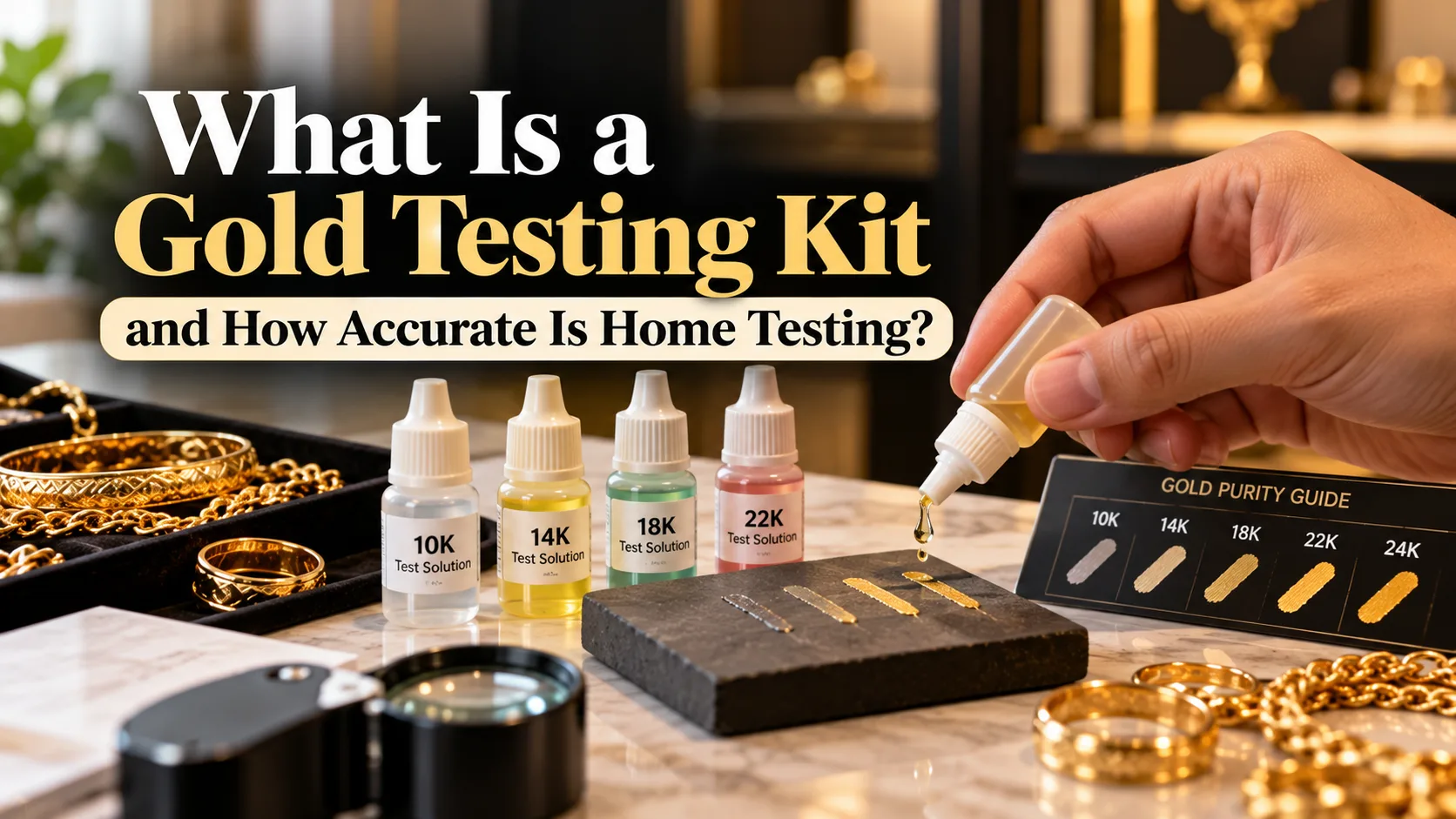
A typical gold test kit includes:
- Graded acids: Bottles marked 10K, 14K, 18K and sometimes 22K, for comparing a metal streak against known grades.
- Testing stone: Unglazed black basalt or slate that holds the streak.
- Comparison needles: Known-karat gold-alloy tips that help you judge reactions side by side.
- Jeweller’s loupe: Usually 10x magnification or higher for examining tiny marks and wear.
- Optional digital scale: Helps you check weight, but does not measure purity by itself.
What the Karat Stamps Mean
Karat describes the gold proportion in an alloy, and fineness marks express that proportion per thousand. If you want the full breakdown of what each grade actually contains, see our guide on gold purity explained.
Stamp | Karat | Gold content |
417 | 10K | 41.7% |
585 | 14K | 58.5% |
750 | 18K | 75.0% |
916 | 22K | 91.6% |
999 | 24K | 99.9% |
A plain 585 stamp can be faked. An official hallmark bearing recognized assay-office marks offers stronger assurance than an isolated purity number. See the official hallmarking guidance.
The Three Types of Gold Testing Tools
A higher price does not necessarily mean a test can see inside an item.
Acid Test Kits
A gold acid test compares the reaction of a metal streak with solutions intended for different karat grades. A surviving streak suggests the sampled metal meets that grade; fading suggests otherwise. A shallow streak can miss plating, and rubbing jewellery on the stone may mark it.
Basic Canadian kits may cost around $20–$50 CAD, while larger multi-bottle sets can exceed $90 CAD.
Electronic Gold Testers
An electronic gold tester, sometimes advertised as a gold tester machine or gold testing machine, estimates karat using electrical measurements such as resistivity. Results can appear within seconds without an obvious scratch.
Dirt, worn probes, alloy differences and thick plating can distort the reading. Canadian devices vary widely; some cost several hundred dollars, and a verified professional-style listing exceeds $450 CAD.
XRF Analysers
An XRF gold tester uses X-ray fluorescence to estimate the elements in a tested area without removing metal. These professional instruments cost thousands of dollars.
XRF mainly measures near-surface composition. It may identify thin coatings, but thicker plating can hide the base metal.
How to Use a Gold Acid Test Kit
Follow the maker’s instructions; scratches can reduce jewellery value.
Step by Step
- Inspect the hallmark with a loupe and note the claimed grade.
- Clean the item to remove grime and residue.
- Make a firm streak on a clean testing stone, using an inconspicuous part.
- Start one grade lower than the marked karat, following your kit’s guidance.
- Apply one drop of the matching solution to the streak, not the jewellery.
- Observe for the specified time, often 20–30 seconds, before interpreting it.
- Test higher grades on fresh streaks, comparing known-karat needles to bracket the result.
If a streak remains, the sampled metal may meet that grade. Fading suggests lower purity; immediate disappearance suggests little gold in that streak. Plating can still mislead you.
Safety and Disposal
Testing solutions may contain nitric acid and other corrosives. Wear goggles and chemical-resistant gloves appropriate to the product, work with suitable ventilation, and avoid skin contact. Never mix bottles or improvise spill neutralization. Store upright in original labelled containers, away from heat, sunlight and children.
Old solutions may give poor readings. Follow Health Canada’s chemical safety guidance and take waste acid to an approved household hazardous-waste facility, never down the drain.
How Accurate Is Home Gold Testing?
A gold purity tester can help screen jewellery, but no routine surface reading proves what an entire object contains. Learning how to test gold purity means understanding what each method measures.
Accuracy by Method
Costs are approximate Canadian estimates; professional assays are services.
Method | Detects fake gold | Estimates karat | Reads below surface | Destructive | Typical cost (CAD) |
Hallmark check | Clues only | Marked grade | No measurement | No | Free-$20 |
Magnet test | Some magnetic fakes | No | Can respond to magnetic core | No | $5-$20 |
Ceramic streak | Some obvious fakes | No | No | May Scratch | Free-$10 |
Acid kit | Many unsuitable alloys | Approximate | If deeper metal is sampled | Slightly | $20-$100+ |
Electronic tester | Some inconsistent alloys | Approximate | Device-dependent | Usually no | Several hundred |
XRF | Many surface mismatches | Surface composition | Shallow, coating-dependent | No | Thousands |
Specific gravity | Some density mismatches | No | Overall density only | No | Equipment-dependent |
Fire assay | Composition of sample | Highly precise | Sample Only | Yes | Professional quote |
A magnet cannot measure purity. Fire assay measures only its representative sample.
What Home Testing Does Well
On clean, uniform, uncoated jewellery, acid tests can often distinguish broad grades such as 10K, 14K and 18K. Visual inspection and magnet checks can flag obvious costume pieces.
Together, they help sort inherited jewellery, but do not prove authenticity.
Where the Accuracy Ceiling Sits
An acid kit reacts with metal transferred onto the stone. If the streak contains only outer gold plating, it may pass even when the core is brass. Exposing deeper metal can reveal the problem but damages the jewellery.
Electronic readings also depend on the area measured. XRF may recognize some coatings yet miss thicker ones. Tungsten is especially difficult for density checks because its density is close to gold’s.
Professionals can combine surface readings with density, ultrasound and sampling.
Where Home Gold Tests Give the Wrong Answer
- Heavy plating or gold-filled jewellery: Surface gold survives testing even when a different metal lies underneath.
- Tungsten-cored bars or coins: Near-matching density can defeat simple weight and specific-gravity checks.
- Rhodium-plated white gold: A surface coating changes what the test touches and may distort results.
- Old or contaminated acids: Changed reactions can lead to the wrong grade.
- An unclean testing stone: Previous metal residue can affect a fresh streak.
- Acid that’s too strong: The streak may disappear before you can compare lower grades.
- Soldered joins or clasps: Their alloys may differ from the main body; test a representative area instead.
If tests conflict, seek another method instead of averaging results.
When You Need Professional Verification
Get professional verification for high-value jewellery, bullion, a significant inheritance, or anything being insured. It’s also sensible when you need an exact karat to agree on a sale price, home tests disagree, or the piece seems hollow, layered or unusually heavy.
A home kit is a useful first screen, but professional tools go further. This is exactly how GTA Gold Buyers tests gold in store, using an XRF analyser you can watch, measuring overall density, and checking suitable bullion for hidden cores. Once purity is confirmed, you can work out how much your gold is worth before you decide to sell your gold. Verifying first also protects you from fakes and lowball offers when it comes time to sell.
Ask for an explanation and, where practical, testing in your presence.
How to Choose a Gold Testing Kit
Pick a gold testing kit that matches the pieces you’ll examine, not the box with the most accessories.
- Right acid grades: 10K–18K covers many everyday jewellery pieces. Add 22K and, where the manufacturer provides a suitable method, 24K capability for higher-purity imported items. Don’t use a home result to certify bullion.
- Fresh solutions: Check dating, seals and storage instructions; avoid bottles with an unknown history.
- Real stone: Choose unglazed basalt or slate, not a plastic substitute.
- Comparison needles: Known-karat reference alloys help make results more consistent.
- At least a 10x loupe: Inspect stamps, wear and suspicious joins.
- Replacement acids: Buy bottles you can replace individually rather than keeping degraded solutions.
Fresh reagents matter more than extra accessories.
Conclusion
A gold testing kit can screen many fakes and estimate karat on suitable jewellery, but it is not a certificate of purity. Combine a careful test with hallmark inspection and a weight check. For bullion, valuable inheritance or jewellery with possible plating, seek professional verification before relying on the result to buy, sell or insure it.
FAQ
How accurate is a gold testing kit?
On clean, solid gold, an acid kit can usually estimate broad karat grades and flag many fakes. Thick plating and hidden cores can defeat a surface test, so the result is an estimate, not proof of purity.
Can a gold testing kit damage my jewellery?
Yes. Making a streak on a testing stone may leave a scratch. More invasive testing can remove plating or metal. Avoid testing delicate, antique or high-value pieces yourself if even minor damage matters.
Does real gold stick to a magnet?
Gold is not ferromagnetic. Strong attraction usually points to another magnetic metal, though clasps may contain separate components. Some counterfeits are also nonmagnetic, so a magnet cannot establish authenticity.
How do I test gold purity at home without acid?
Inspect the hallmark and wear, compare size and weight, and try a magnet to spot certain fakes. An electronic device adds another clue. None of these methods alone reliably establishes exact gold content.
Is an electronic gold tester better than an acid test kit?
Electronic testers are cleaner and usually avoid scratches, but surface conditions and plating can distort readings. Acid kits cost less and offer useful comparisons. Neither method guarantees a solid-gold interior.
How long do gold testing acids last?
Shelf life varies by formulation and storage. Follow manufacturer guidance, keep bottles sealed and replace suspect solutions.