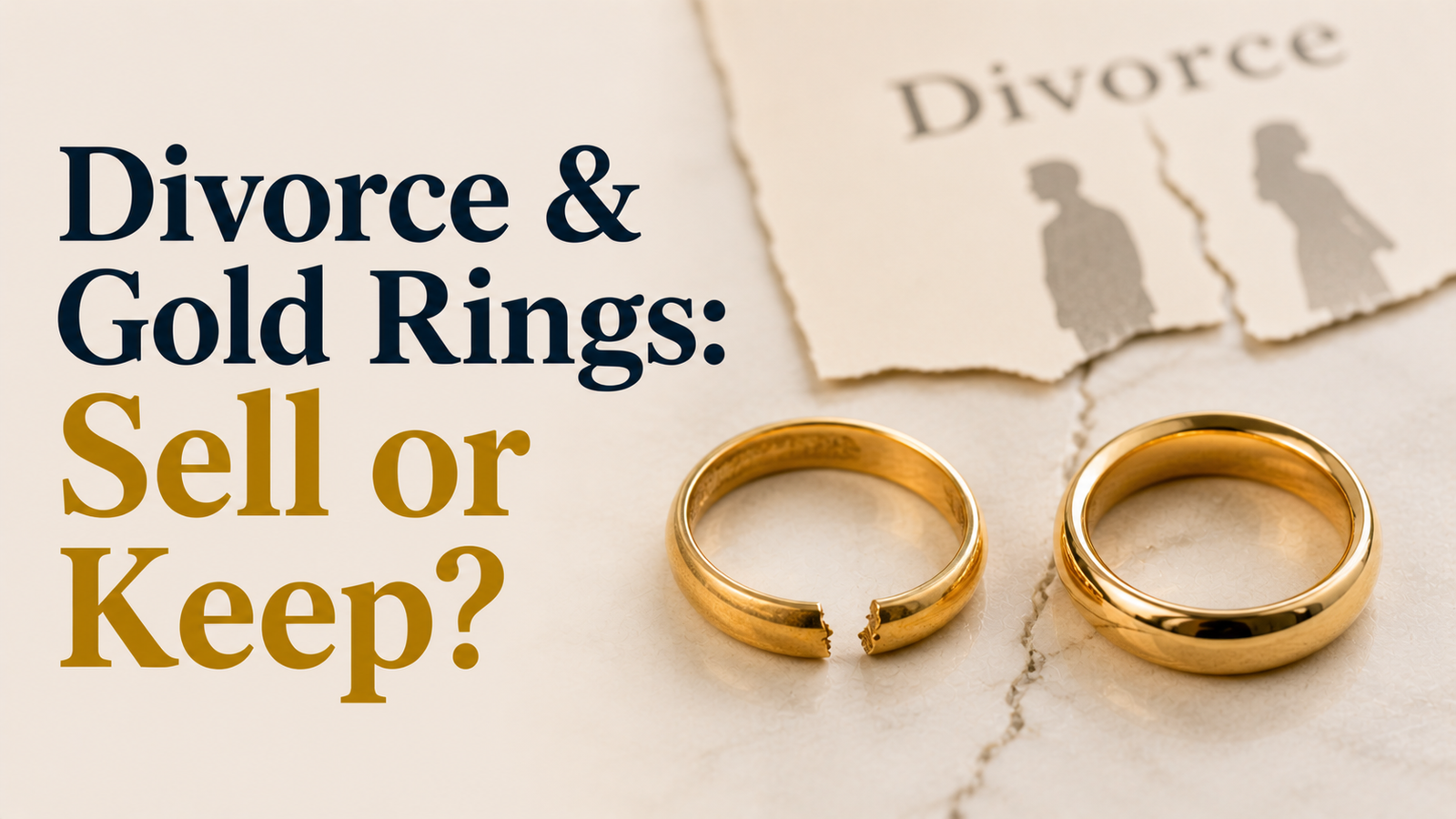
You can keep the ring, sell it, reuse it, or give it away after your divorce or breakup and if you were married, the ring is typically yours to decide what to do with. If you’re thinking about selling it, then you can sell a gold ring for real cash value after knowing what it is worth and where to sell it. This guide will take you through four options, as well as the legal question, honest pricing, and how to sell safely without undercutting.
You're not alone in wondering what to do with it
Perhaps the papers are signed and the ring is still in a drawer that you haven’t taken out of in months. Perhaps you haven’t reached that point yet. Both are normal a need to get rid of it when things are over and not wanting to handle it at all. There is no right answer and there is no deadline you’re missing.
What this article provides you with: a sense of clarity about your choices, a truthful answer to the question, ‘Who owns the ring?’, a realistic idea of the value of the ring—and if you do decide to sell a gold ring, how to do it without sacrificing profitability.
You're not alone in wondering what to do with it
The right thing to do is not the only thing that will do. Truthfully, the table is full of this and this and this…and this.
Keep it (or set it aside for now). There is no need to have a plan today. Many place the ring in a drawer or safe deposit box and think about it again months or years later when the excitement has worn off.
Sell it for cash. When the relationship is ended, the ring can be transformed into something more beneficial—money for a fresh start, debt repayment or closure.
Repurpose it into something new. The gold or stone can be changed into another type of ring altogether, so it’s no longer “the ring,” but your ring.
Donate it. There are a few organizations that do take gold jewelry donations—so that your memory can be spent on a cause you care about instead of a box of gold jewelry.
Who legally owns the ring after a divorce or breakup?
This is the question most people search for first, and the honest answer is, “It depends on your situation and your state.”
Married, then divorced. In most cases, once a couple marries, an engagement ring is treated as having satisfied its “condition”—the marriage happened—so it’s generally considered the recipient’s separate property going forward, not something that automatically gets split.
Engagement called off before marriage. Courts in many states treat an engagement ring as a conditional gift tied to the marriage taking place. If the wedding doesn’t happen, the ring is often expected to go back to the person who gave it, though this varies by state and by the circumstances of the breakup.
Exceptions worth knowing. Family heirlooms passed down through a giver’s family, terms spelled out in a prenuptial agreement, or a ring purchased with joint marital funds can all complicate the general rule above.
State differences matter. Community-property states and equitable-distribution states can treat marital versus separate property differently, and how “gift” law applies to engagement and wedding rings isn’t identical everywhere.
None of this is legal advice, and it isn’t a substitute for reading your state’s rules or talking to a family law attorney about your specific situation—for a general starting point, resources like the American Bar Association’s family law section (americanbar.org) outline how property and gift rules typically work. If there’s any real dispute, confirm your rights locally before you decide anything.
What is a gold ring actually worth when you sell it?
This is the part most emotional guides skip, and it’s where a lot of people get underpaid. A ring has two separate sources of value: the gold band and any diamond or gemstone set into it. They’re priced completely differently, and it helps to think of them as two separate sales.
The gold’s value comes down to karat purity times weight, priced against the current per-gram spot price of gold, which moves daily. A higher karat number means more pure gold in the piece, and therefore more value—18k is worth more per gram than 10k, for example.
Here’s the part that surprises people: resale value is based on melt, or scrap, value—what the raw gold is worth—not what was originally paid for the piece. A custom setting that cost a lot at retail is, in most cases, still melted down to scrap gold by the buyer regardless of the craftsmanship. And many buyers, especially convenience-focused ones, offer roughly half of true scrap value, so it pays to know the real number before you accept an offer.
Diamonds and other gemstones follow their own logic and typically resell for far less than retail price—often a fraction of what was originally paid, since resale value is driven by the wholesale diamond market, not sentimental or retail pricing. For a sense of how appraisers evaluate a stone’s fair market value, GIA’s consumer education resources (gia.edu) are a useful starting point.
The same math applies whether it’s a chain, a gold ring, or another piece of gold jewelry from the relationship it’s still gold priced by weight and purity, plus any stone value on top.
Where to sell a gold ring and where not to
Where can I sell my gold, and where can I find a buyer near me? You have four realistic paths, and they don’t all pay the same.
Local jewelers and gold buyers near you. Many local jewelers buy gold even if you didn’t purchase it from them, and some will test karat and weight on the spot. Pricing varies a lot by shop, so it’s worth calling ahead and comparing more than one.
Online jewelry and diamond buyers Mail-in buyers often pay competitively for both the gold and any diamond, since they deal in volume, but you’re sending a personal item through the mail. Look for insured shipping and a firm quote before you commit.
Pawn shops (fast cash, usually the lowest offer). Pawn shops are the most convenient option if you need money quickly, but they typically offer the least, since they’re pricing in resale risk and turning offers around fast.
Auction, consignment, or a private sale. For a ring with a notable stone or design, an auction house or consignment jeweler can sometimes get closer to full market value, though it takes longer and isn’t guaranteed to sell.
Whichever route you choose, get more than one quote. Offers on the same ring can vary significantly from buyer to buyer.
How to sell your ring safely and get a fair price
If you’ve decided to sell a gold ring, a few simple steps protect you from being underpaid.
Step 1—Know what you have. Check for a karat stamp inside the band (10k, 14k, 18k) and weigh it if you can. If you have the original receipt, appraisal, or a diamond’s grading certificate, dig it outit strengthens any offer you get.
Step 2—Get it valued or appraised. An independent appraisal separates the gold value from the stone value, so you’re not relying on a buyer’s word alone.
Step 3—Collect multiple offers. Get quotes from at least two or three sources—a local jeweler, an online buyer, maybe a pawn shop before accepting anything.
Step 4—Check the buyer and read the terms. Confirm reviews and credentials, and understand how you’ll be paid, whether the offer is final, and what happens if you decline.
If you're not ready to sell: repurpose or hold
Selling isn’t the only ending to this story.
The diamond or center stone can be reset into a pendant, a right-hand ring, or a pair of earrings something that’s unmistakably yours, with no history attached. Some people set it aside to give to a child years down the road or simply as a personal keepsake rather than a wearable piece.
And holding onto it for now, with no plan at all, is a completely legitimate choice. There’s no timeline you owe anyone, including yourself.
Your ring, your decision
Keep, sell, repurpose, or donate every one of these is a valid way to close this chapter, and only you know which one feels right. If you do decide to sell, you now know how to get it appraised, gather a few offers, and choose a reputable buyer instead of taking the first number you’re handed. Whenever you’re ready, it’s worth finding out what the ring is actually worth before you decide anything at all.
FAQ
Do I legally have to give the ring back after a divorce?
Generally, no. Once a marriage takes place, an engagement ring is typically treated as a completed gift belonging to the recipient in most states, meaning it isn’t automatically returned or split in divorce. Rules vary by state and by agreements like prenups, so confirm with a family law attorney if there’s any dispute.
How much is my gold ring worth if I sell it?
It depends on the karat purity and weight of the gold, priced against the day’s spot price, plus separately the value of any diamond or gemstone. Resale offers are typically based on scrap/melt value for the metal, not the original purchase price, so getting it weighed and appraised is the only way to know a real number.
Can I sell a wedding ring while the divorce isn't final?
It’s usually safer to wait until property division is settled or clearly agreed upon, especially if ownership of the ring could be disputed as part of the divorce. If there’s no disagreement about who it belongs to, some people do sell earlier but check with your attorney if you’re unsure.
What is a gold ring's price per gram in Canada (CAD)?
Gold is priced globally in troy ounces and converted to local currency and per-gram rates, so the CAD price moves daily along with the international spot price. A local jeweler or gold buyer can give you the current per-gram rate in Canadian dollars at the time you’re ready to sell.