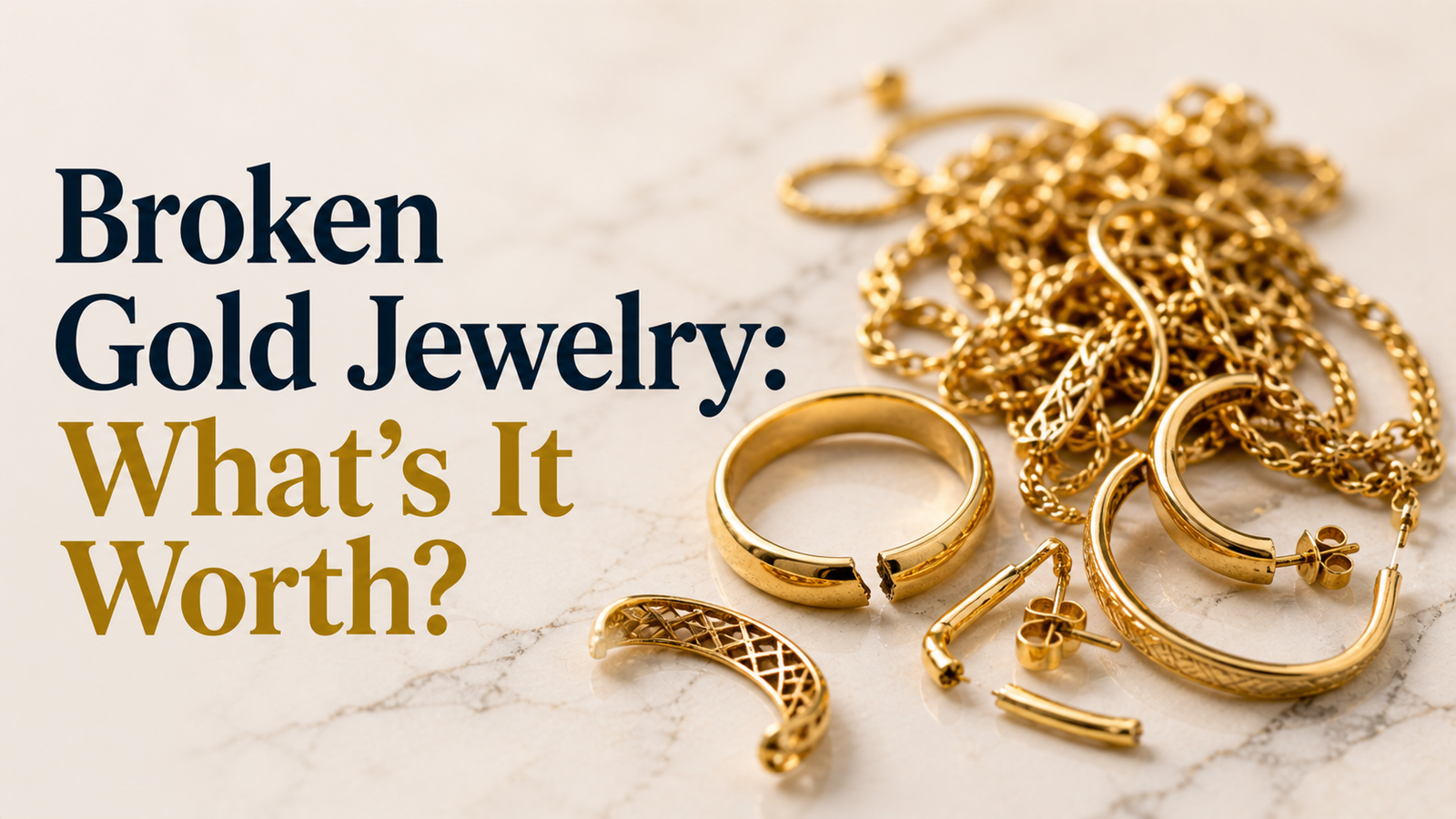
Only one earring on the back of your jewelry box, no pair. A long chain that’s been stored in a drawer for years, perhaps even years, with a broken clasp. There is a ring in the stack that is bent or has a missing stone. It’s easy to think that nothing’s worth fixing; that it’s too mangled, too ruined, too unwhole to be worth anything. This is incorrect. This guide explains exactly what constitutes scrap gold, what scrap gold prices are really based on, and what you can expect your pieces to be worth before you even end up anywhere.
What Counts as Scrap Gold?
In the beginning, it’s the stuff that everyone forgets to wear: a single earring not matched and a choker that’s gotten tangled or broken, but no one’s worn in years. These are both considered scrap gold, period. So is pretty much anything that’s not in use or on display and has a gold finish. The complete list is:
- Single or mismatched earrings—lost the other half of a pair years ago? It still has full value on its own.
- Tangled or broken chains—a snapped clasp or a knot you gave up on untangling doesn’t reduce the gold content.
- Bent, cracked, or stone-missing rings—a ring that’s lost its center stone or been bent out of round is still gold underneath.
- Class rings, dental gold, and damaged coins or charms—anything with real gold content qualifies, regardless of its original purpose.
The rule of thumb is simple: anything that is gold and you don’t own or use is “scrap”. Purchasers don’t buy jewelry; they buy the metal.
Why Broken or Mismatched Jewelry Still Has Real Value
This is where they get confused. While it seems obvious that a necklace that is broken or an earring that is lost should be less valuable than an intact necklace or earring, it does not work that way with scrap gold pricing. Just condition and completeness are not a part of the equation.
Scrap buyers are willing to pay for the melt value, thus paying for the gold material itself, not the working, the pattern, or whether the set is complete or not. A tangled chain of the same karat and weight is as valuable as a clean one of the same karat and weight in scrap. This is done by having only one earring worth half of the pair, each still being valued at the same price per gram.
One caveat: The Only exception to this is pieces that are significant for reasons other than their gold content, such as a genuine antique, a signed designer piece, or a well-known collectible coin. If there is a possibility a piece could be in that category, it’s best to have it appraised individually before melting it down.
How Scrap Gold Prices Are Calculated
Purity (karat). The gold jewelry is not usually 24-karat (pure) gold, but is rather alloyed with other metals so as to be a bit more durable. The karat marking tells you the purity: 10K is approximately 41.7% pure gold, 14K is approximately 58.3% pure, and 18K is approximately 75% pure. Typically, the stamp is small and found on the clasp, inside of a ring band, or on the post of an earring.
Weight. Scrap is measured in grams or penny weights (1 penny weight = 1.555 grams). A kitchen or postal scale won’t be precise enough—you’ll need a jeweler’s scale to get an accurate measure, and you’ll need one too to get a more accurate estimate of yourself.
Live spot price of gold. This is the actual price for pure gold, which continually fluctuates during the trading day. No decent buyer will be willing to pay the spot price for scrap gold; instead, they will be willing to pay a percentage of the melt value, which will include their own margin and the refining costs, so be prepared for any quotes to be below the total calculation.
Put together, the formula for gold scrap value looks like this:
(Karat ÷ 24) × Weight in grams × Spot price per gram = Melt value
So a 14K chain weighing 5 grams, at a spot price of roughly $140 per gram, works out to (14 ÷ 24) × 5 × $140 ≈ $408 in melt value—before any buyer’s percentage is applied. Live gold spot prices shift daily, so always check a current figure rather than relying on a number from an older article.
What Your Scrap Gold Might Be Worth
So how much is scrap gold worth in practice? Here’s a rough per-gram estimate by common karat, based on gold trading near $4,353 per troy ounce (about $140 per gram of pure 24K gold) as of mid-August 2026:
| Karat | Approx. Purity | Est. Value per Gram (USD)* | Est. Value per Gram (CAD)* |
|---|---|---|---|
| 10K | 41.7% | ~$58 | ~C$81 |
| 14K | 58.3% | ~$82 | ~C$113 |
| 18K | 75% | ~$105 | ~C$146 |
Estimated melt value only, based on spot price at time of writing. This is not what a buyer will offer it’s the ceiling before their percentage or margin is applied.
These numbers move with the market, so treat them as a ballpark. For a live, personalized number based on your exact pieces and today’s spot price, use our scrap gold calculator.
Getting Your Pieces Ready to Sell
A little prep before you get quotes makes the process faster and helps you spot a lowball offer.
- Sort by karat stamp. Group your pieces by 10K, 14K, or 18K—mixed lots make it harder to verify what you’re actually being offered.
- Separate stones, clasps, and non-gold components. Gemstones and non-gold hardware don’t factor into melt value and can throw off a weight-based estimate.
- Weigh everything with a digital scale. Getting a baseline weight before you visit a buyer gives you a rough number to compare their quote against.
Where to Sell: Local vs. Online
Local jewelers and pawn shops offer speed—you can walk in, get a quote, and walk out with cash the same day. The trade-off is that payouts tend to run lower and it can be harder to see exactly how they arrived at their number.
Online and mail-in buyers typically provide a more itemized, transparent breakdown of weight, purity, and price per gram, along with insured shipping for your pieces. The trade-off is a slower turnaround usually several business days between mailing your gold and receiving payment.
Whichever route you choose, get more than one quote. Prices and margins vary enough between buyers that a second or third opinion is worth the extra few minutes.
Conclusion
Broken, tangled, or single doesn’t mean worthless. Scrap gold value is about purity and weight—nothing else. That lone earring and that knotted chain in your drawer are worth bringing in, even if they look like the least sellable things in your jewelry box.
Ready to find out what your pieces are actually worth? Get a free scrap gold quote or run your items through our calculator for a live, personalized estimate.
FAQ
Does a single earring with no match count as scrap gold?
Yes. A single earring is valued the same way as any other piece—by its karat and weight. Missing its pair doesn’t reduce its melt value at all; it’s simply priced as half of what the original set weighed.
Does a tangled or broken chain lose value because it's damaged?
No. A broken clasp, a knot, or a snapped link doesn’t affect melt value. Buyers are paying for the gold content, not whether the chain still functions as jewelry, so damage has no bearing on the price.
Is dental gold treated the same as jewelry?
Yes, as long as it’s genuine gold. Dental gold is typically a higher-karat alloy and is priced using the same karat-and-weight formula as rings, chains, or earrings—it’s simply a different source of scrap.
Are scrap gold prices different in Canada?
The underlying math is identical—purity times weight times spot price—but Canadian buyers price and pay out in CAD, and the spot price is converted from its USD benchmark. Always confirm whether a quoted price is in USD or CAD before comparing offers.