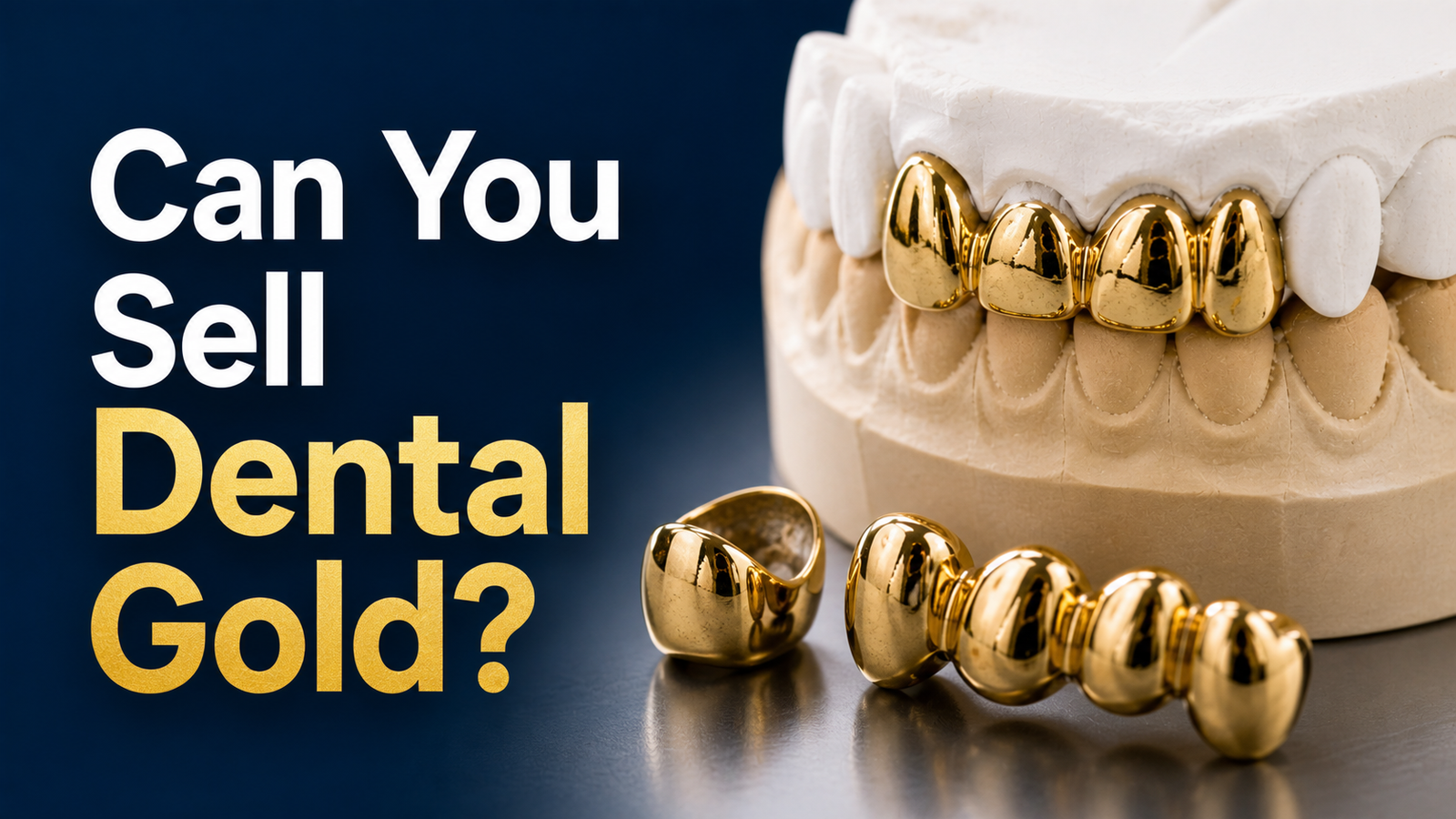
Yes, it is possible to sell dental gold. When dental work is extracted and no longer serves a useful function, it isn’t trash but rather a source of raw materials. Its worth is set by the same things that price any scrap metal: weight, purity, and the current scrap gold prices on the day you sell.
If you have an old crown in a drawer, or maybe your dentist gave you a little bag of metal after you got a new crown, then you may have two questions: Can this be sold at any time, and what’s it worth? Both have straightforward answers, and below is the honest math behind them, so you don’t have to take a chance, guess, or accept the first offer from a stranger!
Can You Actually Sell Dental Gold?
Yes. Most items that are worn as a crown, bridge, gold inlay/onlay, gold filling, or even old gold teeth or grills have sellable precious metals in them. That also applies to porcelain-fused-to-metal (PFM) crowns, which are tooth-colored but are not a disqualifier because it is a normal part of refining to separate the metal from the porcelain. Don’t chip, grind, or clean anything off to sell.
Usually things that are not worth much include all-ceramic or zirconia crowns (no metal core whatsoever) and base metal alloys like nickel chromium (when money is the key issue rather than biocompatibility). If the metal is under the porcelain, the quickest way to determine if it is gold or silver-gray is to look at the color of the crown-although again, only after actually weighing and testing can a real answer be given. Regardless, there is no difference in the value of the piece if it doesn’t look the same as it did when it came out of the assay process, but it still has the same alloy and weight.
What Decides the Value of Scrap Dental Gold
Once you are aware of them, the process doesn’t seem like a mystery any longer, and the price of any piece of dental gold can be understood.
Weight. Dental scrap is weighed in grams, and the number on the scale is for the entire piece, including the porcelain, cement, and tooth structure, which have no metal value. A buyer estimates the total weight of the whole piece and subtracts the weight of the non-metal part (or requests its removal) before quoting a price.
Karat and alloy purity. Dental gold is not always of a high degree of purity. The alloys used in crowns and bridges are usually between 10K and 22K, with average crowns landing around 11K to 16K, and are often mixed with other precious metals such as palladium, platinum, or silver. Unlike most jewelry, where the karat indicates the full story, dental alloys are custom blends and the actual gold and other precious metal contents will vary from piece to piece.
The live scrap gold price. Gold is sold across the world, and the price of gold will fluctuate from day to day and hour to hour; you can see the continually updated price on sources like the live gold price chart on JM Bullion. Dental gold, no matter how heavy or pure, can never be worth any more than its value at today’s price.
Put together, the formula is simple: gold scrap value = pure metal content × spot price × payout percentage. That last variable-the payout percentage a buyer actually offers you against the melt value-is where offers differ the most, and it’s the piece most sellers never think to ask about.
Crown, Bridge & Filling Value: A Quick Reference
Dental Alloys are highly variable, so the exact values can only be given after an actual assay of the specific alloy being used. But an understanding of the general range of where each restoration lies can set expectations before you get an offer.
| Restoration | Typical Gold/Alloy Content | Rough Value Expectation |
|---|---|---|
| Single crown (PFM or full-cast) | ~10K–16K, often with Pd/Pt | Low, sometimes into moderate tens of dollars |
| 3+ unit bridge | ~10K–16K, more total metal weight | Moderate to higher—weight adds up fast |
| Gold inlay/onlay | ~14K–18K, smaller piece | Low, often just a few dollars each |
| Older gold filling | Varies widely, sometimes higher karat | Very low individually |
| Modern composite/ceramic filling | No gold content | Essentially none |
A bridge is usually worth more than a single crown, simply because it holds more metal across its multiple units. A single filling is usually worth very little on its own; several combined may reach a worthwhile amount. View each of these numbers in a directional way-only the piece can be weighed and tested to determine an exact number.
A Worked Example: How the Dollar Figure Is Calculated
This is the section that most people skip, so here is the actual math from start to finish. Below are all examples of numbers, which you can replace with today’s actual spot price, your actual piece weight, and your actual karat.
Step 1: Weigh it. If there are 3 grams of metal, including a little bit of attached porcelain (which is then deducted), then it is about 2.2 grams.
Step 2: Convert karat to pure gold content. If the alloy tests at 16K, that’s about 66% pure gold (16 ÷ 24). So 2.2 grams × 0.66 ≈ 1.45 grams of pure gold content.
Step 3: Apply an illustrative spot price. For the sake of the example only, say gold is trading at $2,600/oz, or a troy gram-equivalent of roughly $83.60/gram. That gives 1.45 grams × $83.60 ≈ $121 in pure melt value. (Use whatever the live price actually is on the day you sell-this number is just for showing the method.)
Step 4: Apply a realistic payout percentage. A specialist refiner, working from an assay report, may pay in the 70-85% range of melt value as compared to a much lower cut from a quick weigh-and-pay counter offer. At 78%, that’s about $121 × 0.78 ≈ $94 take-home on this one crown.
Compare that to a flat “we pay $30 per crown regardless of size” offer—a common tactic at cash-for-gold counters-and you can see exactly how much gets left on the table when a buyer skips the weight-and-karat math entirely.
Jewellery, scrap metal, and lower-purity gold can be treated differently and may be subject to GST/HST. Commercial buyers or retailers generally handle the applicable sales tax requirements.
Where to Sell: Local Buyers vs. Mail-In Refiners
There’s no single best place to sell-it’s a trade-off between speed and maximum return, and the right answer depends on how much you have and how much effort you want to put in.
| Selling Route | Speed | Typical Payout | Best For |
|---|---|---|---|
| Pawn shop / cash-for-gold | Fastest, walk in the same day | Usually the lowest, weigh-and-pay risk | Small amounts need cash now |
| Local jeweler | Fast, but variable | Inconsistent, may not test dental alloys properly | A quick second opinion |
| Specialist mail-in refiner | Slower ship, wait for assay | Usually the highest, assay-based | Larger amounts or several pieces combined |
Convenient though they are, pawn and cash-for-gold shops offer the lowest pay, and many don’t know how to perform an actual assay; the crown in the above example lost about two-thirds of its worth by taking a flat per-crown offer instead of an assay-based one. As for local jewelers, some can perform an accurate test, while others are not equipped to test dental alloys at all. Specialist mail-in refiners will normally perform the actual assay and will offer a payout percentage based on melt value (which usually pays out more), but of course, it will take longer to ship and will require a bit of patience.
Whichever route you choose, check a few things before handing anything over: do they assay it or just eyeball it; is the payout percentage disclosed up front; what are the processing or shipping fees; is mail-in shipping insured and tracked; and what happens if you decline the final offer.
How to Get the Best Price for Your Dental Gold
- Weigh it yourself first on a kitchen or postal scale, even roughly-it’s your baseline for sanity-checking any offer.
- Check today’s scrap gold price before you sell, since a quote from last month is already stale.
- Insist on an assay, not a per-crown guess. A real test of your alloy’s purity is the only way to get an accurate number.
- Get at least two offers-one local, one from a mail-in refiner-and compare the payout percentage, not just the dollar figure.
- Don’t clean or strip the porcelain yourself. Refiners handle separation as part of processing, and doing it yourself risks losing metal.
- Combine smaller pieces like loose fillings into one batch if you have several, since many buyers have practical minimums.
Conclusion
Dental gold is really sellable, and its value is not obscure when you know the formula: weight × purity × today’s scrap gold prices × the payout percentage of the buyer. Whether the buyer performs an actual assay or just eyeballs it is the real difference between a fair sale and a lowball. If you accept the initial quote you receive, you may have no real sense of what the piece is actually worth before you hand it over. Before you accept, compare it with a quote based on an assay or run the numbers through a scrap gold calculator using the current spot price.
FAQ
How much is scrap gold worth per gram right now?
It changes daily with the market, so there’s no fixed number-check a live spot price source and multiply by your metal’s purity (karat ÷ 24) to get pure gold value per gram, then factor in the buyer’s payout percentage for your actual take-home.
Are gold fillings worth selling?
Individually, often not much-many fillings are small and lower in gold content, and modern fillings are frequently non-gold composite or ceramic. It’s usually worth checking, but don’t expect a large payout unless you’re combining several fillings together.
Do I need to remove the porcelain from a crown before selling?
No. Refiners separate metal from porcelain as a standard part of processing, and trying to remove it yourself risks losing metal or damaging the piece. Sell it as-is and let the buyer or refiner handle separation.
Will a pawn shop give a fair price for dental gold?
Sometimes, but pawn shops and cash-for-gold counters commonly rely on quick visual estimates rather than a real assay, which tends to undervalue dental alloys. They’re convenient for fast cash, but rarely the highest offer available.
Can I sell dental gold in Canada?
Yes the same weight-karat-spot-payout framework applies, though Canadian buyers and scrap gold pricing (including per-gram rates by karat) can differ from US offers, so it’s worth comparing quotes locally rather than assuming a US price applies.