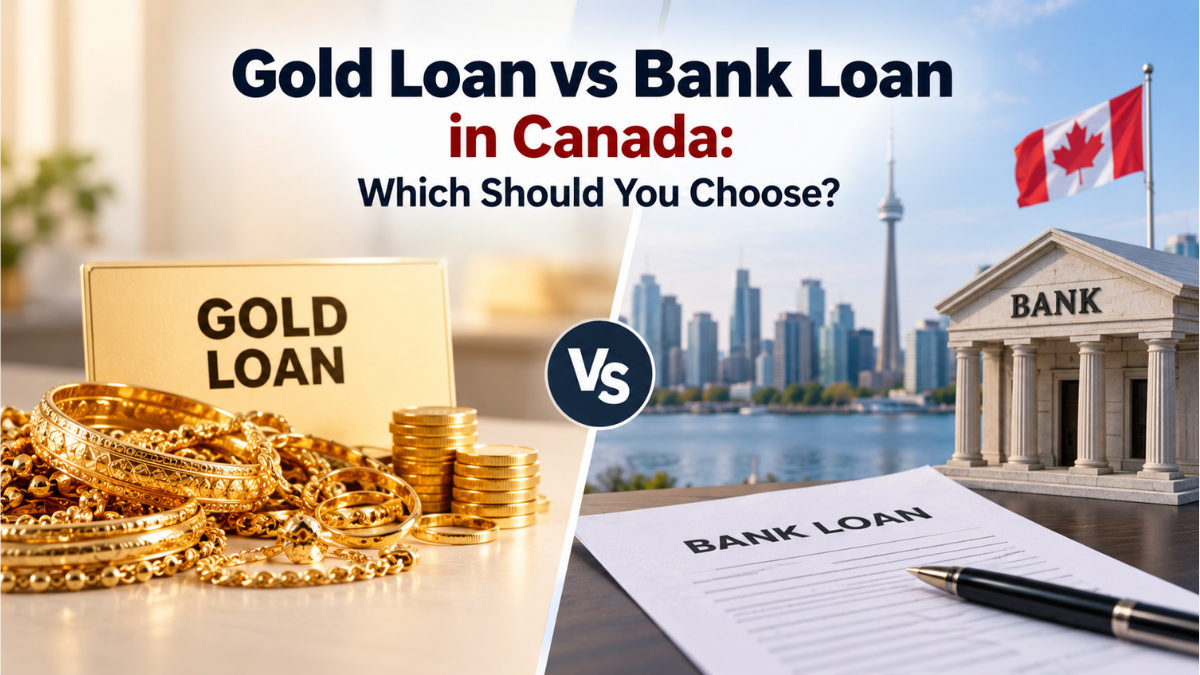
If you own gold and need cash, you have two realistic options: pledge the gold, or apply for a standard bank loan. Choosing between a gold loan vs bank loan in Canada comes down to what you have to offer a lender and how quickly you need the money. This guide lays out the differences in eligibility, rates, speed, and risk for a gold loan in Canada, then walks through the pros and cons of each so you can match the option to your situation. The comparison here applies across Canada, not to any single province or city.
What Is a Gold Loan?
A gold loan is a secured loan: you hand over physical gold, such as gold jewellery, gold coins, or bullion, and the lender advances you cash against it. Because the loan is backed by an asset the lender can sell if you default, the underwriting process leans on the gold itself rather than on your income history.
How gold is valued and stored
When you apply, the lender weighs and tests the gold to confirm its purity, then assesses its market value. You will not receive the full value in cash. Lenders apply a loan-to-value ratio, commonly shortened to LTV, which caps your loan at a percentage of the assessed value.
Who offers gold loans in Canada
A gold loan in Canada is not offered by the big retail banks in the way it is in some other countries. Instead, this niche is filled by specialist bullion dealers, pawn-style lenders, and a small number of credit unions that deal in precious metals. Because the market is less standardized than conventional bank lending, terms, storage practices, and fees can vary noticeably from one lender to the next, so it pays to compare more than one offer. Tenure on these loans tends to run shorter than a typical bank loan, and repayment is usually structured as either regular instalments or a lump-sum payoff at the end of the term, with interest accruing in the meantime.
What Is a Bank Loan?
- A conventional bank loan, in this comparison a personal loan, is the alternative most Canadians already know. In most cases it is unsecured, meaning you are not required to pledge any asset as collateral.
- Instead of assessing an object, the bank assesses you: your credit score, income, existing debt, and repayment history all factor into whether you are approved and at what rate. Because the bank is relying on your promise to repay rather than a physical asset it can seize and sell, the approval process is more document-heavy and can take longer.
- Bank personal loans typically offer larger amounts and longer tenure than a gold loan, and funds are usually disbursed as a lump sum by direct deposit once approval and paperwork are complete.
Gold Loan vs Bank Loan: Key Differences
| Factor | Gold Loan | Bank Loan (Personal) |
|---|---|---|
| Collateral required | Yes, physical gold is pledged | Usually none (unsecured) |
| Credit score impact | Minimal role in approval | Central to approval and pricing |
| Approval speed | Generally fast, often same day | Slower, depends on document review |
| Loan amount | Tied to gold’s assessed value and LTV | Based on income and creditworthiness |
| Typical tenure | Shorter term | Can be longer term |
| Risk if you default | Gold may be sold or auctioned | Debt collection and credit score damage |
| Availability | Specialist lenders, bullion dealers | Widely available through banks |
The biggest differentiator in a gold loan vs bank loan comparison is what the lender is actually relying on. A gold loan shifts the risk onto an asset you already own, which is why approval can move quickly and your credit score matters far less. The lender’s decision hinges on the metal in front of it, not the paperwork behind you, so someone with a thin or damaged credit file can still qualify as long as the gold checks out.
A bank loan works the other way around. It shifts the risk onto your future ability to pay, which is why the bank digs into your credit history and income before it commits, and why the process usually takes longer. That extra scrutiny is also what unlocks larger loan amounts and longer repayment windows, since the bank is underwriting your overall financial picture rather than a single asset sitting in a vault.
Speed and access are the gold loan’s strongest selling points; scale and flexibility of use tend to favour the bank loan. Exact rates and fees vary by lender, so treat any specific figure you see elsewhere as something to confirm directly with the provider before applying.
Interest Rates and Costs Compared
Gold loan interest rates in Canada are not set by a single national formula, and they are not published the way posted bank rates are, so it is worth understanding what actually drives the number a lender quotes you.
What affects your gold loan rate
Because a gold loan is secured, lenders can often offer more competitive pricing than they would on an unsecured product, since the collateral reduces their downside risk. Within that, your rate will move based on a few factors: the LTV you choose (a lower LTV can mean a better rate), the tenure of the loan, the type of lender you use, and the purity of the gold being pledged, since higher-purity gold is easier to value and resell. Any specific interest rate figure should be treated as needs verification with the individual lender rather than assumed from this article.
On top of interest, budget for additional costs: a valuation or appraisal fee, storage charges while your gold is held, and processing or administration fees. These add-ons can meaningfully change the real cost of borrowing, so ask for the full fee schedule up front, not just the headline rate.
Secured Loan vs Bank Loan: Understanding the Difference
Underneath the gold loan vs bank loan comparison sits a more basic distinction in lending: secured loan vs bank loan, or more precisely, secured versus unsecured borrowing.
A secured loan is backed by collateral, an asset the lender can claim and sell if you stop paying. A car loan, a mortgage, and a gold loan are all examples. An unsecured loan, which describes most personal bank loans and credit cards, has no such backstop; the lender is relying purely on your promise to repay and your credit profile.
This distinction is why secured borrowing often comes with easier approval and can price more competitively: the lender’s downside is limited by the value of the asset it holds. A gold loan is simply one specific type of secured loan, using gold as the pledged asset rather than a vehicle or a house.
Gold Loan Benefits (Advantages)
Gold loan benefits, or gold loan advantages, centre on speed and accessibility rather than scale. Here is where a gold loan tends to outperform a conventional bank loan.
- Minimal credit requirement: Because the loan is backed by gold, lenders place far less weight on your credit score or credit history, which helps borrowers who are self-employed, new to Canada, or rebuilding credit.
- Fast access to funds: Valuation and disbursal can often happen within the same day, since there is no lengthy income or credit review to complete.
- You keep ownership of the gold: Pledging is not selling. Once the loan and interest are repaid, the gold is returned to you in full.
- Flexible use of funds: Lenders typically do not restrict what the money is used for, which suits short-term needs like covering a cash-flow gap or an unexpected expense.
Gold Loan Disadvantages and Risks
Gold Loan Disadvantages and Risks
The other half of gold loan advantages and disadvantages is less flattering, and it deserves equal attention, since it is where a gold loan can go wrong for a borrower who is not prepared.
- Your gold can be auctioned or liquidated: If you default, the lender has the right to sell the pledged gold to recover what you owe, and you may not get any of it back.
- Valuation can be subjective: Assessed value depends on the appraiser and the lender’s methodology, so the amount you are offered can vary between providers for the same gold.
- Shorter tenure than many bank loans: You may need to repay faster than you would with a personal loan, which increases pressure if your cash flow does not recover quickly.
- Exposure to shifting gold prices: If gold prices move during the loan term, it can affect how the lender views the collateral.
- Dependence on the lender’s storage and security: You are trusting the lender’s storage and security arrangements to keep your gold safe for the duration of the loan.
Which Should You Choose? Gold Loan or Bank Loan
The right choice depends less on which product is “better” overall and more on your specific circumstances.
Choose a gold loan when
You already own gold you are comfortable pledging, you need funds quickly, your credit history is weak or limited, or you have a short-term need you expect to resolve soon.
Choose a bank loan when
You do not have an asset to pledge, you want a longer repayment tenure to keep monthly payments manageable, your credit score is strong enough to secure competitive terms, or you need a larger amount than your gold holdings would support.
Conclusion
At its core, the gold loan vs bank loan decision comes down to collateral and speed on one side against credit strength and tenure on the other. A gold loan trades ownership risk on a physical asset for speed and lighter credit requirements; a bank loan trades a longer application process for scale and flexibility. Before deciding, take an honest look at your gold holdings, your credit score, and how quickly you actually need the money, then match that to the option built for it.
FAQ
Can I get a gold loan in Canada?
Yes, though it is a narrower market than in some other countries. Gold loans in Canada are typically offered by specialist bullion dealers, pawn-style lenders, and a small number of credit unions, rather than by the major retail banks. Availability and terms vary by lender and region, so it is worth comparing a few providers before committing to one.
Which is better, a gold loan or a bank loan?
Neither is better in every case. A gold loan suits someone who owns gold, needs cash fast, and has weak or limited credit. A bank loan suits someone with strong credit who wants a longer repayment term or a larger loan amount and has no interest in pledging an asset.
What are the interest rates on a gold loan in Canada?
Rates vary by lender and depend on factors like the loan-to-value ratio you choose, the tenure, and the purity of your gold. Because a gold loan is secured, pricing can be more competitive than unsecured borrowing, but exact figures should always be confirmed directly with the lender rather than assumed.
Is a gold loan a secured or unsecured loan?
A gold loan is a secured loan. Your gold acts as collateral, which gives the lender a way to recover its money if you fail to repay, and this is part of why approval tends to be faster and less dependent on your credit score.