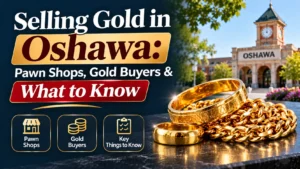
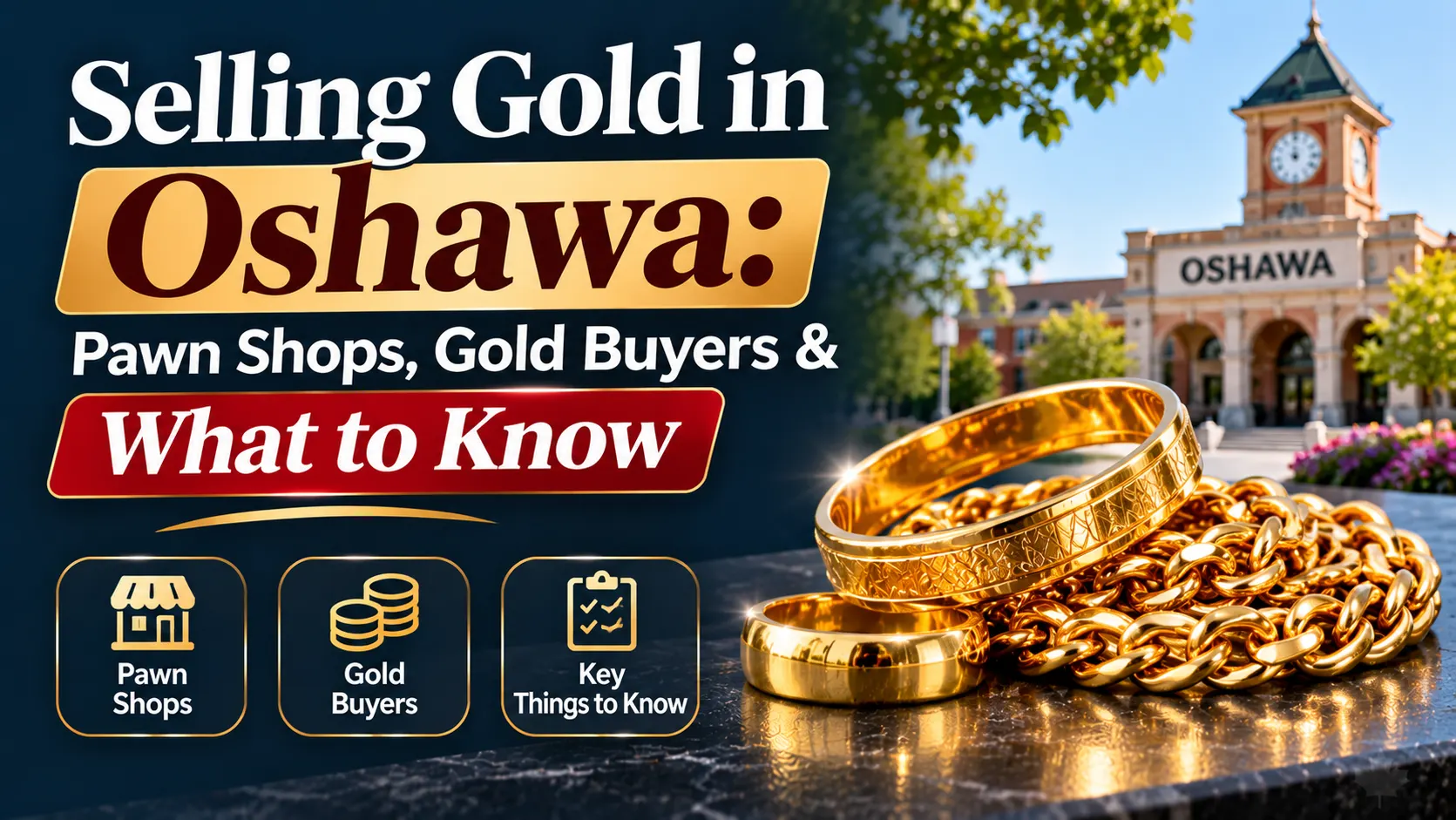
Somewhere in a drawer there is a tangle of chains, a single earring, and a ring that no longer fits, left behind by a relative or snapped years ago. If you live in Oshawa or anywhere in Durham Region, you have probably wondered what it is worth and who will give you a straight answer. Most people selling gold here have never done it before, and many assume the nearest pawn shop in Oshawa is their only option. It is one option of several.
This guide settles three things: where you can go, what a fair offer looks like, and what to bring to the counter. We make no promises about any specific payout, because no honest source can.
In Oshawa, you can sell gold to a licensed pawn shop, a dedicated gold or bullion buyer, or a jeweller. The offer depends on karat, weight, and the day’s gold price rather than the type of shop alone. The same chain can draw different offers because each buyer deducts different refining and handling costs. Collect two or three itemised written quotes, then sell to the one that is clear, fair and tests the item in front of you.
Your options for selling gold in Oshawa and Durham Region
There are three realistic routes for local sellers: a pawn shop, a dedicated gold buyer, or a jeweller or estate buyer. Each has a real strength and a real drawback, and the right one depends on what you are selling and how quickly you need to be done.
Pawn shops
Pawn shops are convenient and used to handling all kinds of items, so you can walk in with a mixed lot and get an answer the same day. They also offer loans against gold, which is useful if you only need short-term cash. The drawback is that a pawn shop’s business is broader than gold’s, so its gold buying may not be as specialised or as competitive as a buyer who does little else. Offers can vary a lot between shops.
Dedicated gold and bullion buyers
A buyer focused on precious metals typically has testing equipment on site and a clear process for weighing and valuing scrap, coins and bullion. That focus is the strength, especially for larger or higher-karat lots. If you are looking at selling gold in Oshawa, this is one option worth comparing with a pawn shop. The drawback is that some operate by appointment, and the quality of service differs, so a specialist label alone does not guarantee a good offer.
Jewellers and estate buyers
A jeweller can often identify a piece properly, which matters if it is worth more as an item than as scrap. The drawback is that many jewellers mainly sell new pieces, so they may buy gold only occasionally or offer store credit.
Businesses in Oshawa that buy or lend against gold and valuables include the following, listed by street and not ranked:
- Cash Connections, 245 King St W
- Durham Precious Metals, 378 King St W, Unit 101
- Hock Shop Canada, 1124 Simcoe St N
- Rock Bottom Deals, 22 Simcoe St N
Check each business’s own information before visiting to confirm what it currently buys and whether it offers pawn loans against gold. Compare quotes yourself rather than relying on any shop’s claims.
Pawning versus selling outright at an Oshawa pawn shop
A pawn is a short-term loan: your gold is held as collateral, you keep ownership, and you can redeem it later by repaying the loan with interest and fees. A sale is final: the item is gone, and you are paid once. At an Oshawa pawn shop, always ask whether you are being quoted for a pawn or a sale before anything else.
A pawn suits you if you need cash for a short time and want the piece back. Selling suits you if you are finished with the item. A pawn loan costs money to unwind, and the cost depends on the shop’s terms, so read them before you sign. If you want the piece back, compare the pawn’s terms with borrowing against gold instead of selling.
Pawn (loan) | Sell outright | |
|---|---|---|
Ownership | You keep it and can redeem it | Transfers to the buyer |
Payment | A loan amount, repaid with interest and fees | One payment, nothing owed after |
Cost to reverse | Interest and fees to get the item back | Not reversible |
Best for | Short-term cash need: you want the piece back | You are done with the item |
Risk | Unredeemed items can be forfeited | Gone for good once agreed |
How your gold's value is actually worked out
Value comes from three things: the karat, the weight and the day’s gold price, minus what the buyer deducts. Once you know the method, you can sanity-check any offer yourself.
Karat, weight and the day’s gold price
Karat tells you purity. 24K is pure gold, 22K is about 92 percent gold, 18K is 75 percent, 14K is about 58 percent, and 10K is about 42 percent. The Royal Canadian Mint explains how karats measure gold purity. Remember that a stamp is only a claim until it is tested.
Weight is measured in grams. Gemstones, clasps, and other non-gold parts do not count toward melt value, so a heavy ring with a large stone weighs less in gold than it feels.
Here is an illustrative example only, using a round placeholder price of $100 CAD per gram for pure gold. A 10 gram, 14K chain contains roughly 5.8 grams of pure gold, which at that placeholder price is about $580 CAD of gold content before the buyer’s deductions. The real price changes daily, so check the live figure on the day, using a current gold price per gram page, before you take any offer seriously.
How buyers test gold
There are two common methods. An acid test scratches a small mark and applies acid to see how it reacts. An XRF analyser reads the metal’s composition without damaging the piece. Either can be accurate in good hands. A good buyer tests in front of you, and you should be able to see the result.
What comes off the top
No buyer pays the full spot price. The gap covers refining, processing, and the buyer’s margin, and it varies from buyer to buyer. That is the real reason two offers on the same chain differ. The only way to know what is fair is to collect two or three written quotes.
What to bring and what happens at the counter
Bring government-issued photo ID and call ahead to confirm what the shop accepts. For a pawn transaction, Ontario’s Pawnbrokers Act requires the pawnbroker to record your name and address, along with details of any identification you provide. If you cannot or refuse to produce identification, the pawnbroker can record that fact instead. Second-hand dealers in Oshawa must also keep a transaction record and give you a receipt, but the city’s rules do not require every seller to show photo ID.
For a pawn, expect your name, address and a description of the item to be recorded. For an outright second-hand sale, the dealer must create a transaction record and give you a receipt that includes your signature and details of the item. Second-hand goods a dealer buys must be held for at least 21 calendar days before they can be altered, repaired or sold. This gives authorities time to trace potentially stolen goods.
Bring everything together, including broken pieces and single earrings, so the weight is assessed as one lot. Ask for the offer in writing, itemised by karat and weight. Keep your copy of the ticket or receipt in a safe place afterwards.
Comparing offers across Durham Region and Toronto
Offers differ between a Durham pawn shop and a Toronto gold buyer for ordinary business reasons: volume, refining relationships and overheads. If you are wondering about the best place to sell gold in Toronto, the honest answer is that no city or buyer type consistently pays more.
If you are looking at cash for gold Toronto buyers, weigh the realistic upside against the drive, the parking and the time, especially for smaller lots, where a modest difference may not cover the trip. Anyone wondering where to sell gold in Toronto should go there with quotes in hand rather than as a first step.
The practical rule is simple. Collect two quotes from Durham buyers before you consider the trip, and use them as your benchmark.
Red flags to walk away from
Walk away if you see any of these:
- A verbal-only quote, or a refusal to itemise by karat and weight
- Weighing or testing done out of your sight
- Pressure to decide immediately, or an offer that expires when you leave
- Fees or refining charges mentioned only after you accept the offer
- Door-to-door buyers and pop-up hotel buying events
Where can I sell my gold if I am not in Oshawa?
You can sell gold in any Durham Region community, including Whitby, Ajax, Pickering, Bowmanville and the rest of Clarington, though Oshawa is the practical hub for most of the region. Smaller towns usually have fewer buyers, so comparing quotes matters even more there. Use our guides to sell gold in Whitby, Ajax, Pickering, and Bowmanville.
Before you sell
The one habit that protects you is simple: get two or three itemised written quotes before you agree to anything. Take your time, compare them and sell only where the process is clear. When you are ready, start with our Oshawa gold buying service for a no-pressure look.
FAQ
Do pawn shops in Oshawa buy gold outright, or only pawn it?
Many do both, but you must ask which one is being quoted. A pawn is a loan you can redeem, while a sale is final. Confirm the terms in writing before handing over anything.
Where to sell gold in Toronto if Durham offers are low?
If two or three itemised Durham quotes feel low, you can get quotes from Toronto buyers too. Weigh the extra travel and time against the likely difference, and go with your Durham quotes in hand.
Do I need ID to sell gold at a pawn shop in Ontario?
Bring government-issued photo ID. For a pawn transaction, the pawnbroker records your name and address and details of any identification you provide. If you cannot or refuse to show ID, the pawnbroker can note that instead. For an outright second-hand sale, the shop has separate transaction-record and receipt requirements. Call ahead to confirm what the buyer accepts.
Will a buyer take broken or single pieces of gold jewellery?
Yes, broken chains, odd earrings and damaged rings are valued by gold content, not by whether they are wearable. Bring them in together so the weight is assessed as one lot.
Do I pay tax when I sell gold jewellery in Canada?
For most people selling inherited or worn jewellery, tax rarely comes up, but a gain above the item’s cost can be reportable. For inherited pieces, the cost is generally their value when you inherited them. Check with an accountant or the CRA, and see our guide to selling precious metals in Canada.