With gold prices reaching high levels, many Canadians are considering selling old jewellery, coins, bars, or other precious metals. That usually brings up two questions: will I owe tax, and how can I avoid getting a bad deal?
Whether you are selling an investment you have held for years or inherited gold from a family member, understanding the tax rules matters. So, is selling gold taxable in Canada? The answer depends on factors such as how you acquired the gold, what you paid for it, how much you receive when you sell it, and whether the gold is personal-use property or an investment. This guide outlines basic tax considerations and practical buying standards; however, it is provided for general informational purposes and does not constitute formal accounting or legal advice. Tax rules and figures can change, so verify your situation against current Canada Revenue Agency (CRA) guidance.
When Selling Gold Is Taxable (and When It Isn't)
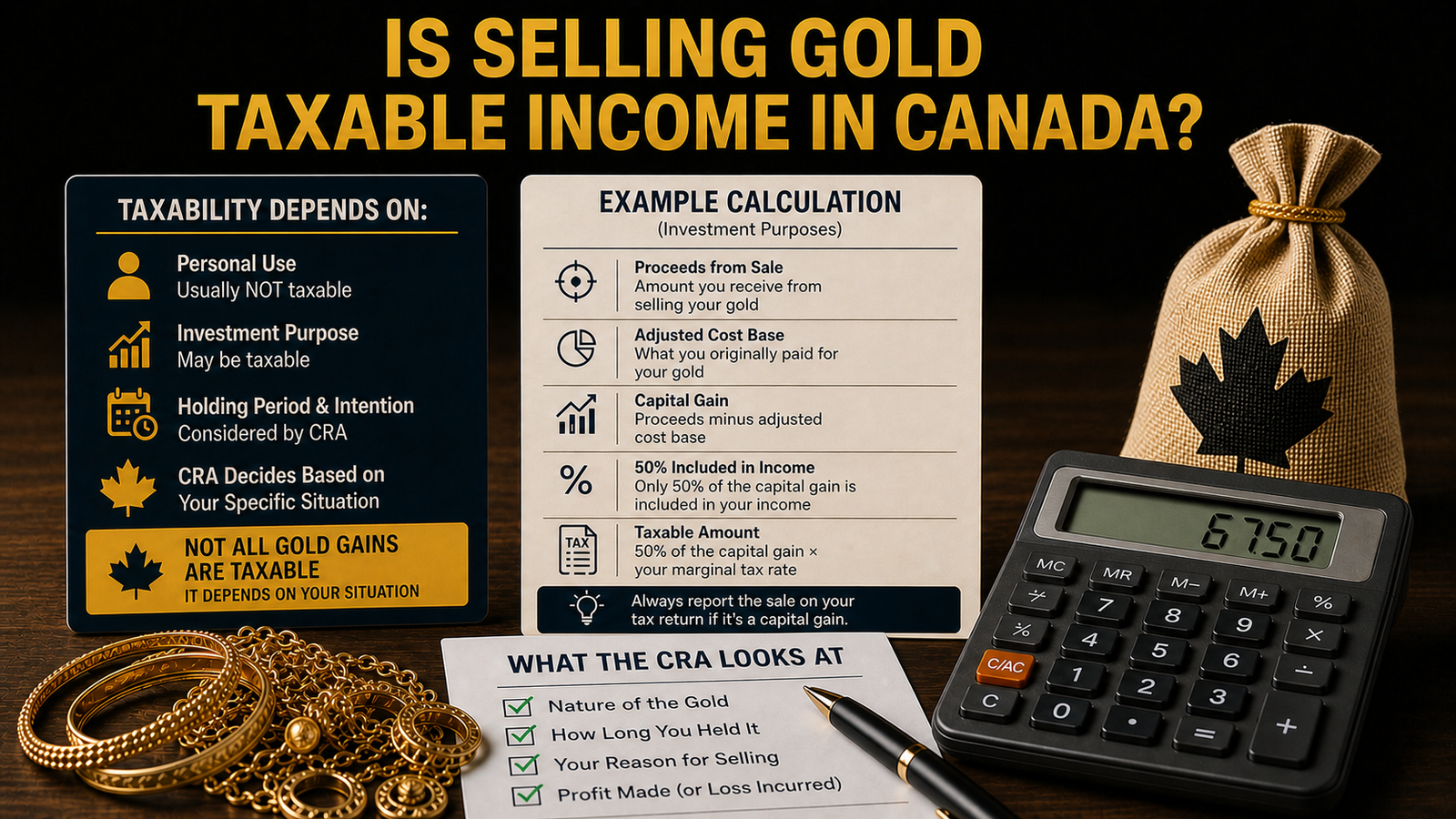
The CRA classifies physical gold into three main tax categories: capital property, business income, or personal-use property. Gold may be considered capital property, business property, or personal-use property, and each category can have different tax consequences.
Capital Gains vs. Business Income vs. Personal-Use Property
For many casual investors, gold is held as capital property. If you sell it for more than its adjusted cost base, the resulting profit is generally a capital gain. Only the applicable portion of that gain is included in taxable income.
The situation can be different if you regularly trade gold with the main goal of making short-term profits. Depending on the facts, the CRA may consider this a business activity. In that case, the net income may be fully taxable as business income rather than receiving capital-gains treatment.
Gold jewellery, collectibles, and other personal items can fall under personal-use property or listed personal property rules. Always verify the applicable thresholds and treatment against current CRA guidance.
When a Sale Usually Isn't Taxable: Small Personal-Use Gains
Under the CRA’s personal-use property rules, if both the adjusted cost base (ACB) and the gross proceeds of a personal-use item, such as a gold ring or necklace, are $1,000 or less, no capital gain or loss arises.
This can mean that selling an ordinary personal item for a modest amount does not create a reportable capital gain. However, the specific circumstances and current CRA thresholds should always be checked before filing your return.
GST/HST: Bullion vs. Jewellery and Scrap
GST/HST treatment depends on the specific gold product. Investment-grade gold bullion, defined as coins, bars, or wafers with a purity of at least 99.5% produced by recognized refiners like the Royal Canadian Mint is generally exempt from GST/HST under CRA tax rules.
Jewellery, scrap metal, and lower-purity gold can be treated differently and may be subject to GST/HST. Commercial buyers or retailers generally handle the applicable sales tax requirements.
Because GST/HST rules can depend on the product and transaction, verify the current requirements before selling.
How the Tax Is Calculated on Gold You Sell
If your gold sale is taxable, the basic calculation starts with what you paid for the gold and what you received when you sold it.
Proceeds Minus Adjusted Cost Base (ACB)
Your capital gain can generally be calculated as
Capital Gain = Proceeds of Disposition − (Adjusted Cost Base + Outlays and Expenses)
Your Adjusted Cost Base (ACB) is generally the original purchase price plus eligible acquisition costs, such as certain legal or brokerage fees. Deductible selling expenses include costs like professional appraisals or secure shipping incurred during the sale.
For example, suppose you bought investment gold bars for $3,000 and later sold them for $5,000. If you had $100 in eligible transaction costs, your capital gain would be $1,900:
$5,000 − ($3,000 + $100) = $1,900
Using the standard 50% inclusion rate referenced in the source material, $950 would be included in taxable income. Figures and current inclusion rules should be verified against current CRA guidance.
Do Inherited or Gifted Gold Get Taxed Differently?
Inherited and gifted gold can have different ACB considerations.
With gifted gold, the donor is generally deemed to have disposed of the property at fair market value (FMV) at the time of the gift. Your ACB then becomes that FMV, subject to the applicable tax rules.
With inherited gold, the deceased person’s estate generally deals with any capital gains that arise up to the date of death. For the beneficiary, the ACB is generally established using the fair market value of the gold at the date of the original owner’s death.
This means that when you later sell inherited gold, the relevant gain generally relates to the increase in value after you inherited it. Keep valuation and estate records because they can be important when calculating your future gain.
Do You Have to Report Selling Gold, and How Much?
A common question is how much gold can you sell without reporting in Canada? The important point is that tax reporting and dealer reporting are not the same thing.
Reporting Thresholds vs. Paying Tax
Receiving a cash payout does not automatically trigger tax liability. The CRA assesses taxes based on whether your sale yields a taxable profit, regardless of the overall transaction amount.
Dealer reporting works differently. Precious metal dealers operate under anti-money laundering (AML) requirements overseen by the Financial Transactions and Reports Analysis Centre of Canada (FINTRAC). The source material states that Canadian bullion dealers must report single cash transactions, or linked transactions within 24 hours, of $10,000 CAD or more.
This AML reporting requirement is designed to help prevent money laundering. It is separate from your personal income-tax reporting obligations. The threshold should be verified against current FINTRAC and CRA requirements before relying on it.
Records to Keep for Tax Time
Keep clear records for your gold purchases and sales. Useful documents include:
- Original receipts or purchase invoices showing the acquisition date and price.
- Receipts for selling costs, appraisals, and applicable storage or related expenses.
- Dated transaction slips from the buyer showing the gold’s weight, purity, and settlement amount.
Good records can make your tax calculation easier and help support your figures if the CRA asks for documentation.
How to Sell Gold in Canada Without Losing Value
Knowing how to sell gold in Canada is not just about finding someone willing to pay cash. The type of buyer you choose can affect your payout, testing process, fees, and paperwork.
Your Options: Dealers, Refiners, Jewellers, Banks
Precious metal dealers: Specialist bullion dealers often provide competitive offers for standard gold bars and coins and may price them with reference to current spot prices.
Refiners: Refiners can be suitable for larger quantities of scrap or industrial gold. They melt and process the metal, although processing fees may apply.
Jewellers: Jewellers can be convenient when selling finished jewellery. However, their offers may focus mainly on the item’s melt value rather than its original craftsmanship or retail price.
Banks: Some major Canadian banks buy back specific bullion products, particularly products that were originally purchased through their branches.
Why Your Choice of Buyer Affects Price and Records
The buyer you select affects both your final payout and the quality of your records. Established bullion dealers may use digital testing equipment and provide itemized invoices showing weight, fine gold content, and pricing calculations.
That documentation can be useful when you need to calculate or support a capital gain for tax purposes.
How to Identify a Legitimate, Reputable Gold Buyer
Finding a buyer is easy. Finding one that clearly explains its pricing and treats your gold fairly requires more care.
Credentials and Transparency to Look For
A reputable buyer should have a professional business presence, whether that is a fixed commercial location or a secure online operation. Look for clear information about current spot prices, visible and properly calibrated scales, and a fee schedule that you can understand before accepting an offer.
Checking Reputation the Right Way
Do not rely only on testimonials published on the buyer’s own website. Look at independent sources such as the Better Business Bureau (BBB) and Google Reviews.
Pay attention to patterns rather than one isolated complaint or glowing review. Look for comments about pricing transparency, communication, payment, testing, and whether customers received the amount they were quoted.
A buyer with a consistent track record is generally easier to evaluate than one with little independent information.
How Fair Pricing Works: Spot Price, Purity, and a Reasonable Spread
Gold prices move throughout the day based on global spot prices. Your offer should therefore have a clear connection to the current market price.
Purity is also important. Jewellery is commonly measured in karats, with 24k representing pure gold, while bullion is often described using millesimal fineness, such as .9999 fine gold.
A transparent buyer should calculate the value using the live spot price, the item’s exact fine-gold weight, and a clearly disclosed dealer margin or spread. The spread covers the buyer’s costs and business risk, but it should not be hidden.
Red Flags and Common Gold-Selling Scams to Avoid
So, is cash for gold legit? The business model itself can be legitimate. The problem is that some operators use tactics designed to make sellers accept less than their gold is worth.
Walk away or ask more questions if you notice these warning signs:
- Hidden testing procedures: The buyer refuses to weigh or test your gold while you are present.
- Uncalibrated or obscured scales: The scale is hidden from view or does not show evidence of proper inspection.
- High-pressure tactics: You are told an offer is available “today only” and encouraged to decide immediately.
- Vague deductions: Unexpected refining, handling, or processing fees appear after the appraisal.
- No written breakdown: The buyer gives you a lump-sum cash amount without showing the weight, purity, unit price, deductions, or final calculation.
You should be able to understand what you are selling, how it was valued, and exactly how the final offer was calculated.
How to Compare Offers and Confirm a Fair Price
Do not feel pressured to accept the first offer. Ask at least two or three independent buyers for detailed quotes. Then compare the calculations, not just the final dollar amount.
| What to Ask / Check | What a Fair Buyer Does | Red Flag |
|---|---|---|
| Pricing base | Shows current global spot prices and explains the calculation. | Gives a flat price per gram without explaining the market reference. |
| Testing and weighing | Tests purity and weighs the gold where you can see the process. | Takes the gold away for testing without explanation. |
| Fee structure | Explains all testing, refining, or transaction fees before the sale. | Adds unexpected fees at the final payout. |
| Documentation | Provides a written receipt with weight, purity, price, deductions, and settlement amount. | Offers cash with no itemized paperwork. |
A fair comparison is easier when every buyer gives you the same basic information. If one offer is much lower, ask why before deciding.
Final Takeaway
Is selling gold taxable in Canada? In many cases, yes. A profit from selling gold may be treated as a reportable capital gain, while personal-use property can receive different treatment under specific CRA rules.
The safest approach is to handle the transaction in two steps: understand your tax position and choose a legitimate buyer. Keep your original purchase records, sale documents, and expense receipts. When selling, compare multiple offers, ask how the price was calculated, and make sure the gold is weighed and tested transparently.
Before selling, calculate your adjusted cost base, gather your original receipts, and compare quotes across multiple reputable dealers to protect your investment.
FAQ
Is selling gold taxable income in Canada?
Selling gold can create taxable income in Canada when the sale results in a taxable gain. For an investor, the profit may generally be treated as a capital gain. Someone who regularly trades gold as a business may face different treatment. Small personal-use sales can also be subject to specific CRA rules and thresholds, so verify the current requirements for your situation.
How much gold can you sell without reporting in Canada?
There is no simple amount of gold that automatically determines whether you personally have to report a taxable gain. Tax reporting generally depends on the nature of the sale and the gain rather than just the amount of gold sold. Separately, precious metal dealers have AML reporting obligations, including rules concerning cash transactions of $10,000 CAD or more. Verify current thresholds before relying on them.
Do you pay tax on selling inherited gold or jewellery?
You may pay tax when inherited gold increases in value after you receive it and you later sell it for more than your ACB. For inherited property, the ACB is generally based on the property’s fair market value at the original owner’s date of death. The estate generally handles gains up to that date. Keep estate valuations and sale records to support your calculation.
How is the capital gain on gold calculated?
A capital gain generally starts with the sale proceeds minus your Adjusted Cost Base (ACB) and eligible selling-related expenses. The ACB can include the original purchase price and eligible acquisition costs. For example, if your gold cost $3,000 and eligible costs totalled $100, a $5,000 sale would produce a $1,900 gain. The applicable inclusion rate is then used to determine the taxable portion.