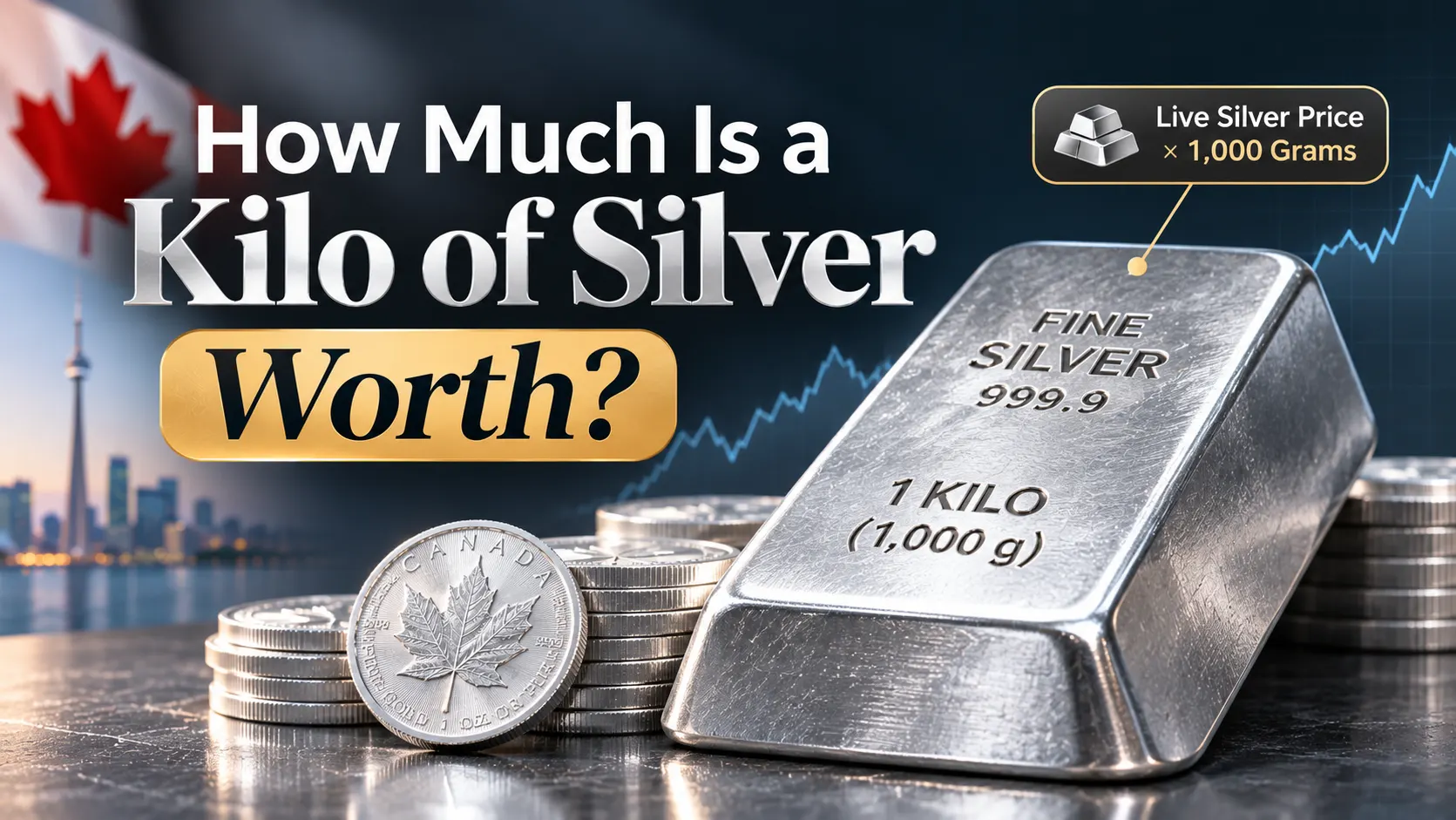
How much is a kilo of silver worth? Unlike most goods, a kilo of silver has no fixed price: its value moves with the live market every day, sometimes every minute. So the honest answer is a formula plus today’s number, and you’ll get both here. Below you’ll find the current value in Canadian dollars, the one-line calculation you can repeat any day, per-gram, per-ounce, and bar-size breakdowns, and what Canadians actually pay or receive once premiums, spreads, and tax are accounted for. Whether you’re stacking silver for the first time or comparing a kilo bar with smaller sizes, these numbers will help you judge a fair price.
How much is a kilo of silver worth today? The number and the math
As of the November 5, 2026 close, one kilo of pure silver was worth about 2,320 CAD at the spot price, based on Kitco’s CAD silver quote of 72.17 CAD per troy ounce (updated 11:57 p.m. EST). That is the metal’s melt value, not what you pay at the counter. Silver is volatile: the same quote showed a day range of roughly 2,308 to 2,420 CAD per kilo, a swing of about 110 CAD in one session. Treat any printed number, including this one, as a snapshot, and check the live silver price page before you buy or sell.
How the kilo price is calculated (32.1507 troy ounces)
The formula never changes:
Value of 1 kg = spot price per troy ounce (CAD) × 32.1507
Worked example, November 5, 2026: C72.17×32.1507=C2,320.32. Swap in today’s spot price, and you have today’s value. A dealer’s number will differ from this melt value because of premiums and spreads, which we cover in the section on spot price versus what you actually pay. The same formula works for gold; see how much a kilo of gold is worth in CAD.
Silver price per gram, ounce and kilo in Canada (CAD)
Silver is priced in troy ounces, the precious metals standard. A troy ounce weighs 31.1035 grams, about 10% more than the standard ounce of 28.3495 grams used in the kitchen, and mixing the two up is a common mistake for new buyers. Every figure below uses the troy ounce at the November 5, 2026 closing spot price of C$72.17.
Unit | Weight | Approx. value (CAD, Nov 5, 2026) |
1 gram | 1 g | C$2.32 |
10 grams | 10 g | C$23.20 |
1 troy ounce | 31.1035 g | C$72.17 |
1 standard ounce | 28.3495 g | C$65.78 |
1 kilogram | 1,000 g | C$2,320.32 |
What a kilo is worth next to other common silver bar sizes
Bigger bars carry a lower premium per ounce, so each ounce costs less as bar size goes up. That is why serious stackers favor kilo and 100 oz bars. If you are wondering how much 10 oz of silver is worth, it is about 721.70 CAD at the November 5, 2026 spot price before premium, or roughly 758 to 794 CAD once a typical premium is added.
Silver bar size | Troy ounces | Approx. value (CAD, Nov 5, 2026) | Typical premium |
1 oz | 1 | C$72.17 | 8–15% |
10 ounce silver bar | 10 | C$721.70 | 5–10% |
1 kilo silver bar | 32.1507 | C$2,320.32 | 3–8% |
100 ounce silver bar | 100 | C$7,217.00 | 2–6% |
Values are melt values at the spot. Premiums are typical ranges and vary by dealer, brand, and market conditions.
Which size suits which buyer? A 10 oz bar is the flexible mid-size: easy to buy in stages and simple to sell in pieces. A kilo is the best value for serious stackers, with a lighter premium and a size that is still easy to store. A 100 oz bar is wholesale weight: the cheapest per ounce, but the biggest single purchase. Browse our full range of silver bars to compare sizes side by side.
Why does the price of a kilo of silver keep changing?
The spot price is the live market price for immediate delivery of silver, quoted per troy ounce and set on global markets that move throughout the trading day. A kilo is simply 32.1507 ounces, so every move in spot moves your kilo by the same percentage.
Four forces do most of the work:
- Industrial demand. Silver goes into electronics, solar panels, batteries and medical devices, so manufacturing cycles can swing the price in either direction.
- Investment demand. Buying of silver bullion in bars and coins adds a second layer of demand that rises and falls with investor sentiment.
- Mine supply. Most silver is mined as a by-product of copper, lead, zinc and gold, so supply responds slowly when prices move, which can amplify swings.
- The USD/CAD exchange rate. Silver trades globally in US dollars, so the Canadian figure rides the exchange rate. A weaker loonie lifts the CAD price even if silver is flat in US dollars.
That last point is why the Canadian price differs from the US quote: the metal is the same worldwide, only the currency changes. Bar quality is anchored by refiners on the London Bullion Market Association’s Good Delivery List, which we come back to below. To follow the market, use our live silver price in CAD.
Spot price vs. what you actually pay or get
Spot is a reference price for the raw metal. In practice, you pay more when you buy and receive slightly less when you sell.
- Buying. You pay spot plus a premium that covers fabrication, distribution, and dealer costs. On kilo bars, that is commonly about 3–8%, and higher on small or collectible pieces. At the November 5, 2026 spot price, that puts a kilo at roughly 2,390 to 2,506 CAD instead of the 2,320 CAD melt value.
- Selling. A dealer pays close to spot, minus a small spread. As an illustration only, a 2% spread would return about 2,274 CAD on a kilo with a melt value of 2,320 CAD.
- Tax. In Canada, investment-grade silver bullion that is at least 99.9% pure, such as recognised bars and coins, is generally exempt from GST/HST. Jewelry, sterling silver and other sub-.999 pieces are not, and collector coins are generally taxable too. This is general information, not tax advice, so confirm the current treatment with the Canada Revenue Agency or your advisor before a large purchase.
Buying or selling a kilo of silver in Canada
Before you buy a kilo bar, check four things: .999 fineness or better, a recognized refiner (an LBMA Good Delivery refiner) or the Royal Canadian Mint, a clear stamp, and an assay card or serial number where the product has one. The Mint’s .9999 fine silver sets the purity benchmark in Canada.
When buying, compare the per-ounce premium across sizes. A 10 ounce silver bar is easier to resell in pieces, a kilo bar is usually the value sweet spot for larger buyers, and a 100 ounce silver bar goes lower still. Our silver bullion range covers bars and coins in every size, and the 1 kilo silver bar page shows current pricing.
When selling, start with the live spot price, then ask each dealer for a written quote so you can compare what they pay against spot. If you want to get a silver quote or sell silver in the GTA, we will price your kilo against the live market.
FAQ
How many ounces are in a kilo of silver?
One kilogram equals 32.1507 troy ounces, the unit silver is priced in. That is about 35.27 standard ounces, so always check which ounce a price refers to.
How much is 10 oz of silver worth today?
Ten troy ounces of silver is worth ten times the spot price per ounce. At the November 5, 2026 close of 72.17 CAD, that is about 721.70 CAD in melt value. A 10 oz bar usually adds a premium on top, so expect to pay somewhat more.
Is a 100 ounce silver bar a good way to buy silver?
For larger buyers, often yes: a 100 oz bar usually carries the lowest premium per ounce. The trade-offs are a higher upfront cost, about C$7,217 at spot on November 5, 2026, and less flexibility if you want to sell only part of it.
Why is the silver price in Canada different from the US price?
Silver trades globally in US dollars, so the Canadian price is the US spot price converted at the current USD/CAD rate. The metal is the same; only the currency changes, so exchange-rate moves alone can shift the CAD price from day to day.
Do you pay GST/HST on silver bullion in Canada?
Generally no, if the silver is at least 99.9% pure and in recognised bar or coin form. Jewelry and lower-purity silver are taxable. Confirm current rules with the CRA before a large purchase.
Is a kilo of silver a good investment?
That depends on your goals and risk tolerance, and silver can swing sharply in a single day. A kilo carries a lower premium than smaller bars, but no one can promise returns, so consider speaking with a financial advisor.