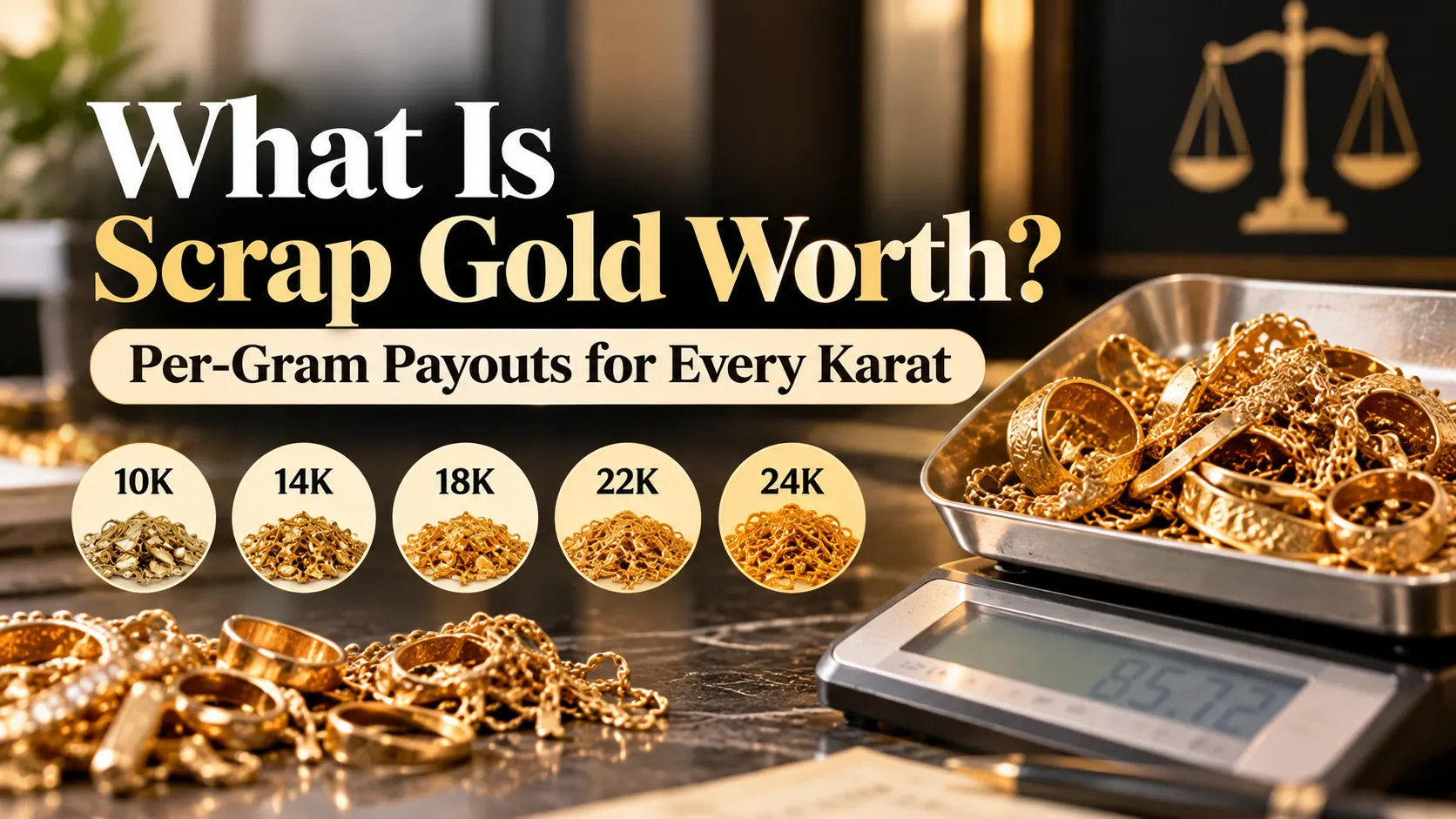
A broken gold chain, a single earring, or an old ring sitting in a drawer may still be worth money. The amount depends on how much pure gold the item contains and the current market price.
When checking scrap gold prices, the biggest mistake is assuming that a buyer will pay the full market value of the gold. Buyers calculate their offers using the item’s weight and purity, then deduct costs and their margin. Two buyers can offer different amounts for the same piece.
Knowing the price for scrap gold before visiting a shop helps you judge whether an offer is reasonable. This guide explains how to calculate melt value, compare scrap gold prices per gram by karat and identify common warning signs when selling unwanted jewellery.
What Counts as Scrap Gold?
Scrap gold is gold purchased mainly for its metal content rather than its design, brand, or craftsmanship. Buyers assess its purity and weight to estimate how much recoverable gold it contains.
Items commonly sold as scrap include:
- Broken gold chains, snapped necklaces, and damaged bracelets.
- Single earrings without a matching pair.
- Bent rings, scratched pendants, and outdated jewellery.
- Gold dental crowns, caps, and bridges, if a buyer accepts them.
Some gold items may be worth more when sold intact.
Items to assess separately before selling:
- Gold bullion coins and bars: Recognized bullion products may carry a premium over their metal value. Check their bullion value before accepting a scrap offer.
- Designer, antique, and estate jewellery: Signed pieces from brands such as Cartier or Tiffany & Co., along with collectible vintage jewellery, may attract buyers who value the item as a whole.
- Gold-plated jewellery: Stamps such as GP, GEP, and HGE usually indicate a thin gold layer over another metal. The recoverable gold content is generally too small to make these items worthwhile for ordinary scrap buyers.
How Scrap Gold Value Is Calculated
Two things determine the basic melt value of scrap gold: its purity and its weight. The market spot price sets the starting point. For a wider look at valuing all types of gold, not just scrap, see our guide on how much your gold is worth.
Gold prices are commonly quoted in US dollars per troy ounce. One troy ounce equals 31.1035 grams, so you must convert the quoted price to a per-gram figure before calculating the value of a small item.
The scrap gold melt formula
Step 1: Calculate the pure gold price per gram.
Spot price per troy ounce ÷ 31.1035 = pure gold price per gram.
Step 2: Adjust for purity and weight.
Pure gold price per gram × purity percentage × weight in grams = melt value.’
Use the purity percentage as a decimal in the calculation. For example, 14K gold is approximately 58.33% pure, so its purity factor is 0.5833.
Worked example: A 10-gram 14K gold chain
For an example based on a spot price of US$4,177.50 per troy ounce, quoted by Kitco at 12:01 a.m. New York time on October 9, 2026:
- Pure gold price per gram: Four thousand one hundred seventy-seven dollars and fifty cents divided by 31.1035 equals approximately one hundred thirty-four dollars and thirty-one cents.
- 14K gold value per gram: One hundred thirty-four dollars and thirty-one cents multiplied by 0.5833 equals approximately seventy-eight dollars and thirty-five cents.
- Melt value of a 10-gram chain: Seventy-eight dollars and thirty-five cents multiplied by ten equals approximately seven hundred eighty-three dollars and fifty cents.
The chain’s estimated melt value is about US$783.50 at that quoted spot price. This is an illustrative calculation, not a current guaranteed offer. The actual amount may change with the spot price, the verified purity, and the buyer’s assessment of the item.
Melt value represents the estimated value of the gold content at the reference price. It is a starting point for comparing offers, not the amount a buyer must pay.
Scrap Gold Prices Per Gram by Karat
Higher-karat gold contains a greater proportion of pure gold, so it generally has a higher melt value per gram than lower-karat gold of the same weight.
The table below uses the Kitco spot bid of US$4,177.50 per troy ounce on October 9, 2026, at 12:01 a.m. New York time. Figures are estimated melt values, rounded to two decimal places. They are not guaranteed buyer payouts.
Karat | Common marks or fineness | Approximate purity | Melt value per gram (USD) |
24K | 999 / 9999 | 99.9% | $134.18 |
22K | 916 / 917 | 91.67% | $123.12 |
20K | 833 | 83.33% | $111.92 |
18K | 750 | 75.00% | $100.73 |
14K | 585 / 14KT | 58.33% | $78.35 |
10K | 417 / 10KT | 41.67% | $55.96 |
9K | 375 / 9KT | 37.50% | $50.37 |
Price reference: GoldPrice.org. These figures are a dated snapshot. Check the current spot price before calculating the value of your jewellery.
The figures show the estimated metal value at the stated spot price. A buyer’s offer will usually be lower because the buyer must account for testing, processing, overhead, and margin.
Grams vs. pennyweights
Check the unit of measurement whenever you compare quotes. One pennyweight (dwt) equals approximately 1.55517 grams. A price quoted per pennyweight will therefore look about 55.5% higher than the price per gram for the same gold and purity.
For a fair comparison, convert both offers to the same unit and confirm that each buyer is using the same purity and spot-price reference.
How to Read Karat Stamps
Check your jewellery for a purity stamp before estimating its value. You can often find it inside a ring band, on a bracelet clasp, or on the small tag near a chain clasp. A magnifying glass or your phone’s camera zoom can help you read a faded mark.
Gold purity is commonly shown in two ways: karats and fineness numbers. Fineness indicates the number of parts of gold per 1,000 parts of metal. For a full breakdown of what each karat means and how purity is measured, see our guide to gold purity explained.
Stamp | Meaning | Gold content |
24K / 999 | Nearly pure gold | 99.9% |
22K / 916 | 22-karat gold | 91.67% |
18K / 750 | 18-karat gold | 75.0% |
14K / 585 | 14-karat gold | 58.33% |
10K / 417 | 10-karat gold | 41.67% |
14KP / 10KP | Plumb karat | Meets the stated karat purity |
GP / GEP / HGE | Gold-plated | Thin gold coating |
GF / RGP | Gold-filled or rolled gold plate | Varies by construction |
Vermeil / 925 | Gold over sterling silver | Gold coating over silver |
The letter P in a mark such as 14KP stands for plumb, meaning the gold meets the stated karat purity. It does not mean the item is pure gold.
Gold-filled items contain more gold than ordinary gold-plated pieces, but their recoverable gold value is usually limited. Vermeil is gold plating over sterling silver, so its value depends on the underlying silver and the recoverable gold.
A stamp is useful, but it does not prove an item’s composition on its own. If an item has no mark or the stamp looks questionable, ask a professional buyer to test it. Acid testing and X-ray fluorescence (XRF) analysis are two methods used to assess metal composition.
For more information on jewellery markings, see the US Federal Trade Commission’s Jewelry Guides.
Melt Value vs. What a Buyer Actually Pays
The gold scrap price calculated from the spot market is not the same as the cash offer you receive. A buyer may pay less than the full melt value because the item needs to be tested, processed, and refined before the gold can be reused.
The difference can cover several costs:
- Refining and assaying: Separating gold from other metals and testing its composition costs money.
- Business expenses: Staff, premises, insurance, and testing equipment all contribute to operating costs.
- Price risk: Gold prices can change between the purchase and the time the buyer’s lot is processed or settled.
- Business margin: Buyers need to earn money from the transaction.
The size of this difference depends on the buyer, the amount of gold being sold, and the terms of the offer. Pawn shops, local jewellers, mail-in buyers, coin dealers, and specialist refiners may use different pricing methods. Avoid assuming that one buyer type always pays the most.
Before accepting an offer, ask two questions:
- What percentage of the total melt value are you offering?
- Which spot price are you using, and when will that price be locked in?
These questions make quotes easier to compare. A buyer offering a high percentage of a lower reference price may still pay less than a buyer using a higher reference price with a smaller percentage.
Conclusion
Scrap gold value comes down to purity, weight and the spot price used in the calculation. The melt value gives you a starting point, while the buyer’s offer reflects processing costs, business expenses, and margin.
Check your karat stamps, weigh your items, and compare more than one quote before agreeing to sell. Ask each buyer which spot price they use and what percentage of melt value they offer. A transparent calculation makes it easier to judge whether the cash offer is fair.
FAQ
What is scrap gold worth per gram today?
At the October 9, 2026, reference price of four thousand one hundred seventy-seven US dollars and fifty cents per troy ounce, estimated melt values range from fifty dollars and thirty-seven cents per gram for 9K gold to one hundred thirty-four dollars and eighteen cents for 24K gold. These are estimates, not guaranteed cash offers.
How much do gold buyers pay for scrap gold? Do you get the full price?
Buyers generally pay less than the full melt value. The difference covers testing, refining, operating expenses, price risk, and the buyer’s margin. The percentage varies by business and transaction, so there is no single payout rate that applies to every buyer. Ask for the offer as a percentage of melt value and confirm the spot price used.
Is gold-plated or gold-filled jewellery worth anything as scrap?
Gold-plated jewellery usually has very little recoverable gold because the coating is thin. Gold-filled items contain more gold than ordinary plated pieces, but their scrap value depends on their construction, weight and recovery costs. Some buyers may not accept small quantities. Check the markings and ask a buyer whether the item is worth testing
Should I sell scrap gold by the gram or the pennyweight?
Grams make it straightforward to compare small jewellery items, but either unit can work. One pennyweight equals approximately 1.55517 grams, so a price per pennyweight will be about 55.5% higher than a price per gram for the same gold and purity. Convert quotes to the same unit before comparing them.
Does the colour of gold (white, rose, or yellow) change its scrap value?
The colour does not directly determine the scrap value of solid gold. White, rose, and yellow gold of the same purity contain roughly the same proportion of gold. The other metals in the alloy create the colour differences. A buyer will assess the item’s gold content, weight, and any other relevant material factors when calculating an offer.