You Don't Have to Drive Downtown
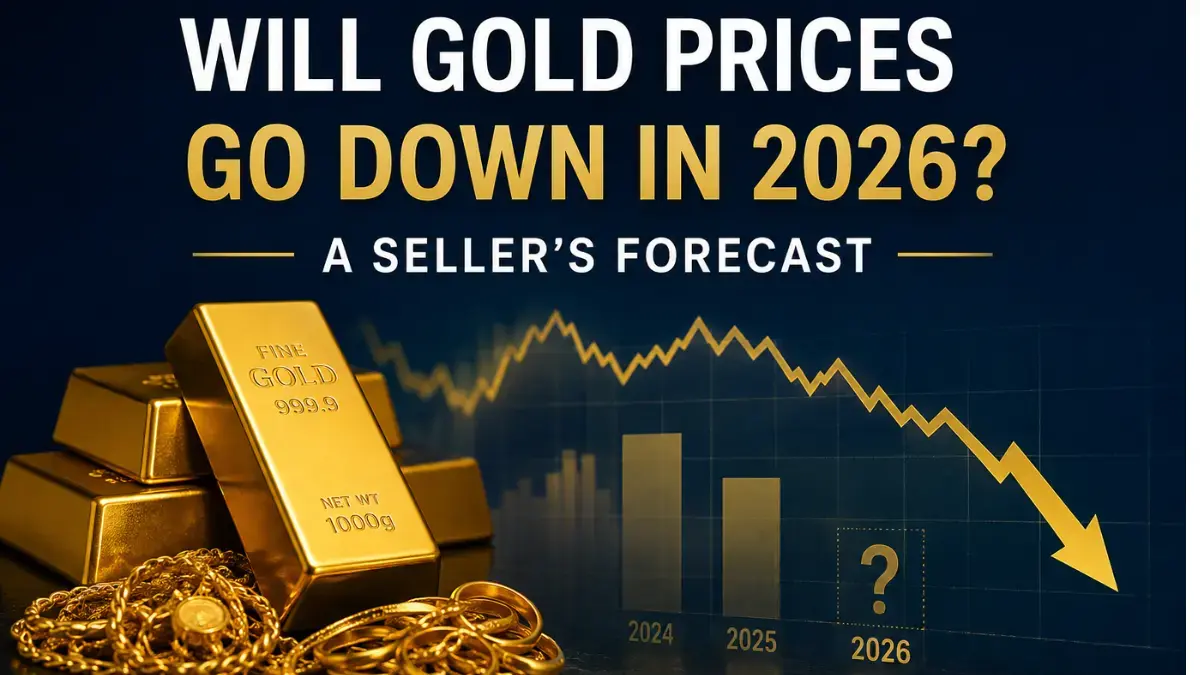
If you’re holding gold, you’ve probably asked yourself, will the gold price go down before it’s time to sell? Gold hit a record high earlier in January 2026, but has been volatile since then, leaving many Canadian sellers to ponder whether it is time to sell or wait for another price hike. Now, the truth of it is that nobody can be certain about the market; however, if they know what is influencing the costs, they can make a more educated choice.
This guide uncovers the reasons behind the pullback, what analysts are predicting for the future of gold for 2026 and beyond, and how the Canadian dollar can impact how much you end up receiving from your gold sale.
Why Did Gold Drop Today?
If you’ve recently searched “why did gold drop today,” you’re not alone. Gold prices do not tend to trend in a straight line. Long-term bull markets can still experience short-term corrections and are often caused by economic news, interest rate changes, currency fluctuations, and changes in market sentiment.
Gold rallied to new highs in early 2026 before settling into a consolidation phase. In the wake of the fast-rising equity prices, many investors decided to cash out; at the same time, better economic statistics cut down urgent demand for traditional safe-haven assets. Short-term corrections like these are a normal part of financial markets and don’t necessarily signal the end of a longer-term upward trend.
Higher Interest Rates Increase Pressure
The interest rate is one of the most significant factors that influence gold. Gold does not accrue interest or dividends like savings accounts or government bonds. Rates that are kept high or indicated to keep higher tend to make investments that generate income more appealing.
This then forces some investors to move out of gold, leading to price declines. Investors also react to expectations of future central-bank decisions. Even before interest rates change, expectations alone can influence gold prices.
A Stronger U.S. Dollar Can Weigh on Gold
The price of gold is quoted worldwide in dollars. If the U.S. dollar appreciates when compared with other major currencies, it is going to cost more to purchase gold overseas. Weaker global demand can reduce buying activity and place short-term pressure on gold prices.
Currency movements are one of the key factors influencing short-term gold prices because they affect how expensive gold becomes for buyers using other currencies.
Cooling Inflation and Slower Central Bank Buying
When inflation persists, gold is likely to do well because investors consider gold a store of value. Some of this defensive demand might ease if inflation further slows down.
Central banks have also been significant buyers of gold in the last few years, assisting with prices. Central banks remain important buyers of gold, although many analysts expect purchasing to slow from the record pace seen in recent years. Together with the deceleration in inflation and the shift in investors’ expectations, it can put further downward pressure on a stable market.
What Could Keep Gold High (The Other Side)
Indeed, there are good arguments for short-term price corrections, but also robust factors that may mean that gold trading at historically high levels will persist throughout 2026. These factors help explain why many analysts believe any short-term weakness may not develop into a prolonged decline.
One of the biggest supports for gold is geopolitical uncertainty. These events can lead to an increase in demand for safe-haven assets, like gold.
Another important factor is central bank demand. While purchasing has slowed a bit from record levels, some central banks continue to diversify their reserves by holding gold. This continuous demand serves as a good base to prop up this market and also helps reduce the chances of a prolonged price collapse.
There is also an ongoing argument that gold is the preferred asset choice due to long-term economic issues. But high government debt, continued fiscal deficits and worries about weaker global growth lead some investors to hold on to gold as a hedge against financial uncertainty. Any downward pressure will be capped by rising demand should recession fears intensify or inflation keep coming in higher than anticipated.
For sellers, the bottom line is that although gold may suffer short-term declines, there are several strong bull markets that may be in place for the medium and long-term.
Gold Price Forecast Canada: What Analysts Expect for 2026
If you’re looking for a gold price forecast in Canada, you’ll find that there are a lot of different forecasts from experts. Instead of a consensus on a specific target, the big banks and market analysts have come up with a number of forecasts that differ from one another depending on their expectations of inflation, interest rates, central-bank buying and geopolitics.
The range of forecasts brings to light one thing: nobody can predict the price of gold at the end of 2026. Forecasts should not be taken as predictions; they are often subject to revisions when the economic outlook changes.
Typically, those who are bullish on the price cite ongoing central-bank purchases, geopolitical tensions and government debt worries. Higher levels of economic growth, lower inflation and higher real interest rates are more conservative projections which may lead to less demand for gold from investors.
Sellers ought to use the range, rather than one forecast, to be positive or negative. The spread in views from the respected financial institutions is illustrative of the uncertainty of the outlook. When you are considering selling, your financial objectives and timeline may be more important than hoping to receive a specific price after a number of months.
Gold Price Forecast Canada: What Analysts Expect for 2026
| Source / Institution | 2026 Outlook (USD/oz) | Outlook |
|---|---|---|
| J.P. Morgan | ~$6,000 | Bullish |
| UBS | ~$5,900–6,200 | Bullish |
| Goldman Sachs | ~$4,900 | Moderately Bullish |
| Wells Fargo | ~$4,500 | Neutral |
| HSBC | ~$3,950 | Conservative |
| Market Consensus | ~$4,000–5,300 | Mixed |
Note: These figures are illustrative based on analyst expectations referenced in the writer brief. They should be verified against the latest published research before publication, as banks frequently revise their forecasts.
Gold Price Predictions for the Next 5 Years
Looking beyond 2026, gold price predictions for the next 5 years become even more uncertain. For many analysts, the forecasts are that gold will stay above its historical average, but as time goes on, the range of expectation increases. It’s because long-term gold prices are driven by variables that are virtually unpredictable at this moment in time, such as inflation, interest rates, geopolitical concerns, central bank policies and growth in global economies.
There are projections that gold will continue to rise due to ongoing central bank purchases, continued uncertainty in the world situation and increasing government debt. Others think that lower inflation, higher real rates and better economic growth may cap the gains or even trigger a protracted correction. This makes predictions for the 2028–2030 timeframe span several thousand dollars per ounce.
The lesson for the seller is that this is not an accurate enough projection on which to sell based. Long-range forecasts are best viewed as possible scenarios rather than promises. When it comes to money targets, cash flow needs, and the market price, that’s typically more crucial than attempting to forecast where gold will trade in a few years.
Illustrative 5-Year Gold Forecast Range*
| Year | Forecast Range (USD/oz) | Market View |
|---|---|---|
| 2027 | $5,100–$6,300 | Most analysts remain constructive. |
| 2028 | $4,800–$7,000+ | Wider range as uncertainty increases. |
| 2029 | $4,500–$7,500+ | Outcomes depend heavily on global growth and inflation. |
| 2030 | $4,000–$8,000+ | Highest uncertainty; forecasts vary significantly. |
*Illustrative forecast ranges based on published institutional outlooks and market research. Forecasts change frequently and should be verified before publication.
How the Canadian Dollar Changes What You Actually Net
Many articles also don’t consider the fact that sellers in Canada do not receive payment in U.S. dollars. Your payout is usually in Canadian dollars (CAD), and gold is bought and sold in U.S. dollars (USD). This translates into the exchange rate being just as significant in determining your payment as the price of the gold.
A Canadian dollar depreciation would make gold more expensive in Canadian dollars, even if the price of gold does not rise in international markets or falls slightly. However, a rising Canadian dollar could see your payout drop even though the gold price is relatively unchanged in USD. That’s why you can’t always rely solely on the international spot price.
A Simple Example
- Imagine gold falls from US$4,200 to US$4,000 per ounce.
- Scenario A: USD/CAD = 1.45
- Because the Canadian dollar is weaker, your payout remains relatively strong despite the lower USD gold price.
- Scenario B: USD/CAD = 1.30
- With a stronger Canadian dollar, the same US$4,000 gold price converts into fewer Canadian dollars, resulting in a noticeably lower payout.
These examples are illustrative only. Always check the live gold spot price and the current USD/CAD exchange rate before selling.
Conclusion
So, will the gold prices go down in 2026? Actually, no one can be sure. Other analysts say prices will continue to rise, but as the economy settles down, they may relax. The wide range of forecasts shows just how unpredictable the market can be.
Once you’ve checked today’s live spot price and compared offers, requesting a free quote from a reputable local gold buyer can help you understand exactly what your items are worth before making a final decision.
FAQ
Is It a Good Time to Sell Gold?
Among the most frequently asked questions by sellers is, “Is it a good time to sell gold? The truth is, it depends on you, not on making exact predictions on the market. Forecasts can be useful background information but shouldn’t be the sole reason to make a decision.
Reasons It May Make Sense to Sell Now
If you’re able to reach your financial targets at current gold prices, selling now might be the correct option. Instead of waiting for the unknown, many sellers opt to cash out at current high prices.
You might also consider selling if:
- You have a large purchase or emergency that requires cash.
- You don’t want declining interest rates or worsening economic conditions to have a negative impact on gold.
- You are satisfied with today’s profit and want to take no chances with your investments.
Absolute timing of the peak in the market is very hard (even hard for the pros to do regularly).
Reasons You Might Choose to Wait
If you do not need cash and think that economic turmoil will keep driving up prices, it could be wise to hold onto your gold.
Some sellers decide to wait because:
- Political tensions are high.
- Central banks have been continuing their gold buy programmes as part of their reserves.
- Safe-haven demand may rise in the event of worries about inflation or recession.
- They consider gold a store of value, not an investment.
Being patient could be more in line with your long-term financial goals if you don’t mind riding out the price fluctuations in the short term.
How to Sell Smart When You're Ready
Whenever you decide to sell, focus on getting the best possible value, not just choosing the right day.
Before accepting an offer:
- Shop around with different reputable gold buyers.
- Know your item’s purity (10K, 14K, 18K, 22K, or 24K).
- Use a scale to determine the weight of your gold.
- Before going to a buyer, check the live gold spot price
- Know what impact the current USD/CAD exchange rate is likely to have on your payout.
Knowing more about the situation often helps a seller to do better than waiting for the market to move slightly higher.