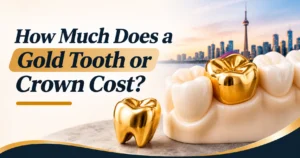
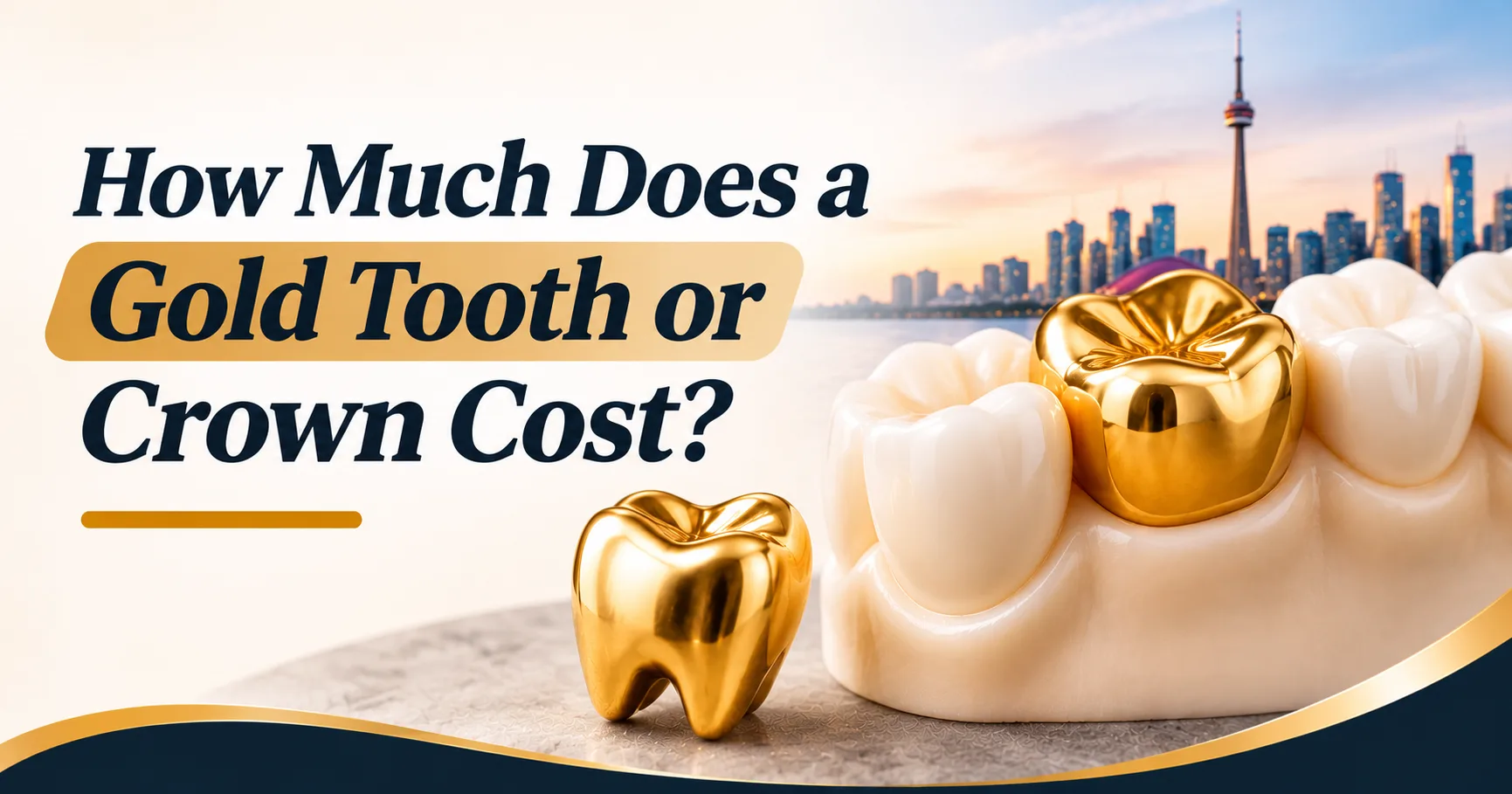
How much does a gold tooth cost in Ontario? A gold crown, the usual gold tooth, runs about $1,100 to $1,500 for the dentist’s fee plus a lab fee, and the gold price and the alloy move the lab fee. Gold fillings and gold crowns on implants are priced differently.
A dentist has said “crown” and offered gold, or you want a gold tooth for the look, or an old gold crown is sitting in a drawer. Whichever it is, the first question is how much does a gold tooth cost, and the second is what the metal is worth. This guide covers the cost of each kind of gold dental work in Ontario, gold against porcelain, gold fillings and implants, what dental alloys contain, how to get a gold tooth, and what the gold brings when you sell it.
How Much Does a Gold Tooth Cost in Ontario?
Three things set the price of gold dental work: the dentist’s fee, the lab fee, and the alloy the lab casts. The table shows each type side by side.
Gold tooth cost in Ontario by type of gold dental work (2026)
Type of gold dental work | Gold tooth cost in Ontario (CAD, 2026) | What changes the gold crown cost |
Gold crown on a natural tooth | The dentist’s fee of about $1,100 to $1,500, plus a lab fee | The alloy class and the gold price, which set the lab bill |
Gold inlay or onlay (gold filling) | A per-tooth dentist’s fee plus a lab fee; ask for a written estimate | How many surfaces of the tooth it covers |
Gold crown on an implant | A complete single implant (post, abutment and crown) starts at about $4,200 | The implant surgery, not the gold |
Removable gold grill | Priced by the jeweller, not a dentist | Karat and weight; it isn’t dental treatment |
Ontario has no mandatory fee schedule. Dentists set their own fees, and most start from the Ontario Dental Association’s yearly Suggested Fee Guide, so two offices can quote differently. The lab bill is the part that moves, because it follows the alloy and the gold price. If the gold crown cost looks high, read the lab line first.
Ask for a written estimate that lists the dentist’s fee, the lab fee, and the alloy by name. If the alloy isn’t named, ask for it before you agree. That estimate is your out-of-pocket number, and it is the only gold tooth cost worth comparing between offices.
Gold Crown vs Porcelain: Why Some Gold Teeth Still Make Sense
A gold crown is the most durable option for back molars and needs the least natural tooth removed, but it doesn’t match your other teeth.
Gold lasts 20 years or more, is gentle on the opposite teeth, fits precisely, and needs less of the tooth filed away. Porcelain, zirconia and porcelain-fused-to-metal (PFM) crowns match tooth colour, which is why most front-tooth crowns aren’t gold. They also need more of the tooth removed to make room for the material.
The decision rule is plain. A molar or premolar at the back that takes heavy chewing or grinding is where gold earns its price. A tooth that shows when you smile is where porcelain or zirconia wins. Gold teeth suit the bite; ceramic suits the smile.
Gold Filling Cost and Gold Tooth Implants
Two kinds of gold work get confused with a standard crown. Costs for both are in the table above.
Gold Fillings: Inlays and Onlays
Today a gold filling is almost always a lab-made inlay, which sits inside the cusps of the tooth, or an onlay, which covers one or more cusps. Both are cemented in place after the lab casts them. Hammered gold foil fillings are rare now. For the gold filling cost, check the table and get the estimate in writing, since the price follows how many surfaces the restoration covers.
Gold Tooth Implant: A Titanium Post With a Gold Crown
The implant post that anchors into the jawbone is titanium (or zirconia), never gold. The abutment connects the post to the crown, and the gold is only the crown on top. A gold tooth implant is therefore a standard implant with a gold crown fitted at the last stage. If you want gold, ask for it at the crown stage. The implant itself costs the same either way.
Palladium Dental Alloys: How Much Gold Is in a Gold Crown?
Palladium dental alloys are common, and the wording on your estimate matters, because a “gold” crown is an alloy and the American Dental Association sorts dental alloys by how much noble metal and gold they contain.
Dental gold alloy classes and their gold content
Dental alloy class | Noble metal content (gold, platinum, palladium) | Gold content required | How the dental alloy looks |
High noble | At least 60% | At least 40% gold | Yellow gold |
Noble | At least 25% | No minimum | Yellow or white, often palladium-silver |
Predominantly base | Under 25% | None | Silver-coloured (nickel, chromium or cobalt) |
Palladium is a noble metal used in white, semi-precious alloys and under porcelain. Seeing “palladium” on your estimate means a noble alloy with little or no gold. Platinum, silver and copper are the other metals mixed in to adjust hardness and colour, and base alloys often carry nickel, which is the usual source of metal allergy (the allergy advice is in the FAQs below).
If you want a gold tooth for its gold, ask for a high noble alloy by name. Then keep the lab slip that names the alloy. Dental gold often isn’t stamped with a karat mark, so that slip is the best proof of what’s inside when you sell it later.
How to Get a Gold Tooth: What Happens at the Dentist
How to get a gold tooth is simple: it’s a crown your dentist fits over two visits, with a lab casting the gold in between.
- Exam and X-ray to confirm the tooth needs a crown.
- Choose the alloy and get the written estimate (see the cost section).
- The dentist shapes the tooth and takes an impression or digital scan.
- A temporary crown goes on.
- A dental lab casts the gold crown, usually over about two weeks.
- The dentist checks the fit and bite and cements the crown.
For purely cosmetic gold, a removable grill is made by a jeweller from a mould of your teeth, not by a dentist. The FAQs below cover why dentists don’t crown healthy teeth.
How Much Is a Gold Tooth Worth When You Sell It?
How much is a gold tooth worth? Only the gold, plus any platinum or palladium, in its alloy, which is usually a few grams, so it sells for far less than it cost to make.
A single crown usually weighs about 2 to 4 grams of alloy, between 10 and 22 karat. The value is grams of alloy multiplied by gold content, multiplied by today’s gold price. Gold is quoted in US dollars, so convert with the Bank of Canada’s daily exchange rate. If you’re unsure what the karat figure means, gold purity explained covers it.
Because the alloy isn’t stamped, buyers test scrap dental gold with an XRF analyser or an acid test. The lab slip from the alloy section speeds that up. Weigh the crown with any tooth or cement removed, and ask the buyer to pay for platinum and palladium too, not only the gold. A refiner prices each metal separately, so a buyer who ignores them is paying you less than the metal is worth. If you’re ready to sell dental gold, take the crown, the slip, and your weight.
Is a Gold Tooth Worth the Cost?
Gold is so malleable that a dental technician can burnish a crown’s edge tight against the tooth, which helps it seal well. Since a gold tooth costs far more to make than its gold will ever fetch, pay for it because the tooth needs it, not as a store of value. So when you ask how much a gold tooth costs, book a consultation and take the cost table with you; GTA Gold Buyers also buys old dental gold when that day comes.
FAQ
Will a dentist give you a gold tooth?
Yes, when the tooth needs a crown. A crown means filing the natural tooth down for good, so ask your dentist directly whether they will crown a healthy tooth only for the look. If they won’t, a removable grill from a jeweller is the cosmetic route.
Will insurance cover a gold tooth?
Most plans treat a crown as a major service with a lower coverage share, and some pay only what a cheaper crown would cost, leaving you the difference. A gold tooth on a healthy tooth for looks isn’t covered. Under the Canadian Dental Care Plan, crowns need pre-authorization before the work is done.
Can you be allergic to a gold crown?
Gold itself rarely causes reactions. Reactions come from other metals in the alloy, such as nickel or palladium. Tell your dentist about any metal allergy and ask for a high noble alloy, which keeps the gold content highest and the other metals lowest.
Can I keep my old gold crown after the dentist removes it?
Ask your dentist before the appointment to give you the removed crown back, cleaned. Most offices will return it if you ask first. Once you have it, keep it with the lab slip if you still have one, since that slip names the alloy.