
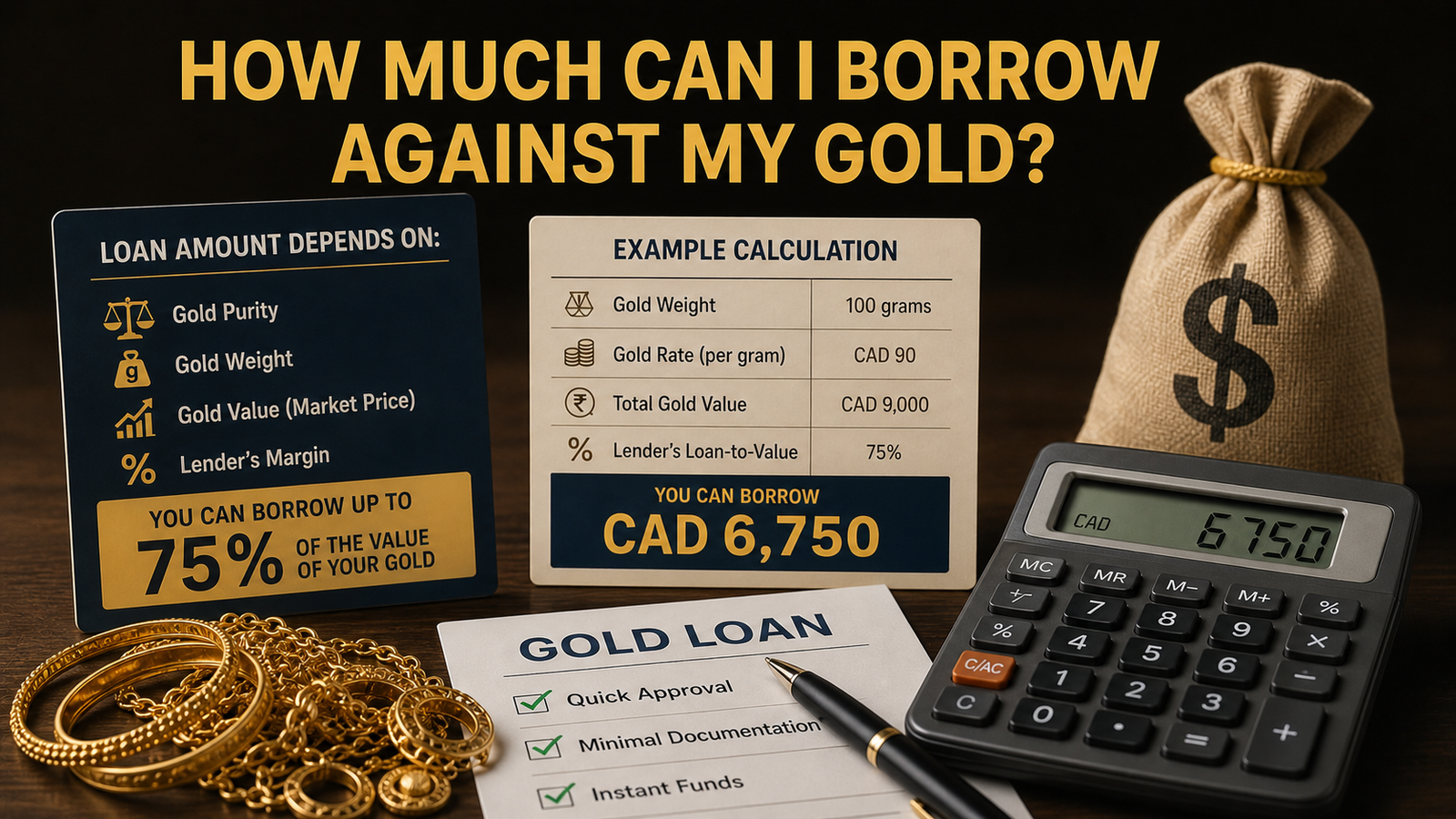
Most gold lenders in Canada will let you borrow between 60 and 75 percent of your gold’s current market value. Bullion and high-purity coins, such as 24K Canadian Maple Leafs, tend to sit at the top of that range, often around 70 to 75 percent, because their purity and resale value are easy to verify. Jewellery and scrap gold usually land lower, since it costs the lender more to assess purity and resell the piece if needed.
Where you borrow from matters too. A specialist bullion or gold lender typically offers the strongest LTV, banks are more conservative and less common for this type of secured lending, and general pawnbrokers can go as low as 25 to 50 percent. Lenders never advance the full market value because they need a margin of safety in case gold prices dip before you repay the loan.
What Is Loan-to-Value (LTV) and Why It Caps Your Cash
Loan-to-value, or LTV, is simply the percentage of your gold’s assessed value that a lender is willing to hand you as cash. If your gold is worth $1,000 and the lender’s LTV is 70 percent, you walk away with $700.
The gap between 100 percent and the LTV percentage is not a hidden fee. It is the lender’s cushion against the gold price moving down while your loan is outstanding, so they can still recover their money if they ever need to sell the collateral. A higher LTV means more cash in your pocket today, but it can also come with tighter repayment terms, since the lender is carrying more risk. Understanding this trade-off helps you compare offers properly instead of chasing the highest headline percentage alone.
The 3 Things That Decide Your Number
Three factors combine to set your exact borrow amount, and each one is worth understanding on its own.
Weight
The more grams of actual gold you have, the more collateral value you are offering, and the higher your potential loan. Weight is measured on a precise scale at the time of appraisal, and it is the most straightforward variable in the equation since it does not change with market conditions.
Karat / Purity
Karat tells the lender how much of your item is actually gold versus other metals. Canadian jewellery is commonly 10K, 14K, or 18K, while bullion coins and bars are usually 24K, or .999 fine gold. A 10K piece is roughly 41.7 percent pure gold, a 14K piece is about 58.5 percent, an 18K piece is about 75 percent, and 24K bullion is essentially pure. This is why a 14K chain and a 24K coin of the same weight are worth very different amounts, and why loans on gold jewellery generally borrow less than loans on equivalent-weight bullion.
The Day's Gold Price
Gold trades on a global spot market, and its price in Canadian dollars shifts throughout the trading day. Lenders base your appraisal on the current spot rate, converted to CAD, at the time you bring your gold in. This is the one variable you cannot predict in advance, which is why any example figure is only a snapshot and should always be checked against a live price before you rely on it.
A Real Canadian Example: From Grams to Cash
Here is how the math actually plays out, using one jewellery piece and one bullion coin. The per-gram prices below are illustrative only, based on a sample date, and must be verified against a live gold price source or the GTA Gold Buyers calculator before you make any decisions, since gold prices move daily.
Take a 14K gold chain weighing 20 grams. At 58.5 percent purity, it contains about 11.7 grams of pure gold. If the illustrative rate is $90 per gram of pure gold, that chain is worth roughly $1,053 in market value. At a 70 percent LTV, you could borrow approximately $737 CAD against it.
Now compare that to a 1 oz Maple Leaf bullion coin, which weighs about 31.1 grams at 24K, or .999 purity. At the same illustrative $90 per gram, that coin is worth close to $2,796. At a 70 percent LTV, the borrow amount comes to roughly $1,957 CAD.
| Karat / Purity | Illustrative $/g (verify live) | Est. Borrow @ 70% LTV |
|---|---|---|
| 14K jewellery (20g) | 58.5% | ~$737 CAD |
| 24K bullion, 1 oz Maple Leaf | 99.9% | ~$1,957 CAD |
The gap between the two is not about weight alone. It comes down to purity: the bullion coin packs far more actual gold into a similar-sized item, which is exactly why loan against gold in Canada tends to favour bullion holders with a higher ceiling.
Estimate Your Own Borrow Amount (Quick Formula)
You do not need to wait for an appraisal to get a ballpark figure. Run this before you contact anyone:
(weight in grams × purity factor × current price per gram) × your lender’s LTV = estimated borrow amount
Use this purity cheat-sheet for the middle step:
- 10K: approximately 0.417
- 14K: approximately 0.585
- 18K: approximately 0.750
- 24K: approximately 0.999
Plug in today’s gold price, multiply through, and apply an LTV somewhere in the 60 to 75 percent range depending on your item type. If you would rather skip the manual math, the GTA Gold Buyers gold loan calculator does this instantly using the live price of the day.
Borrow Against It or Sell It? Which Gets You More
This is a genuinely useful question to sit with before you decide. Borrowing lets you keep ownership of your gold. You receive cash now, pay interest over the loan term, and get your item back once you repay it in full. Selling gets you more cash upfront, with no interest to worry about, but the piece is gone for good.
As a quick rule of thumb: if you have a short-term cash need and want your gold back eventually, borrowing against it usually makes more sense. If you are simply done with the piece, whether it no longer fits your life or you would rather have the full value in hand, selling is often the cleaner option. GTA Gold Buyers offers both paths, so you are not locked into one before you have compared them.
How to Get the Highest Borrow Amount
A few simple steps can push your borrow figure closer to the top of the range. First, know your gold’s approximate market value before you walk in, using the formula above, so you can spot a lowball offer immediately. Second, compare the loan-to-value ratio across lenders, not just the interest rate, since a lower rate on a lower LTV can still leave you with less cash. Third, a specialist gold or bullion lender typically outperforms a general pawnbroker on LTV, because they have the expertise to value your item accurately and confidently.
Conclusion
In short, you can typically borrow 60 to 75 percent of your gold’s current market value, with your exact figure set by three levers: weight, karat or purity, and the day’s gold price. The fastest way to see your real number is to run it through the GTA Gold Buyers calculator or book a free, no-obligation appraisal in the GTA.
FAQ
Can I borrow against gold jewellery, or only bullion and coins?
Yes, you can borrow against gold jewellery as well as bullion and coins. Jewellery typically comes in at a lower loan-to-value than pure bullion, since its purity is usually 10K to 18K rather than 24K, but it is still accepted as collateral by most specialist gold lenders across the GTA and wider Canada.
Does borrowing against my gold affect my credit score?
Gold-backed loans are secured by your item rather than your credit history, so most lenders do not run a credit check or report the loan to credit bureaus. This makes it a practical option if you want cash without touching your credit profile, though it is worth confirming a lender’s specific policy before signing.
What happens to my gold if I can't repay the loan?
If you cannot repay within the agreed term, most lenders will offer an extension or renewal option first. If the loan ultimately defaults, the lender keeps the gold as settlement, since it was pledged as collateral. Reputable lenders outline this clearly in the loan agreement, so read the terms carefully before you borrow.
How long does it take to get cash for my gold in the GTA?
Most gold loans in the Greater Toronto Area can be arranged the same day. Once your gold is weighed and its purity confirmed, the lender calculates the offer on the spot, and you can typically walk out with cash within an hour of your appraisal.