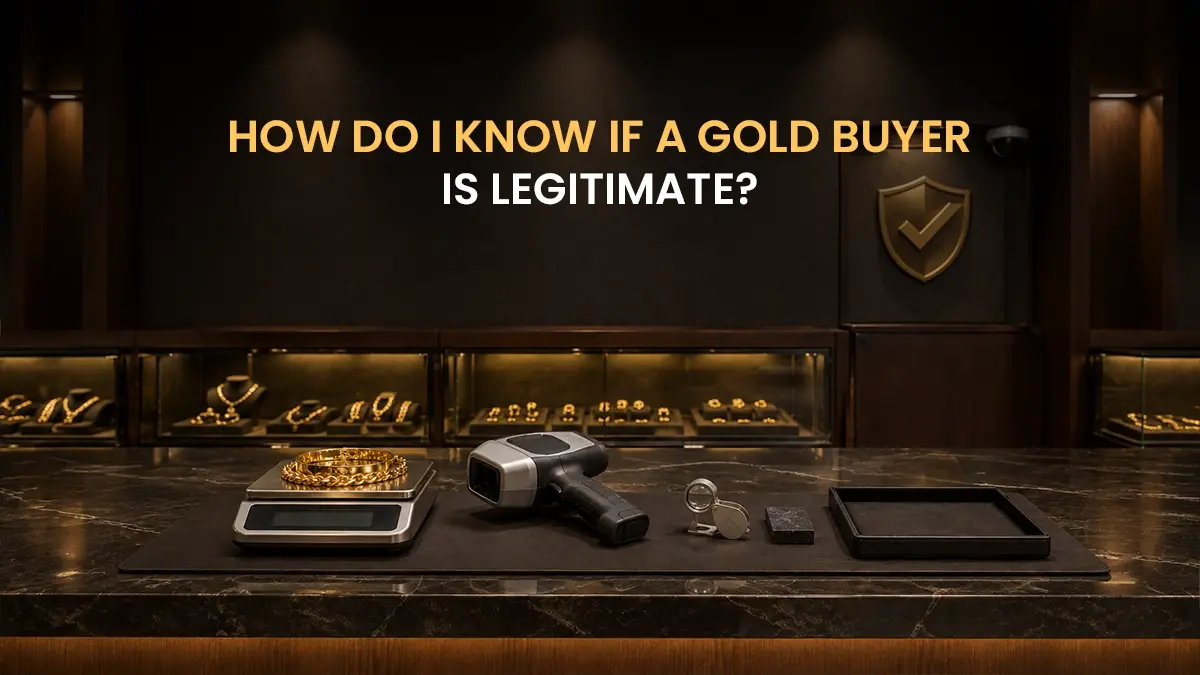
A reputable gold dealer is a licensed and registered gold dealer, tests and weighs your gold in your presence, prices the gold based on the live spot price, has no pressure to buy, has verified reviews, and has a real, physical address. If the buyer cannot check all five boxes, proceed to look again.
Few people sell gold more than one time. Typically, a jewelry box, a box of old chains you will never wear, or coins that no one in the family can recognize. You don’t know what a fair deal looks like; you don’t know who to trust, and you only have one chance to get a fair deal, and if the gold is weighed and the cash is counted, there’s no do-over.
The good news is that spotting a reputable gold dealer isn’t guesswork. There’s a short list of things every legitimate buyer does, a shorter list of things a dishonest one does instead, and a simple way to understand why an honest offer is below the spot price—not a sign you’re being cheated, just how the business works. This guide walks through all three, so you can walk into any gold-buying transaction knowing exactly what to check.
First, know what you are selling
You can’t make a fair judgment on an offer until you know what you have in your bag. That’s the leverage that all sellers miss out on.
Jewelry vs. coins/bullion vs. scrap vs. dental gold are all valued differently. Jewelry and dental gold are almost always priced on their gold content alone. Recognized bullion coins and bars trade closer to the metal’s market value because dealers can resell them easily. Broken chains, single earrings, and mixed scrap are treated as raw material—melted down and valued purely on weight and purity.
Karat and purity matter more than most sellers realize Gold jewelry is typically stamped 10K, 14K, 18K, or 24K, and that hallmark tells you roughly what percentage of the piece is actually gold (24K is pure; 10K is under half). No stamp doesn’t automatically mean fake, but it does mean the buyer needs to test it—which is exactly what a legitimate dealer will do openly.
It’s also worth understanding melt value vs. numismatic value Ordinary jewelry is paid out on melt value—essentially weight times purity times the current price of gold. Recognized coins, on the other hand, can carry a premium above melt because collectors and investors want the coin itself, not just its metal content.
One practical tip: separate your pieces by karat before you go.
If you hand over a mixed pile of 10K and 18K items together, some buyers will assess the whole lot at the lowest karat present, which quietly costs you money on the higher-karat pieces.
The legitimacy checklist: what to verify before you sell
This is the core of deciding whether you’re dealing with a reputable gold buyer. Run through this checklist before you agree to sell anything.
Licensing and registration.
A legitimate gold dealer operates as a registered business and, depending on the province, may hold specific licensing to buy precious metals or operate as a pawnbroker/second-hand dealer. Ask directly, or check with your local municipality or provincial consumer affairs office. A real dealer will have no problem naming their registration; a hesitant answer is itself a signal.
Testing and weighing done in front of you.
Your gold should never leave your sight, and it should never be tested “in the back.” A reputable buyer tests purity (acid test, electronic tester, or XRF machine) and weighs the item on a calibrated scale right in front of you, explaining each step as they go. If a buyer wants to take your items out of view before quoting a price, that’s a hard stop.
Transparent, spot-based pricing in writing
Ask what today’s spot price is and how they arrived at your offer. A legitimate dealer can show you the live spot price, walk you through their calculation, and put the final offer in writing before you sign anything. Vague answers like “it’s just what we pay” are a red flag, not a policy.
Verifiable reputation: reviews, BBB rating, and a real address.
Look the business up before you go. Check Google reviews, the Better Business Bureau, and whether they have an actual physical storefront or office—not just a phone number and a P.O. box. A dealer with years of reviews and a fixed address has a reputation to protect; a buyer with none of that has nothing to lose.
Red flags: when to walk away
Any one of these on its own is a reason to stop the transaction—you don’t need all five to justify leaving.
- They won’t show you the scale, test your gold out of sight, or visibly rush through the weigh-in so you can’t follow along.
- They refuse to state the spot price or get evasive when you ask how the offer was calculated.
- High-pressure tactics—”today only” pricing, discouraging you from getting a second quote, or pushing you to decide on the spot.
- No fixed address, cash-only deals with no paperwork, or a pop-up “gold party”-style event with no traceable business behind it.
- The offer is far below your own melt estimate, with no explanation for the gap.
This is really the heart of the “is cash for gold legit” worry, and the honest answer is: the industry itself is legitimate, but individual operators vary widely, and cash-for-gold rip-offs almost always show up as one of the behaviors above—not as a fundamentally different business model. Watch the behavior, not the sign on the door.
Where to sell and who to trust
Not every channel pays—or protects you—the same way. Here’s how the common options compare when you’re weighing where to sell gold for cash.
| Where you can sell | What they typically pay | Trust / best for |
|---|---|---|
| Dedicated bullion/gold dealer | Closest to spot, especially on bars and coins | Best for bullion, coins, and larger lots; look for licensing and a storefront. |
| Jeweller | Melt value, sometimes with a markdown | Convenient, but shop around—pricing transparency varies a lot. |
| Pawn shop | Often well below melt value | Fast cash, but usually the lowest payout; fine for small, low-value items. |
| Private buyer / online stranger | Unpredictable, hard to verify | Avoid anything valuable—little recourse if something goes wrong. |
| Mail-in "cash for gold" service | Varies widely; the offer is made after they receive your gold. | Only use well-reviewed, established services; you lose the "watch them test it" advantage. |
The honest takeaway: dedicated bullion and gold dealers usually pay closest to spot on recognizable bars and coins, because that’s their core business. Jewellers and pawn shops price on melt and often pay noticeably less. Private buyers are the riskiest route for anything of real value, since there’s little to no recourse if the deal goes wrong.
Whichever channel you choose, run it through the legitimacy checklist above first—even the safest-sounding option still needs verifying before you hand anything over.
How a fair offer is calculated (and why it is below spot)
This is the piece most guides skip, and it’s the one that actually answers how cash-for-gold places work.
Spot price is the benchmark
This is the live market price of gold, and it moves throughout the trading day. Check it yourself right before you go, using a public source like Kitco, so you’re not relying on the buyer’s word for what “today’s price” is.
Why buyers pay below spot
Gold dealers aren’t a charity—they buy below spot so they can resell at a profit, whether that’s to a refiner, another dealer, or a collector. This spread is completely normal and varies by product: it’s usually tighter on recognized coins and bars and wider on jewelry and scrap, which need to be melted and refined before they can be resold.
Rough fair ranges to expect
Recognized bullion coins and bars typically sell within a few percent of spot. Jewelry and scrap gold are priced at melt value minus the dealer’s margin, so the payout will be noticeably lower—that’s expected, not a rip-off.
The self-check every seller should do
Before you walk in, do the rough math yourself: karat × weight × purity × spot price ≈ rough melt value. A fair offer will land a reasonable margin under that number. A number that’s far under your estimate, with no explanation for the gap, is where you push back or walk.
Selling gold in Canada: ID, records, and tax
A few Canada-specific points worth knowing before you sell.
ID isn’t a red flag—it’s compliance a reputable dealer will ask for government-issued photo ID before buying your gold. This isn’t the dealer being nosy; it’s a requirement tied to Canada’s anti-money-laundering rules (FINTRAC), and a dealer who doesn’t ask for ID is the one to be suspicious of.
Keep your documentation If you have original receipts, appraisals, or certificates for coins or jewelry, bring them. They can speed up authentication and, in some cases, support a better offer.
There can be tax implications Selling gold at a profit may count as a capital gain and be reportable to the CRA, depending on your specific situation. This article isn’t tax advice—check the CRA’s guidance on capital gains, or speak with an accountant if you’re selling anything substantial.
A real business gives you paperwork Whatever else happens, you should walk away with a written record of the transaction—what was sold, the weight and purity, the price paid, and the date.
Conclusion: sell with confidence
The fast test is simple: is the dealer licensed, do they test and weigh in front of you, is the offer spot-based and in writing, do they have a verifiable reputation, and are they applying zero pressure? If you can answer yes to all five, you’re almost certainly dealing with a legitimate buyer.
Know what you’re holding, check the live spot price before you go, get a second quote if anything feels off, and let the checklist — not a gut feeling in the moment — make the call. GTA Gold Buyers works exactly this way: transparent, spot-based pricing, testing and weighing done in front of you, and no pressure to sell on the spot. If you’re ready, check what your gold is worth today, or find the sell-gold page for your city to get started.
FAQ
How can I tell if a gold buyer is licensed?
Ask directly—a legitimate dealer will readily name their business registration and any provincial licensing that applies to buying precious metals or operating as a second-hand dealer. You can also check with your local municipality or provincial consumer affairs office if you want to verify independently. Hesitation or vague answers are a warning sign.
Is cash for gold legit, or will I get ripped off?
The cash-for-gold industry itself is legitimate, but individual buyers vary widely in honesty. Rip-offs almost always show up as specific behaviors—hidden testing, no spot-price transparency, high pressure—rather than a different business model. Use the checklist and red flags above to judge the buyer in front of you.
Why is a gold dealer's offer lower than the spot price?
Dealers buy below spot so they can resell at a profit, whether to a refiner, another dealer, or a collector. This spread is normal — it’s usually tighter for recognized coins and bars, and wider for jewellery and scrap, which need to be melted and refined first.
Do I need ID to sell gold in Canada?
Yes, typically. Reputable dealers are required to ask for government-issued photo ID as part of Canada’s anti-money-laundering compliance rules (FINTRAC). Treat this request as a sign the business is following the rules, not as something to be wary of.
Are "we buy gold" pop-up shops and gold parties safe?
Approach them with extra caution. These events often lack a fixed business address, verifiable licensing, or online reviews you can check beforehand, which makes it harder to confirm legitimacy or seek recourse afterward. If you do attend one, apply the same checklist you’d use anywhere else — and don’t feel pressured to sell the same day.