
A gold cross necklace is worth about the same as the gold in it. To find that, multiply its weight by its purity and by today’s gold price. Gold is C$210 to C$830 as melted gold. A well-known brand, a nice design, or real diamonds can make it sell for more than that.
A cross on a chain carries faith and family memory, but it also has a hard cash value, and the two are rarely the same number. Sentimental value, melt value, and resale value each tell a different story, and mixing them up is how people overpay or get lowballed. This guide shows how to work out what your gold cross necklace or gold cross pendant is worth in Canadian dollars, what moves the number, how scrap differs from resale, and where to sell in Canada.
The Three Ways to Own Gold in Canada
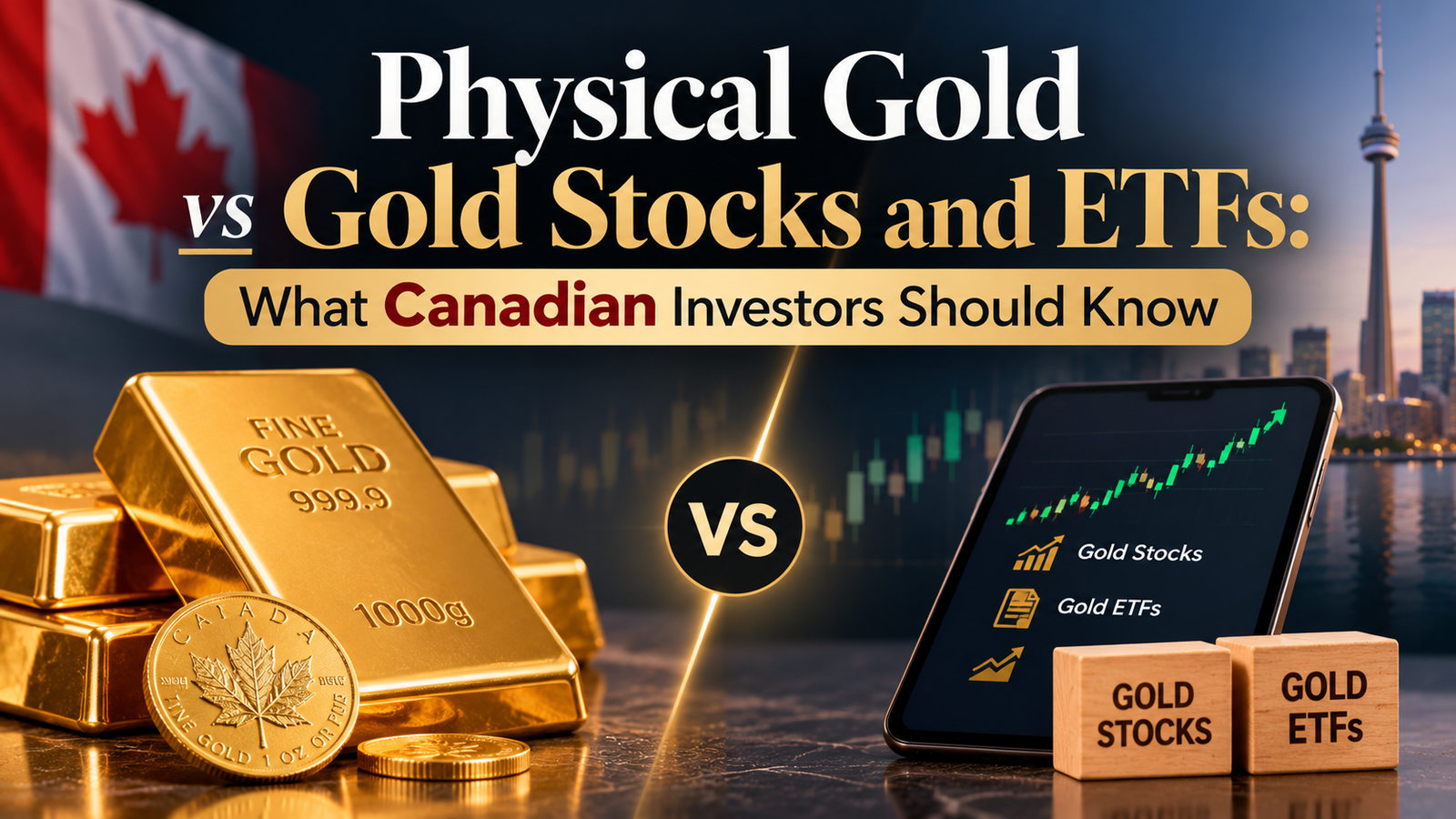
Understanding how to invest gold in Canada starts with knowing what each option represents. You can buy the metal itself, hold a fund that owns or tracks it, or purchase shares in mining companies.
Physical Gold Bars and Coins
Physical gold means owning the metal itself. You can buy bars or bullion coins, such as the Royal Canadian Mint’s Gold Maple Leaf, which has a stated purity of 99.99%. The Royal Canadian Mint’s bullion information provides product details and specifications.
You decide where to keep the bullion, whether at home or in a secure storage facility. You are responsible for its security and any storage or insurance costs. When you sell, the amount you receive depends on the gold price, the product’s condition and the dealer’s buyback price.
Physical bullion may suit someone who wants direct possession of gold. However, buying and selling through a dealer is generally less convenient than trading an exchange-listed fund.
Gold ETFs and Trusts: CGL and Sprott Physical Gold Trust (PHYS)
Gold ETFs and trusts let you gain exposure to gold through a brokerage account. You buy and sell units on an exchange rather than arranging delivery and storage yourself.
Two Canadian-listed examples are the iShares Gold Bullion ETF (CGL and CGL.C) and Sprott Physical Gold Trust (PHYS). CGL is designed to hedge the Canadian-dollar value of gold, while CGL.C provides unhedged exposure. Currency movements can therefore affect their returns differently.
PHYS is a closed-end trust that holds physical gold bullion. Buying its units gives you an interest in the trust, not personal ownership of specific bars. Its market price can also trade above or below the value of the gold held by the trust.
PHYS has a physical redemption facility, but it is not designed for investors who want to exchange a small holding for a few coins. Redemptions are subject to the trust’s conditions and minimum requirements, which are discussed in the FAQ below.
Gold Mining Stocks and ETFs: XGD
Gold mining stocks represent ownership in companies that explore for, extract and sell gold. Their share prices are influenced by the gold price, but also by production costs, debt, management decisions, mine performance and the countries where they operate.
You can buy individual mining shares or use an ETF such as the iShares S&P/TSX Global Gold Index ETF (XGD), which holds a group of gold-related companies. This spreads your investment across several miners, but it does not give you direct ownership of bullion.
Mining shares can rise faster than gold when a company benefits from higher prices and controls its costs. They can also fall while gold is rising if the company faces operational or financial problems.
Physical Gold vs Gold ETFs vs Gold Stocks: Side-by-Side
Physical gold gives you ownership of the metal, while funds and mining shares provide exposure through financial markets. The differences affect how you buy, hold and sell each investment.
Factor | Physical gold | Gold ETFs and trusts | Gold mining stocks |
|---|---|---|---|
What you own | Gold bars or coins | Units in a fund or trust | Shares in mining companies |
Counterparty risk | No fund issuer, but dealer and storage risks remain | Depends on fund structure, custodian and service providers | Company management, operations and financial health |
Main costs | Dealer premium, resale spread, storage and insurance | Fund expenses and brokerage fees | Brokerage fees and, for an ETF, fund expenses |
Storage | You arrange and pay for it | Fund handles bullion custody where applicable | No personal bullion storage |
Liquidity | Depends on dealer, product and market conditions | Usually exchange-traded during market hours | Exchange-traded during market hours |
Link to gold price | Direct exposure to the metal, less buying and selling costs | Depends on holdings, structure, fees and currency exposure | Indirect; affected by gold prices and company performance |
Income | No interest or dividend | Bullion funds generally do not provide regular income | Some miners pay dividends, but payments can change |
TFSA/RRSP eligibility | Only qualifying bullion under CRA conditions and held through an eligible trustee | Eligible if the specific fund meets CRA qualified-investment requirements | Eligible if the specific shares or ETF meet CRA qualified-investment requirements |
During a market sell-off | No company earnings exposure, but the gold price can still fall | Follows its underlying exposure, subject to market pricing and fund structure | Can fall with the wider equity market, even if gold holds up |
A fund can carry structural and custodian risks, while physical bullion carries storage, security and resale risks. Mining shares add company-specific and wider equity-market exposure. Compare the risks of the actual investment rather than relying only on its category.
What Each Option Actually Costs
The purchase price of physical gold is usually higher than the spot price. Dealers add a premium to cover manufacturing, distribution and selling costs. As an indicative range, premiums may be around 1-4% for larger bars and 3-8% for many bullion coins. The actual amount varies by product, dealer, order size and market conditions, so request a current quote before buying.
There is also a resale spread: a dealer’s buyback price may be lower than the price at which it sells the same product. If you store bullion outside your home, include storage and insurance in your total cost.
Funds charge ongoing expenses, usually expressed as a management expense ratio (MER). For example, Sprott reported a 0.39% MER for PHYS for the period ended June 30, 2026. This is a period-specific published figure, not a guarantee of the current rate. Check the official PHYS fund information for the latest figure. MERs for CGL, CGL.C and XGD should be checked against their current issuer documents before publication rather than relying on older figures.
The MER is an annual fund expense, not a one-time purchase charge. Brokerage commissions and the difference between an ETF’s buying and selling prices may add to the cost. For individual mining shares, you generally pay brokerage fees rather than a fund MER. If you buy a mining ETF such as XGD, its MER also applies.
Performance and How Each Option Behaves in a Crisis
Physical bullion is designed to follow the market price of gold. Your return in Canadian dollars will also reflect the CAD/USD exchange rate, as gold is commonly quoted internationally in US dollars. The amount you receive when selling will be affected by the dealer’s buyback price and any costs you incurred.
Gold ETFs and trusts aim to provide exposure to the gold they hold or track. Their returns can differ from the spot price because of fees, currency hedging, trading premiums or discounts, and the structure of the product. PHYS, for example, is a closed-end trust, so its market price can move differently from its net asset value.
Mining shares can move more sharply than gold in either direction. Higher gold prices may improve a miner’s revenue and margins, but rising energy, labour or equipment costs can reduce the benefit. Production delays, debt, regulatory changes and political instability can also weigh on a company’s share price.
This distinction becomes important during a market sell-off. Investors may sell mining shares alongside other equities, even if the gold price is holding steady. Physical gold and bullion-backed funds do not have the same direct exposure to company earnings, but neither guarantees a gain. Gold itself can fall during periods of market stress.
Tax, TFSA and RRSP Rules for Canadian Investors
Tax treatment is an important part of deciding how to invest gold in Canada. The rules depend on what you own, how you hold it and whether the investment is inside or outside a registered account.
Capital Gains on Gold Investments
When you sell physical bullion, fund units or mining shares outside a registered account for more than your adjusted cost base, you may have a capital gain. Selling costs can affect the calculation. Under the currently enacted general capital gains inclusion rate, 50% of a capital gain is included in taxable income. The federal government announced the cancellation of the proposed increase in March 2025. Read the Canada Revenue Agency’s update on the capital gains changes.
Keep purchase records, including the price paid and eligible transaction costs. For bullion, retain invoices that identify the product, weight and purity. For securities, keep your trade confirmations and account records.
GST/HST on Investment-Grade Bullion
Qualifying precious-metal bullion is generally exempt from GST/HST when it meets the applicable conditions. For gold, the purity threshold is at least 99.5%; for silver, it is at least 99.9%. The product must also meet the CRA’s requirements for its form. Jewellery and other products that do not meet the definition of qualifying precious metal may receive different tax treatment.
Check the product specifications and the CRA’s guidance on precious metals for GST/HST purposes before buying. The Royal Canadian Mint’s product information can also help confirm the stated weight and purity of its bullion products.
Can You Hold Gold in a TFSA or RRSP?
Some gold investments can be held in a TFSA or RRSP, but eligibility depends on the investment and how it is held.
Many securities listed on designated stock exchanges, including eligible ETF units and company shares, can qualify as registered-plan investments. However, the CRA does not maintain a master list of every qualifying security, and financial institutions may apply their own restrictions. Confirm the status of the specific fund or security with your plan provider.
Physical gold can also qualify in certain circumstances. Under CRA rules, eligible gold bullion coins generally need to be legal tender coins produced by the Royal Canadian Mint, with at least 99.5% purity and a value that does not exceed 110% of their gold content. Qualifying bars must meet the applicable purity, refiner, marking and acquisition requirements. The bullion must be held through the registered plan’s trustee and an appropriate custodial arrangement. Keeping coins or bars at home does not make them TFSA- or RRSP-eligible.
Read the CRA’s qualified-investment rules for registered plans and ask your plan provider whether it accepts the exact bullion product and custody arrangement.
Currency Exposure and US Dividend Withholding
CGL and CGL.C provide different currency exposures. CGL uses a Canadian-dollar hedge, while CGL.C leaves the currency exposure unhedged. A hedge can reduce the effect of CAD/USD movements, but it does not remove every source of tracking difference.
US dividend withholding tax is relevant when an investment pays US-source dividends. A bullion fund that does not distribute US-source dividends does not incur withholding tax on a dividend payment it does not make. Check the fund’s actual holdings, distributions and listing rather than assuming all gold investments have the same tax treatment.
Where Silver Fits: Gold vs Silver Investment
Gold and silver can both play a role in a precious-metals portfolio, but they respond to different market forces. Gold demand is strongly influenced by investment activity, central-bank purchases and its role as a reserve asset. Silver also has substantial industrial demand, including uses in electronics and solar technology.
Silver has historically shown greater price volatility than gold over many market periods, although the relationship changes over time. It can rise more sharply during some rallies and fall harder during downturns. Physical silver products may also carry different premiums and tax treatment from gold bullion.
When comparing silver vs gold investment, consider why you want exposure to precious metals, how much price movement you can tolerate and whether you plan to hold physical metal or exchange-traded products. The gold vs silver investment decision depends on the role you want each metal to play. Neither metal is automatically the better choice for every portfolio.
Which Should You Choose? A Simple Framework
Start with the job you want gold to do.
- You want direct ownership: Physical gold may suit you if you are comfortable arranging secure storage, insuring it where appropriate and selling through a bullion dealer. Compare the purchase premium and buyback price before placing an order.
- You want convenient market exposure: A gold ETF or trust may be easier to buy, hold and sell through a brokerage account. Check its holdings, MER, currency exposure, structure and TFSA/RRSP eligibility.
- You want exposure to mining businesses: Individual mining shares or a fund such as XGD may suit investors who understand company and equity-market risk. Review the miners’ operations, costs, debt and geographic exposure rather than treating the shares as a substitute for bullion.
- You want more than one type of exposure: Holding bullion alongside a fund or mining shares is one way to combine direct metal ownership with market-based investments. Each position should have a clear purpose, and the overall allocation should reflect your financial goals and ability to absorb losses.
Before investing, compare the full cost of buying and selling, the tax treatment and the risks you would be taking. A low MER does not make a fund risk-free, and owning a physical coin does not guarantee that you can sell it at the spot price.
Conclusion
Physical gold, gold funds and mining shares give Canadian investors three different ways to gain exposure to the metal. Compare what you own, what you will pay to hold it, how you can sell it and whether it qualifies for your registered account. Once you know which form fits your goal, review the specific product and its current costs before investing.
FAQ
Is Physical Gold Worth Buying in Canada in 2026?
Physical gold may suit Canadian investors who want to own bullion directly and are prepared to manage storage, insurance and resale. It does not pay interest or dividends, and the purchase premium and resale spread affect your return. Whether it is worth buying depends on your reason for holding gold, your costs and your wider financial plan.
Is Sprott Physical Gold Trust (PHYS) the Same as Owning Physical Gold?
No. The Sprott Physical Gold Trust holds physical gold bullion, but an investor who buys its units owns an interest in the trust, not specific bars held in personal custody. Its units trade on an exchange and may trade above or below the trust’s net asset value.
PHYS does allow eligible unitholders to redeem units for physical gold, but the minimum is enough units to represent one full-sized London Good Delivery bar, approximately 400 ounces. Redemptions are available monthly and subject to the trust’s requirements. This is a substantial minimum compared with buying or selling retail bullion. See Sprott’s physical bullion redemption requirements.
Can I Hold Physical Gold in a TFSA or RRSP?
Qualifying physical bullion may be eligible if it meets CRA requirements for purity, form, acquisition and custody. The bullion must be held through the registered plan’s trustee and an appropriate custodian. You cannot simply place gold coins or bars in a home safe and treat them as registered-plan assets. Confirm the product’s eligibility and the custodian’s acceptance before purchasing.
Do Gold ETFs or Physical Gold Have Better Returns?
Neither has consistently better returns in every period. Physical gold tracks the metal’s market price less the purchase premium, resale spread and ownership costs. A gold ETF or trust has fund expenses and may also be affected by currency exposure, tracking differences or its market structure. Compare the same time period and currency when reviewing performance.